Author Archive

Shame (2011)

Director. Steve McQueen/co-writer Abi Morgan | Cast. Michael Fassbender, Carey Mulligan, James Badge Dale | 106mins Cert 18

Michael Fassbender and Carey Mulligan give coruscating performances as emotionally damaged siblings in this second feature from Brit director Steve McQueen (Hunger).

Set in Manhatten, the action plays out in corporate offices, cocktail haunts and Brandon’s (Fassbender) plush penthouse. In the workplace he’s a slick executive, but personally there are issues as big as his dick: Those of an avoidant male sex addict. Out of hours he’s eyeing up some new potential pick-up or erupting angrily at his needy sister Sissy (Carey Mulligan) who is reluctantly given bed and board.  Pretty soon both are fighting and feeding hungrily off each other’s obsession to fill an aching void. The nature of their broken past is not explored.

Visually alluring vanilla porn scenes swirl seductively before our eyes but never titillate nor distract from the gnawing emptiness of Brandon’s barren emotional landscape. Girls come and go never to return once souls are bared or feelings expressed. There’s a great vignette with Nicole Beharie as Marianne, a sparky contender for his heart who falls by the wayside when she tries to get too close.  Being in constant motion enables Brandon to avoid his feelings or any any semblance of realness. At one point the camera catches an expression of sheer desperation and we realise that there’s no real pleasure in this sexual conquest, and why Fassbender won best actor for this portrayal of emptiness.  James Badge Dale gives a convincing turn as Branden’s boss and side-kick on predatory evenings out. Divorced and desolate Brandon keeps on dating relentlessly without depth, because in this day and age, he can.  His brief interlude with Sissy is another telling insight into the life of lost souls.   Primal and urgent, voyeuristic and visceral with a taut and teasing score: this is McQueen making a great start. MT

NOW ON NETFLIX


Jiro Dreams of Sushi (2012)

Dir: David Gelb | Cast: Jiro One, Yoshikazu One, Masuhiro Yamamoto,  Daisuke Nakazawa, Hachiro Mizutani, Hiroki Fujita, Toichiro Iida, Akihiro Oyama, Shizuo Oyama | Doc 82′

For any self-professed sushi nut, this film is a must see. Jiro One is a legend in his own lifetime; a man devoted to the creation and serving of sushi for 75 years from the basement of a faceless Tokyo office building in a restaurant that only seats ten. The sushi is served up in specific order and you are expected to demolish it piece by piece, under his rather intimidating gaze in about 15minutes flat, shelling-out something like £300 for the privilege. That makes this one of the most expensive restaurants in the world.

What is remarkable though is the skill, dedication and thought that has gone into a meal. And the rest of the world has recognised this: Jiro’s tiny, unassuming Sukiyabashi Jiro sushi bar has garnered all three Michelin Stars and, as the makers of this film attest, global recognition.

Jiro One is one of the old school; a believer in hard work, total commitment and dedication to a chosen field, whatever it may be. To serve an apprenticeship under Jiro is to spend ten years of dedicated to the most gruelling, repetitive, thankless work in the kitchen, learning the trade. And all this against the prevailing tide of today’s theme of growing fat doing the minimum with little application or indeed mastery in any field, all the while aspiring to coin maximum cash.


The title alludes to Jiro as a young man dreaming of making not just sushi but the best sushi. This film illustrates how Jiro never believes he has arrived, and that there is always room for improvement be it in the choice of the fish, the preparation of the rice, or the serving of the sushi. In doing so it opens out the film as an allegory or lesson in life and how best to live it. But also demonstrates how hard it must be for his sons to live under the shadow of a man who has truly reached the pinnacle of his profession, even if he himself doesn’t see it as so.

Food and film often make for successful lovers and any gourmand who truly appreciates the subtleties and depth of haute cuisine will relish this one. Make sure to eat beforehand or you will find yourself scrambling to a sushi bar straight after, only to feel all but affronted that it isn’t Jiro’s hand that serves up a concerto in seafood for, hereafter, nothing else will do. AT

NOW ON MUBI

Something to look forward to…

Shame - filmuforia reviewThere’s plenty to get excited about film-wise this year and here’s sneak preview of the best so far.  January kicks off with a psychologist’s dream in the shape of SHAME. Artist turned filmmaker Steve McQueen was once awarded the Turner prize and his visual mastery comes out in this glossy tale of avoidant sex in the City…watch out for my review later this week. Another psychological thriller to look out for in February is MARTHA MARCY MAY MARLENE, a low-budget gem with a standout performance by Elizabeth Olsen, as a young woman sucked into a strange American cult but then, aren’t they all.

Fans of Nuri Bilge Ceylan won’t be disappointed with his latest offering ONCE UPON A TIME IN ANATOLIA.  It’s the nearest you’ll probably get to a Turkish Western. Mysterious events surrounding a police inquiry are overshadowed by the sinister workings of the local community.

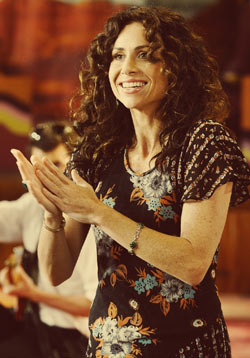
Another arthouse treat you’re really going to love is HUNKY DORY in March. This British movie from Welsh director Marc Evans,  is a musical joyride through the seventies and a heartfelt study of how a young teacher in the shape of Minnie Driver, inspires her school-leavers on to great things.

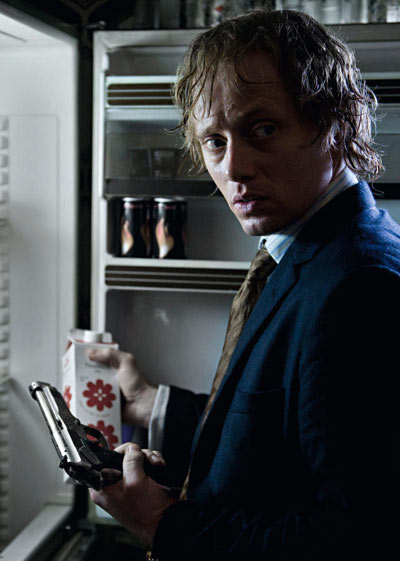
If you thought a combination of extreme violence and silliness just wasn’t feasible then you’ve got to see HEADHUNTERS in April. Based on the novel by Joe Nesbo, it begins as a slick film noir and morphs into something wacky and wonderful and with more twists than a Danish pastry. Two of Scandinavia’s foremost actors, Aksel Henni (Max Manus: Man of War) and Nikolaj Coster-Waldau star.  Robert Redford brings the Sundance Film Festival to London this April but more about that later…

Microphone (2010) Mubi

With Khaled Abol Naga, Atef Yousef, Hany Adel, Yosra El-Lozy,| Egypt 120mins  Cert12

Upbeat, fun and vibrant; Microphone is a picture postcard from the Mediterranean town of Alexandria and Ahmad Abdalla’s follow up to Heliopolis.

Khaled (lead and co-producer Khaled Abol Naga) arrives back in his native town from the States to find things aren’t what they used to be.  Even his former girlfriend is moving on to study abroad. He comes across a band of young musicians and a documentary crew who want to film him.  Although glad to be back home, his life is “touched with a little bit of sadness that never goes away” thanks to his unsettled love life.

Punchy, full of passion and often rather hit and miss, this film taps into the Alexandrian way of life and sheer exhuberance of Egyptian culture.  Khaled’s character remains undefined. He’s a metaphor for Alexandria’s sultry dynamism, a guy reacting to events around him, and Abdalla’s visualized fascination with the city’s urban energy is a magnetic force and a delightful insight into Egypt before the Arab Spring. MT ©


The Past is a Foreign Land (2008) Il Passato e una Terra Straniera

Director Daniele Vicari

Chiara Caselli, Elio Germano, Valentina Lodovini, Michele Riondino

Italy  127 mins 15

The southern Italian city of Bari is the setting for this fast-moving thriller from documentary filmmaker Daniele Vicari.  Based on a crime bestseller it adapts well to the big screen with its luxury location shots and contemporary subject matter.  It’s a chalk and cheese story of two young guys from opposite ends of the social spectrum who diverge with a common interest: gambling.

Elio Germano (My Brother is an Only Child) plays Giorgio a well-heeled, quick-witted law student who hides his winnings in hard-back classics and Francesco (Michele Riondino) is just a hard-nosed card shark with a bed-ridden mother you feel he rather resents.

Kicking off as small time card tricksters in the local bars and nightclubs, the two rub shoulders with bored, society housewives and unscrupulous businessmen. Soon they develop more sophisticated scams and the big money starts to roll in. We can’t help feeling that for Giorgio’s it’s just a game.  But for Francesco it’s all he has.

The action switches to the road as they expand their horizons from Bari to Barcelona and from gambling to drug dealing. From sunny seascapes and sophisticated scenarios the story takes a darker and more sinister hue as Giorgio spirals down into drug abuse from risk-taking respectability while Francesco develops full-blown misogyny in scenes of bloody-nosed violence.

This is where their characters fuse into a well of negativity but their friendship starts to fall apart.  And there’s no prize for guessing who sees the light at the end of the tunnel and manages to morph his misspent youth into a respectable future.

This is a cracking thriller and there is much to be admired in Vicari’s skill as a filmmaker with his finger on the emotional pulse and his eye firmly on the action.

Meredith Taylor ©


Director Daniele Vicari

Chiara Caselli, Elio Germano, Valentina Lodovini Michele Riondino

**** 127 mins 15


The southern Italian city of Bari is the setting for this fast-moving thriller from documentary filmmaker Daniele Vicari.  Based on a crime bestseller it adapts well to the big screen with its luxury location shots and contemporary subject matter.  It’s a chalk and cheese story of two young guys from opposite ends of the social spectrum who diverge with a common interest: gambling.


Elio Germano (My Brother is an Only Child) plays Giorgio a well-heeled, quick-witted law student who hides his winnings in hard-back classics and Francesco (Michele Riondino) is just a hard-nosed card shark with a bed-ridden mother you feel he rather resents.


Kicking off as small time card tricksters in the local bars and nightclubs, the two rub shoulders with bored,

Society housewives and unscrupulous businessmen. Soon they develop more sophisticated scams and the big money starts to roll in. We can’t help feeling that for Giorgio’s it’s just a game.  But for Francesco it’s all he has.


The action switches to the road as they expand their horizons from Bari to Barcelona and from gambling to drug dealing. From sunny seascapes and sophisticated scenarios the story takes a darker and more sinister hue as Giorgio spirals down into drug abuse from risk-taking respectability while Francesco develops full-blown misogyny in scenes of bloody-nosed violence.


This is where their characters fuse into a well of negativity but their friendship starts to fall apart.  And there’s no prize for guessing who sees the light at the end of the tunnel and manages to morph his misspent youth into a respectable future.


This is a cracking thriller and there is much to be admired in Vicari’s skill as a film-maker with his finger on the emotional pulse and his eye firmly on the action.


Director Daniele Vicari

Chiara Caselli, Elio Germano, Valentina Lodovini Michele Riondino

**** 127 mins 15


The southern Italian city of Bari is the setting for this fast-moving thriller from documentary filmmaker Daniele Vicari.  Based on a crime bestseller it adapts well to the big screen with its luxury location shots and contemporary subject matter.  It’s a chalk and cheese story of two young guys from opposite ends of the social spectrum who diverge with a common interest: gambling.


Elio Germano (My Brother is an Only Child) plays Giorgio a well-heeled, quick-witted law student who hides his winnings in hard-back classics and Francesco (Michele Riondino) is just a hard-nosed card shark with a bed-ridden mother you feel he rather resents.


Kicking off as small time card tricksters in the local bars and nightclubs, the two rub shoulders with bored,

Society housewives and unscrupulous businessmen. Soon they develop more sophisticated scams and the big money starts to roll in. We can’t help feeling that for Giorgio’s it’s just a game.  But for Francesco it’s all he has.


The action switches to the road as they expand their horizons from Bari to Barcelona and from gambling to drug dealing. From sunny seascapes and sophisticated scenarios the story takes a darker and more sinister hue as Giorgio spirals down into drug abuse from risk-taking respectability while Francesco develops full-blown misogyny in scenes of bloody-nosed violence.


This is where their characters fuse into a well of negativity but their friendship starts to fall apart.  And there’s no prize for guessing who sees the light at the end of the tunnel and manages to morph his misspent youth into a respectable future.


This is a cracking thriller and there is much to be admired in Vicari’s skill as a film-maker with his finger on the emotional pulse and his eye firmly on the action.


Director Daniele Vicari

Chiara Caselli, Elio Germano, Valentina Lodovini Michele Riondino

**** 127 mins 15


The southern Italian city of Bari is the setting for this fast-moving thriller from documentary filmmaker Daniele Vicari.  Based on a crime bestseller it adapts well to the big screen with its luxury location shots and contemporary subject matter.  It’s a chalk and cheese story of two young guys from opposite ends of the social spectrum who diverge with a common interest: gambling.


Elio Germano (My Brother is an Only Child) plays Giorgio a well-heeled, quick-witted law student who hides his winnings in hard-back classics and Francesco (Michele Riondino) is just a hard-nosed card shark with a bed-ridden mother you feel he rather resents.


Kicking off as small time card tricksters in the local bars and nightclubs, the two rub shoulders with bored,

Society housewives and unscrupulous businessmen. Soon they develop more sophisticated scams and the big money starts to roll in. We can’t help feeling that for Giorgio’s it’s just a game.  But for Francesco it’s all he has.


The action switches to the road as they expand their horizons from Bari to Barcelona and from gambling to drug dealing. From sunny seascapes and sophisticated scenarios the story takes a darker and more sinister hue as Giorgio spirals down into drug abuse from risk-taking respectability while Francesco develops full-blown misogyny in scenes of bloody-nosed violence.


This is where their characters fuse into a well of negativity but their friendship starts to fall apart.  And there’s no prize for guessing who sees the light at the end of the tunnel and manages to morph his misspent youth into a respectable future.


This is a cracking thriller and there is much to be admired in Vicari’s skill as a film-maker with his finger on the emotional pulse and his eye firmly on the action.


La Belle Personne (2008)

Director Christophe Honore

Starring Lea Seydoux, Louis Garel, Le-Prince Ringuet

French/subtitles 90 mins 12

Christophe Honore takes a seventh century novel “La Princesse de Cleves” and fast forwards it to the 21st century lycee as beautiful young things enjoy romantic encounters jumping in and out of bed with each other and that’s just the boys in this surprisingly fun French romp.

When these students are not exchanging amorous glances in the Italian class they are kissing during break or chatting up a teacher who looks like he’s walked out of the pages of French Vogue.  Mr Nemours is only a few years older than his new pupil Junie (Lea Seydoux) and he can’t keep his hands off her.  She smoulders and sulks but eventually goes for kind-hearted Otto (Le-Prince Ringuet) who she thinks will ultimately make a better long-term boyfriend. Nemours is trying to ditch his long-term girlfriend and flirting with a fellow teacher.

The realistic nature of this film draws us into the action and soon we’re accomplices in an illicit game: eavesdropping on conversations, hanging about in doorways, scanning facial expressions and eye contact between the loved-up and their rivals and getting quite intimate with all concerned.

Honore creates a powerful and palpable sexual tension with Junie finds herself unable to resist the tousled insouciance of Louis Garel’s Nemours. It gradually prepares us for a shocking and inevitable climax and it’s great fun to watch.

Meredith Taylor©

Favourite films of 2011

Well let’s look back on 2011 film-wise: was it a good year? It certainly wasn’t a bad one although let’s accentuate the positive for now and give you my personal thoughts and then you can give me yours. I’d like to hear them when you’ve got a minute..

I’ll have to start with The King’s Speech, as it would be impossible not to include it in any film list due to Colin Firth as King George. In a stellar performance he combines sensitivity with regal bearing – no mean feat – and the subtlety of his myriad facial expressions throughout are testament to his talent as one of the best actors currently working today.

Moving swiftly on let’s talk about Brighton Rock because I felt it had a raw deal and was a very nifty piece of filmmaking with great turns from Helen Mirren and Sam Riley. Roland Joffe managed to convey the sinister edginess of Graeme Greene’s original forties work by giving it a sixties setting and the jaw-dropping violence of that era worked particularly well with the storyline.

Another British film from the indie stable last year was Archipelago from director Joanna Hogg. She’s particularly good at her portrayals of middle class Englishness seen from a woman’s point of view as in “Unrelated” her first feature. Here along with a tight script and intelligent casting, she uses a wonderful sense of lighting thanks to DOp Ed Rutherford. The ambient birdsong of Tresco is the soundtrack to this stiff-upper-lipped family affair starring Tim Hiddleston.

Polish director, Jerzy Skolimowski’s Essential Killing is a gorgeous film to look at. It’s an escape and survival movie set against the stark and pared-down beauty of snowy landscapes and starring Vincent Gallo as a convict on the run.

In fifth place comes a gritty little British thriller called Blitz that I actually saw in Spain and was an unexpected treat. Aidan Gillen gives a dynamite performance as a creepy serial killer of cops up against action hard man Jason Statham and Mark Rylance. This is Elliott Lester’s second feature.

Let’s include an Italian film in the mix and I was completely charmed by Michelangelo Frammartino’s Le Quattro Volte. It’s a gently soporific saga of a goatherd living out his days in a quiet corner of Calabria set against a background of bells and goats bleating in the breeze. Real navel-gazing stuff and very thought-provoking.

It’s difficult to go wrong with John Michael McDonagh writing and now directing and The Guard was probably the most entertaining film of 2011 for me. A subversively silly crime caper starring Brendan Gleeson as a delightfully un-pc PC and Don Cheedle as his FBI sidekick, it’s another winning combination from the producers of The King’s Speech.

I think possibly my favourite film of 2011 would have to be Drive. Slick violence and sublime screenplay are a winning combination and the palpable on-screen chemistry between Carey Mulligan and Ryan Gosling makes them one of the most pleasurable romantic pairings of last year. I admire Nicolas Winding Refyn’s work and let’s hope he goes from strength to strength.

Tilda Swinton is probably my favourite actor de nos jours. In We Have To Talk About Kevin she’s superb as mother driven to distraction by her delinquent son. Let’s just remember here that a book’s not a film and this adaptation of Lionel Shriver’s work has to stand alone and be judged as such.

And let’s end on a dramatic note with the final film of the 2011, Snowtown. It’s not so much about the violence but the bleak emotional cruelty of this Aussie psychopath fest…. and a soundtrack like a striking cobra…

The Artist (2011)

Director: Michel Hazanavicius

Cast: Jean Dujardin, Berenice Bejo, Uggie the dog

France  100mins

Hollywood 1927. Georges Valentin (Jean Dujardin) is a megastar of the silver screen.  An actor so convinced of his power and so proud that he refuses to move with the times and to have any truck with the ‘Talkies”.  Who insists on progressing a film project that’s destined to be a flop.  Whose imegawatt smile and Latin looks are no longer enough.  Times are a’ changing in the world of movies and cheeky Peppy Miller (Berenice Bejo) is now being feted by the studio as the new star in town.  Valentin discovered her and that’s a threat to his ego.

Enduring themes of pride, fame and vanity are all interwoven in this delightfully entertaining story. Who would have thought that a silent film shot in black and white, would make such a loud noise with the critics and viewers alike.  In the absence of words, the story works on a purely emotional level and this is the secret of its power.  This homage to Hollywood harks back to an old-fashioned era of love that is pure, yet achingly stylish. The irresistibly perky Berenice Bejo and Jean Dujardin give pitch perfect performances.  But the Oscar goes to Uggie, his lovable dog and trusty companion, who eventually saves the day.

Meredith Taylor

Snowtown (2011) **** LFF 2011

Dir: Justin Kurzel | Cast: Lucas Pittaway, Daniel Henshall | Score: Jed Kurzel | 120mins Australia

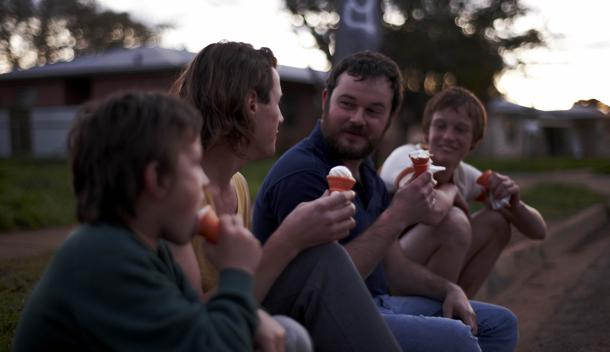
Serial killer John Bunting is currently serving 11 life sentences for crimes that took place in Snowtown near Adelaide during the late nineties.  This haunting and at times unwatchable film grips with a palpable sense of foreboding made all the more sinister by Jed Kurzel’s menacing soundtrack that heightens the tension throughout with pavlovian effect. The story plays out through the eyes of Jamie (Lucas Pittaway)  He’s a sensitive teenager living with his single mum and brothers in a poor community riddled with crime, violence and suspicion and makes ideal prey for Bunting.  James longs for a better life but is drawn to the controlling but charismatic father figure of Bunting.

SNOWTOWN_1

Daniel Henshall, brilliantly cast here as Bunting, is a highly manipulative sociopath masquerading as a self-styled vigilante.  Mixing freely in this sad town of social misfits from paedophiles to the mentally ill,  he gains the support of Jamie by purporting to stand up for him.  Other locals are gradually coralled into this social circle and take part in the killings believing that they are justified in ridding society of its evil elements. Bunting’s real agenda is to control and steal their benefits. This sinister feature is a remarkable directorial debut for Justin Kurzel and one of the most disturbing and shocking films of 2011. MT

London Film Festival 2011 – Standout films

Did I enjoy the London Film Festival this year – you bet! That said, there was very little to laugh at and a great deal to feel generally sad and downbeat about – in a good way.

Maybe this reflects the general mood of anxiety that this great city is currently feeling with all the economic woe and uncertainty – but it’s still the most vibrant place to live and strut your stuff… and I’m not the only one who feels this way..

I’ve picked out 10 films that tweaked my buttons – which ones tweaked yours?

  1. Hunky Dory – for the sheer joy of the music and the memory of that wonderful hot summer of ’76
  2. Lawrence of Belgravia – hats off to this charismatic little film about an almost superstar – Lawrence
  3. Shame – damaged siblings feed off one another in glitzy Manhatten – nuff said!
  4. Snowtown – serial killings, sinister soundtrack. .and fab casting especially of Daniel Henshall as a sociopath
  5. Terraferma – Sensitively told Sicilian story of a changing world
  6. The Monk – mysterious misdoings in a Madrid monastery – sublime lighting: Vincent Cassel shines out
  7. The Ides of March – tight plot, dynamite performances, sizzling political thriller
  8. Drifters – (Gli Sfiorati) upbeat tragi-comedy of a really decent guy, from the novel by Sandro Veronesi
  9. Hara Kiri – Death of a Samurai – sumptuous tale of economic meltdown of a 17th century ronin
  10. Headhunters – glossy, gritty and hilarious Norwegian thriller
  11. We Need To Talk About Kevin – just ’cos I love Tilda and pretty much anything she lends her name to…and this is Tilda at her best as a mother in crisis.

And the boobie prize goes to:

Dragonslayer – vacuous script, repetitive footage and aimless unlikeable characters – I’m all for well-placed expletives but this was tedious fare

Losing the will to live…..

Two Years At Sea – felt like 10 years but I now some of you may appreciate the pared- down simplicity of this slow-burning study

Tulpan (2008)

Dir: Sergei Dvortsevoy | Drama | Kazakhstan | 120mins

If you thought that Borat had Kazakhstan sewn up then think again. Dvortsevoy won the Prix Un Certain Regard for this endearing picture of life on the windswept southern Steppe for a family of nomadic herders.

This film is so cute you’ll want to pick it up and cuddle it but preferably with gloves on. Apart from a touching script and great performances not least from the animals it features mouth-to-mouth resuscitation with a newborn lamb and gets down and dirty with camels, a real tornado, endless sandstorms and some very grim weather indeed. Powerful wide-angled visuals combine with the cosy interiors of the yurt, the tent where the all live.

Asa, the gentle boy with a vivid imagination, has completed his navel service and wants to join his family of herders. In order to become a shepherd he must find a wife and women are thin on the ground in this part of the world. Infact the nearest one for several hundred miles is Tulpan. She doesn’t fancy Asa largely because of his ears but it may be because he talks too much. With the help of his friend Boni he tries to win her over. The alternative is a move to the city where he wouldn’t have his family’s love and support let alone a reliable job.

In contrast to the incredible hardships that the herders suffer they are entirely without anger or aggression. Their gentleness and perseverance is totally inspirational. There is no alternative but to learn to live in harmony with each other and with nature as a whole and therein lies the magic of their existence. Dvortsevoy succeeds with skill and patience in eliciting both humour and compassion in this exquisite debut feature.

WINNER | PRIX UN CERTAIN REGARD | CANNES 2008

The Absence of Love | Michelangelo Antonioni Retro

Humans are intruders in the film world of Michelangelo Antonioni: they destroy the harmony of nature and society. Only in a few cases, when they act in solidarity with others, do they have a chance to become part of something whole.

Antonioni grew up in Ferrara in the Po Valley not far from the setting of his documentary short GENTE DEL PO (1943-47). Visconti was in the throws of filming Ossessione nearby. Despite its neo-realistic moorings, this is a personal statement: an effort to interpret the world via the moving image, rather than the other way round. Antonioni’s realism is not to show anything natural, humane or  dramatic, and particularly not anything like an idea, a thesis. Memory alone forms the model for his art. Memory in the form of images: photos, paintings, writing – they form the basis of his later work – an adventure, where the audience peels off the many layers, like off an onion: a painting, more than once painted over.
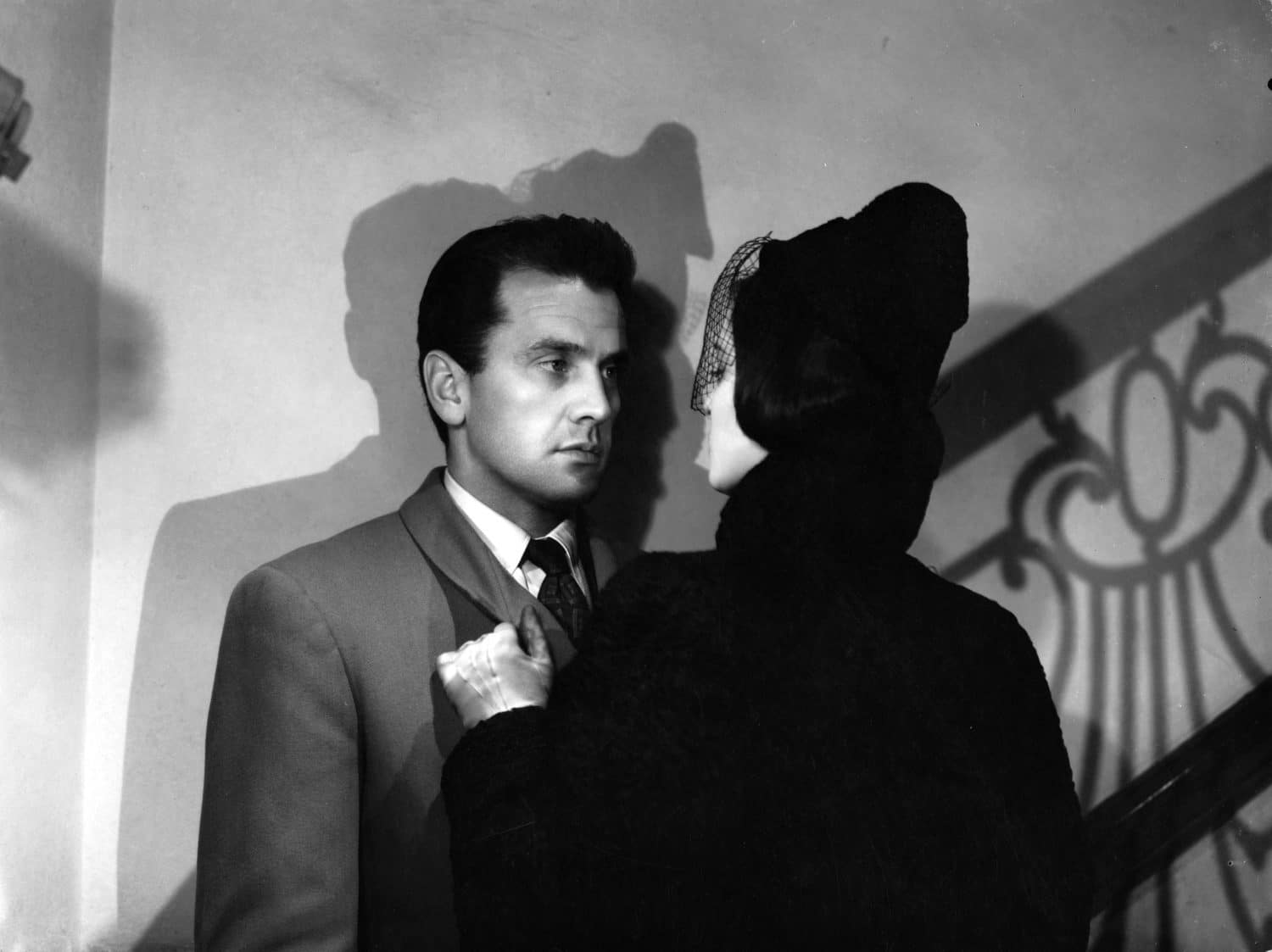
Antonioni was already 38 when he made his drama debut with Cronaca Du Un Amore (1950)  Superficially a film noir, in the mood of Visconti’s first opus Ossessione, this expressed the overriding existential angst, loneliness and alienation that would permeate his work. Paola and Guido grew up in the same neighbourhood in Ferrara, and want to do away with Paola’s rich husband Enrico Fontana. This is no crime of passion, because Paola and Guido are unable to love, or even imagine a life together –  but they both stand to profit from Fontana’s death. And the city of Milan is much more than a background: life here is a reflection of the state of mind of the conspirators: like a drug, the street life full of chaos, the neurotic atmosphere in the cafes. All this is unreal, jungle like: modern urbanity as hell, a central topic of Antonioni’s opus. And he observes his main protagonists often, when they are alone, not only in dramatic scenes. This way, he creates an elliptical structure, with two combustion points: action and echo. As Wenders said: “The strength of the American Cinema is a forward focus, European cinema paints ellipses”.

I VINTI (1952) is set in three different countries (Italy, France and the UK), and tells the stories of youthful perpetrators, who commit their crimes not out of material necessity, but just for fun. Even though the crimes are central, Antonioni is not much interested in the structure of the genre. The police work is secondary, as are the criminals themselves: Antonioni is fascinated with the daily life of his protagonists, the crimes are more and more forgotten, the investigations peter out – shades of L’ Avventura and Blow Up.

In LE AMICHE (1955) Antonioni finds the structure for his features, seemingly overpopulated with couples and friends – who are all busy, but play a secondary role to their environment, in this case Turin. Clelia who comes to Turin, to open a designer shop for clothes, falls in with four other young women, all of them much wealthier than she is. Their changing couplings with men end tragically. Set between Clelia’s arrival in Turin and her leaving for Rome, LE AMICHE is a kaleidoscope of human frailty, in which the audience is waiting for something to happen, some sort of story of boy meets girl story, but when something like it really happens, it is so secondary, so much overlaid by all the small details we have learned before, that we are as dislocated as the characters: we flounder because Antonioni does not tell a story with a beginning and an end (however much we pretend), but he tells us, that the world can exist without stories. Because there is so much more to see in the city of Turin, as there will be in Rome: Clelia is only the messenger, send out by Antonioni to be a traveller, not a story teller. In so far, she is his archetypal heroine.

Aldo, the central protagonist in IL GRIDO (1956/7) is the most untypical of all Antonioni heroes: he has been expelled from paradise, after his wife left him. His travels are romantic, because he does not let himself go, but sticks to his environment, travelling with his daughter in the Po delta. Whilst looking back on his village, towered over by the factory chimney, it is his past history, which forces him to leave. He becomes more and more marginalised: an outsider, even when living near the river in a derelict hut, he becomes the victim of the environment, of the background of landscape, seasons and the history of his live, spent all here. El Grido ends tragically, because Aldo (unlike most other Antonioni heroes) insists on keeping to his past: he does not want to cross the bridges, which are metaphorically there to be crossed. And Aldo’s titular outcry becomes a good-bye, even though he is back home. Il Grido is also Antonioni’s return to neo-realism, another contradiction, because he never really was part of it.


L’AVVENTURA (1960) has four main protagonists, three of them humans, but they are dwarfed by Lisca Bianca, a rocky island in the Mediterranean See. A group of wealthy Italians visit the island but when they want to leave, the main character Anna, is missing. Her boyfriend Sandro starts the search, but is soon more interested in Claudia, Anna’s best friend. When they all leave, without having found Anna, Claudia and Sandro are ready to start a new life together. Antonioni is often compared with Brecht. Like the German playwright, he refuses the dramatization of the narrative, because it is a remnant of the bourgeois theatre. Analogue to this comparison, L’Avventura is epic cinema. Brecht’s plays are often transparent, because the actors do not identify with their roles. The audience is not drawn into the play, but left outside to observe. The same goes for Antonioni, because, as Doniol-Valcroze wrote “to direct is to organise time and environment”. Antonioni genius is, that he first introduces time scale and environment, before he develops the narrative, via the actions and words of the protagonists. The breakers on the island, are the real music of the feature. The fragility of the emotions manifests it selves mainly in the way the protagonists talk –  but mostly they are on cross purpose. Yet the overall impression is not that of a modern film with sound, but of a very sad silent movie. At Cannes in 1960, the feature was mercilessly jeered at the premiere, but won the Grand Prix nevertheless – a rarity of the jury being ahead of the public.


In LA NOTTE (1960) we observe twenty-four hours in the live of the writer Giovanni and his wife Lydia. Whilst their friend dies in a hospital, they have to accept that their love has been dead for a while. Antonioni uses his characters like figures on a chess board. They are real, but at the same time ghosts. He does not tell their story, but follows their movements from one place to an another. There is no interconnection between them and their environment. They have lost the feeling for themselves, others and the outside. Their world is cold and threatening. Antonioni offers no irony or pity. He is the surgeon at the operating table, and his view is that of the camera: mostly skewed over-head shots. It is impossible to love La Notte. Whilst Antonioni is the first director of the modern era, he is also its most vicious critic.


When L’ECLISSE (1962) starts in the morning, it feels somehow like a continuation of La Notte. Before Vittoria (Vitti) ends her relationship with Francisco, she arranges a new Stilleben behind an empty picture frame. Next stop is Piero (Delon), a stockbroker. Vittoria is like Wenders’ Alice in the City: a child in a world of grown ups, repelled by their emotional coldness. Piero, very much a child of this world, is all calculations and superficiality, his friend’s remark “long live the façade” sums it all up. Long panorama shots show very little empathy with the eternal city, particularly the shots without much noise (music only sets in after the half-way point of the film), are representative of a ghost town populated by little worker ants, dwarfed by the huge buildings. The couple’s last rendezvous is symbolic for everything Antonioni ever wanted to show us: none of the two shows up, we watch the space where they were supposed to meet for several minutes. L’Eclisse will lead without much transition to Deserto Rosso, where Monica Vitti is Guiliana, wandering the streets, getting lost in a fog on a very unlovable planet.


DESERTO ROSSO (1963/4)


Guiliana: “I dreamt, I was laying in my bed, and the bed was moving. And when I looked, I saw that I was sinking in quicksand”. Guiliana’s world is threatening, everything is monstrous, the buildings of an industrious estate are unbelievable tall. The machines in the factories, the steel island in the sea, and the silhouettes of the people surrounding her are enclosing around her. We travel with her from this industrial quarter of Ravenna to Ferrara and Medicina. She is never still, only at the end she is standing still in front of a factory gate. In Deserto Rosso objects become blurred, they seem to be alive, making their way independently. The camera never leaves Guiliana during her nightmare. We see the world through Guiliana’s eyes: “It is, as if I had tears in my eyes”. In the room of his son she sees his toy robot, his eyes alight. She switches it off – but this the only activity she is allowed to master successfully. There is always fog between her and everybody else, even her lover Corrado is “on the other side”. And the fable, which she tells her son Vittorio, who cannot move, before he is suddenly running through the room, lacks anything metaphysical. Roland Barthes called Antonioni “the artist of the body, the opposite of others, who are the priests of art”. For once, Antonioni is one with the body of his protagonist: Guiliana’s body is not one of the many others, she will never get lost.


BLOW UP (1966)


A feature one should only see once – never again. Otherwise one will suffer the same as Thomas photos: Blow Up. Antonioni to Moravia: “All my films before are works of intuition, this one is a work of the head.” Everything is calculated, the incidents are planned, the story is driven by an elaborate design. The drama, which is anything but, is a drama perfectly executed. Herbie Hancock, the Yardbirds, the beat clubs, the marihuana parties, Big Ben and the sports car with radiophone, the Arabs and the nuns, the beatniks on the streets: everything is like swinging London in the 1960ies: a head idea. Blow Up is Antonioni’s most successful feature at the box office – and not one of his best.


ZABRISKIE POINT (1969/70)


Given Cart Blanche by MGM, Antonioni produced a feature in praise of the American Cinema. Zabriskie Point is the birth of the American Cinema from the valley of the Death. Antonioni has to repeat this dream for himself. But he had to invent his own Mount Rushmore, his Monument Valley, to make a film about this country in his own image. A car and a plane meet in the desert. The woman driver and the pilot recognise each other immediately. The copulation in the sand is metaphor for the simultainacy of the act, when longing and fulfilment, greed and satisfaction are superimposed. Then the unbelievable total destruction: the end of civilisation; Antonioni synchronises both events, a miracle of topography and choreography. This is Antonioni’s dream: the birth of a poem.


Both, the TV feature MISTERO Di OBERWLAD (1979) nor IDENTIFICAZIONE DI UNA DONNA (1982) have in any way added something to Antonioni’s masterful oeuvre. The same can be said of his work after he suffered a massive stroke in 1985, leaving him without speech partly paralysation: BEYOND THE CLOUDS (1995), a collaboration with Wim Wenders, and Antonioni’s segment of EROS (2004). AS

A RETROSPECTIVE TAKING PLACE AT  THE BFI EARLY IN 2019



Copyright © 2026 Filmuforia