
Dir: Marcelo Caetano | France/Netherlands/Brazil 2024 105 min
Reviewed by Peter Herbert
Marcelo Caetano’s Baby opens with a young man’s release from prison. Facing a troubled future there are nonetheless signs that he is hoping to avoid repeating the kind of problems that sent him to prison.
The road ahead is not easy for 18-year-old Wellington (soon to be referred as Baby). With nowhere to go, as his estranged parents have deserted him, he is forced to live rough on the streets of Brazil’s Sao Paulo. A chance encounter with a group of queer street hustlers brings a sense of identity and belonging which will lead him towards the caring attention of an older 40-year-old hustler Ronaldo.
The age difference of the two men, played by Joao Pedro Mariano as Wellington/Baby and Ricardo Teodor as Ronaldo, is handled well by Caetano who observes how the balance between subservient and dominant personalities is often a rite of passion for younger and older relationships of any gender. There is a subtle coincidental reference to the dynamics in Baby and the age differences of two gay men in Harry Lighton’s British Pillion for which this Brazilian film handles variations on themes of dominance and submission in relationships with quiet authority .
As a follow up to the directors’ debut Body Electric (2017), which was also finely tuned into street life and gay lifestyles, Baby is more confident with the free-flowing, observant nature and pace of a filmmaker keen to watch, listen and observe. Although the filmmaker could work with a more concentrated finely tuned script, there are many fine sequences. These include a touching moving reunion with his mother and baby sister, an amusing encounter between Baby and an overweight punter, scenes of wild audience behaviour in a sex cinema and convincing detail about the murky dark sides of illicit drug scenes.
There is also a sequence involving the unease with which Baby reacts to a voyeur who has been allowed to watch him and Ronaldo have sex which turns sour when Baby discovers he is being taken advantage of. This sequence is one of a number which prefigures the film’s conclusion with which Baby will have to make a crucial decision about the direction of his life, either leaving or staying in an edgy but also dominant relationship with Renaldo. Questions about the changing nature of a loving and sexual relationship between two different people are profoundly handled here by Caetano.
In cinemas 12 December 2025 | UK steaming platforms from 22nd December:
Available On Demand from BFI Player, Curzon Home Cinema and Peccadillo


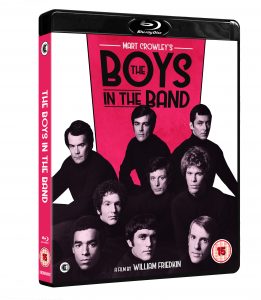 Dir: William Friedkin | Writer: Mart Crowley | Drama | 118’
 London is the setting for the UK’s longest running LGBTQ film event which began in 1986 as Gay’s Own Pictures. Since then it has also become the largest LGBTQ film event in the UK with this year’s edition boasting 56 feature films, an expanded industry programme, selected films on BFI Player VOD service, and a series of special events and archive screenings. With its partner fiveFilms4freedom it offers LGBT short films for free across the world and promoted through the British Council’s global networks.
 Opening the festival this year is Talit Shalom-Ezer’s poignant lesbian love story MY DAYS OF MERCY written by Joe Barton, who scripted TV’s Troy, and featuring Kate Mara and Ellen Page. The European premiere of moral fable POSTCARDS FROM LONDON is the closing gala, telling a revealing story of a suburban teenager (Harris Dickinson) arriving in the West End where he falls in with a gang of high class male escorts ‘The Raconteurs’. Set in a vibrant, neon-lit, imaginary vision of Soho, the film works as a beautifully shot homage to the spirit of Derek Jarman and a celebration of the homo-erotic in Baroque art, and is Steve McLean’s long-awaited follow-up to his 1994 Sundance and Indie Spirit-nominated drama POSTCARDS FROM AMERICA. This year ‘Second Chance Sunday offers the opportunity to watch the on-demand repeat screenings of the audience festival favourites.
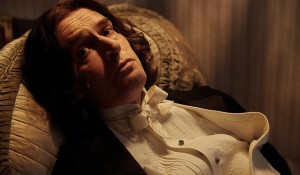 Other films to look out for are Rupert Everett’s Oscar Wilde-themed passion project THE HAPPY PRINCE in which he also stars alongside Colin Firth and Emily Watson. Robin Campillo’s rousing celebration of AIDS activism 120 BPM. MAURICE, a sumptuous restoration of the 1987 adaptation of E M Forster’s gay novel starring James Wilby and Rupert Graves.
  Avant-garde Berlinale Teddy feature HARD PAINT presents a startlingly cinematic look at how a college drop-out deals with his needs, and Locarno favourite, a saucy Sao Paolo-set vampire drama