

Dir: Hlynar Palmason 2025 Iceland /Denmark 109′
Reviewed by Peter Herbert
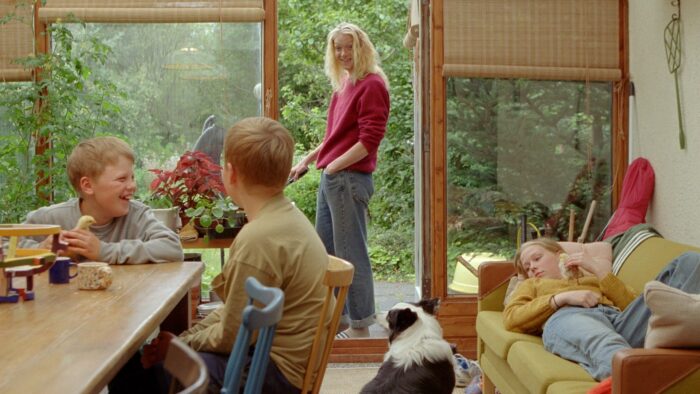
This portrait of a fractured family opens with a roof being violently lifted off a building, a terrible noise replaced by sounds of quiet and calm. Hlynur Palmason’s fourth feature explores the process of separation for a couple forced to find new ways to communicate through loving relationships with their children.
The film follows the tradition of Scandinavian cinema with directors like Ingmar Bergman often using similar themes with dark metaphorical intensity. Scripted by Palmason with autobiographical elements, this is a warm and empowering film that may be the filmmaker’s most personal.
As with Winter Brothers 2017, A White, White Day 2019 and Godland 2022, there is an underlying theme of life as a cycle of growth and change evolving out of choices and decisions. At times, the film is a kaleidoscopic quilt, suggestive of Terrence Malik, with the way it sifts together a vast range of sounds and images from past and present.
Scenes filmed on 35m Kodak film over three months, providing depths of light and colour, are intercut with other footage using different cameras filmed over a longer period of time. The result is a flow of images involving routines of family life including an enchanting family dog called Panda who won the Palm Dog award at the 2025 Cannes film festival. The beautiful soundtrack is largely both jazz inspired with natural soundscapes.
Acts of creativity are recurring themes for Palmason with Godland built around glass photographic plates from the early 19th century, creating new forms of art work. Anna (Saga Gardarsdottir) is an installation artist living on a harsh Icelandic coastline where she creates real life textures on canvas, burnt onto by eroding tin during four seasons of the year. With plans to exhibit in a gallery on the mainland, there is a very real and telling discussion with a city art dealer about the value of artwork. Palmason cites references to the work of artist Rebecca Horn with string tied over faces and the roof being ripped off a building is that of the director’s own studio being pulled apart.
Palmason’s rapport with his own children feels very natural. The talk about what kids think they know about sex and relationships as well as risky games children play, with no sense of fear or danger, mark this out as a remarkable film about childhood.
The mother appears to hold together their growth and development and in one scene Anna declines sex with Magnus so as to not confuse the kids. Magnus (Sverrir Gudnason) appears to be the eye of the film and unlike Anna, is more adrift and uncertain about his masculinity and role as a man in the world at large. He appears frustrated by physically harsh work aboard a sea fishing trawler and the sounds of grinding machines and water combine to echo how he feels about himself.
Beautiful images flooding his mind as he looks up at Anna while the sunlit fabric of a skirt swirls around her legs are linked to clips from Jack Arnold’s 1955 Creature Of the Black Lagoon with a creature gliding beneath the movement of a woman swimming in water above.
Another sequence of magical realism involves an imaginary battle with a huge avenging cock, reinforcing the focus of the male psyche at the heart of the film. The film concludes with Magnus adrift on a vast expanse of water with the feeling that The Love that Remains is a film aware of the power of love to heal precious and often-harsh realities of life.
IN UK CINEMAS FROM FEBRUARY 2026