

Czechoslovak New Wave: Cinema on the Edge of Change
Throughout September and October, in collaboration with The Garden Cinema, the 30th Made in Prague Festival celebrates one of the great explosions of cinematic creativity: the Czechoslovak New Wave.
Emerging in the early 1960s from Prague’s renowned FAMU film school and the state-funded Barrandov studios, a remarkable generation of filmmakers transformed the possibilities of cinema. Their films were playful, politically charged, formally audacious and often darkly comic — capturing a society undergoing profound change while pushing against the limits of what could be said, shown and imagined on screen.
During this Autumn the season brings together essential works from the movement alongside films by the directors who helped shape its extraordinary creative landscape.
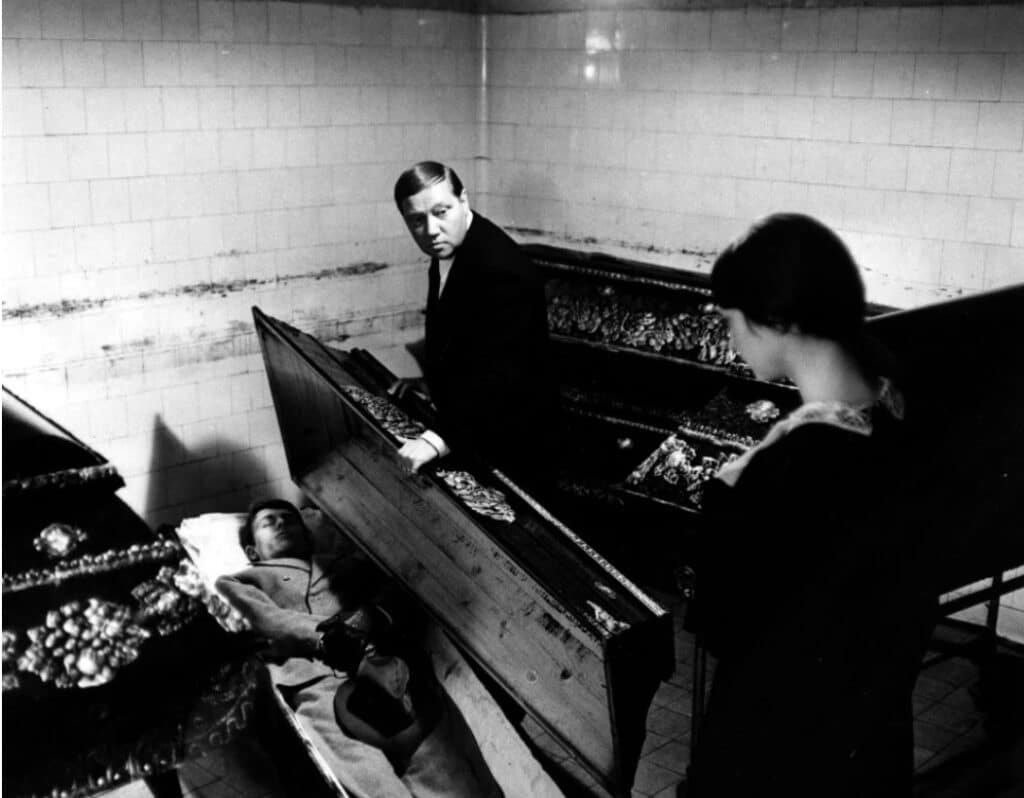
There are epic historical visions, including František Vláčil’s monumental Marketa Lazarová (1967) and The Valley of the Bees (1968); radically inventive accounts of war and its aftermath, from Jan Němec’s haunting Diamonds of the Night (1964) to Juraj Herz’s nightmarish black comedy The Cremator (1969) (below)
The influence of Czech literary traditions — from Kafka’s absurdism to Bohumil Hrabal’s humane, anarchic storytelling — runs through the work of Miloš Forman, whose A Blonde in Love (1965) and The Firemen’s Ball (1967) turn everyday provincial life into wonderfully sharp social comedy. His FAMU contemporaries were no less remarkable: Jiří Menzel adapted Hrabal for his Oscar-winning Closely Observed Trains (1966), while Věra Chytilová’s Daisies(1966) remains one of cinema’s most exhilarating acts of feminist and surrealist rebellion.
The New Wave did not emerge in isolation. A loosening of censorship and changing social attitudes had already allowed an older generation of directors to experiment with form and subject matter. Among them are Vojtěch Jasný’s irresistible, cat-powered satire The Cassandra Cat (1963) and Ján Kadár and Elmar Klos’s devastating The Shop on the High Street (1965), one of the defining films about the moral compromises and human consequences of Nazi occupation.
Together, these films reveal a cinema in which artistic freedom and political freedom became increasingly inseparable. The extraordinary flowering of the 1960s helped create the atmosphere that culminated in the Prague Spring of 1968. Its suppression by the Soviet Union and Warsaw Pact forces brought the New Wave to an abrupt end. Filmmakers who remained in Czechoslovakia faced censorship, professional restrictions and, in some cases, years of enforced silence.
The season concludes with Karel Kachyňa’s The Ear (1970), a bitterly claustrophobic marital drama that mutates into a paranoid political thriller. Banned by the Communist authorities immediately after its completion, the film would not be seen publicly until 1990 — a final, extraordinary testament to the risks these filmmakers took in pushing cinema towards the truth.
Beyond the New Wave
Following the Czechoslovak New Wave season, the Made in Prague Festival presents the UK premiere of Jaromil Jireš’ digitally restored Valerie and Her Week of Wonders (1970), a darkly seductive and surreal coming-of-age fairy tale that emerged just as the New Wave was being silenced.
Then, in November, the festival returns to The Garden Cinema with a selection of the best contemporary Czech cinema, bringing the extraordinary films and ideas of the 1960s into conversation with Czech filmmaking today.
A month of films from a moment when cinema, politics and artistic freedom collided — and changed film forever.
September–November 2026 | The Garden Cinema and other London venues | Part of the 30th Made in Prague Festival