
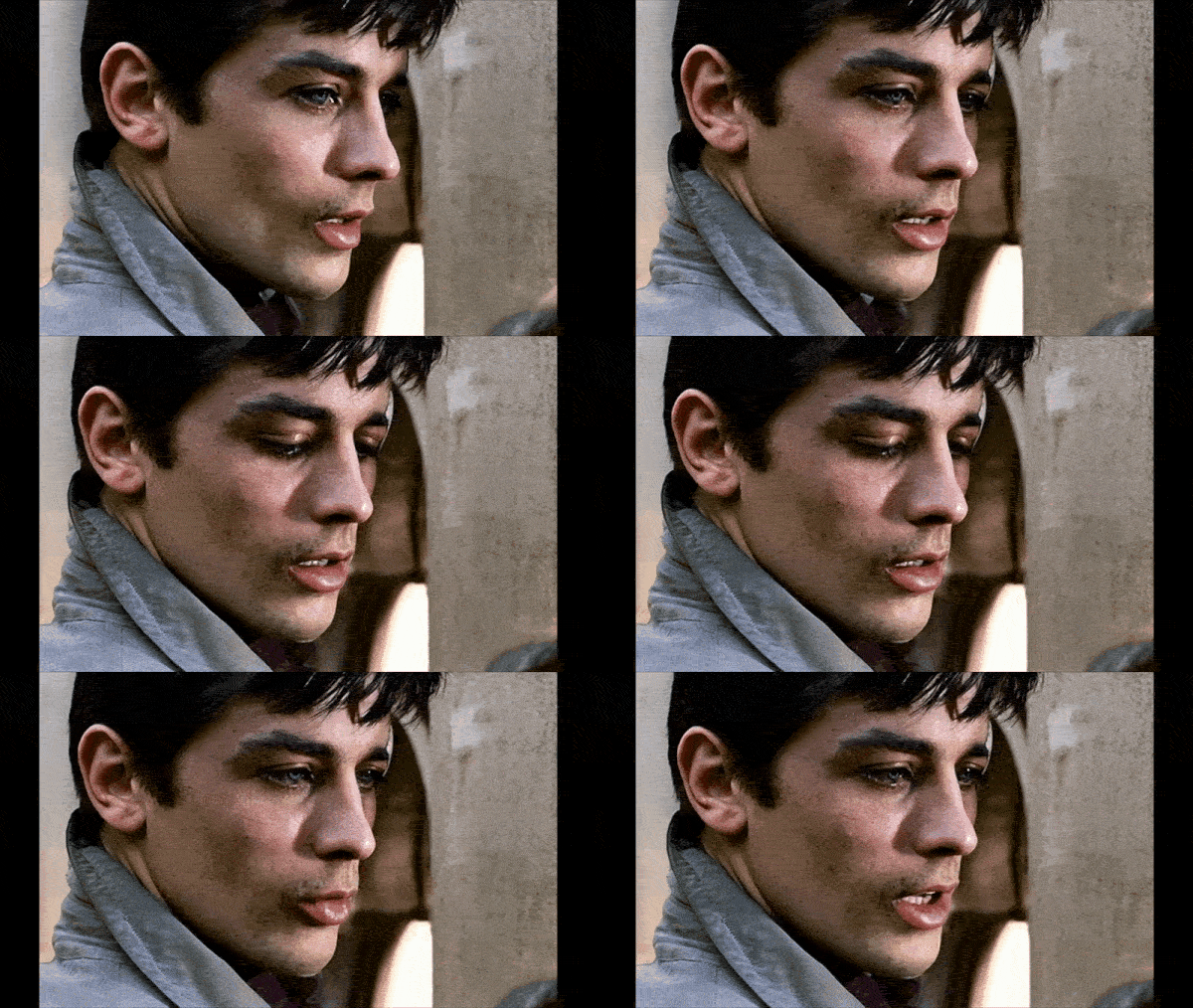

Dir: Luchino Visconti | Italy Drama
Luchino Visconti’s Rocco e i suoi fratelli (Rocco and His Brothers, 1960) stands at the crossroads of Italian neorealism and grand operatic melodrama, a work that gathers the social conscience of post-war cinema and infuses it with the emotional sweep of classical tragedy. If La terra trema was Visconti’s austere hymn to Sicily’s fishermen and Il Gattopardo his majestic requiem for a dying aristocracy, Rocco is his epic of internal migration, family loyalty and the corrosive promises of modernity.
The story follows the Parondi family as they leave the impoverished South for the industrial North, joining the great tide of Italians who sought prosperity in Milan during the economic miracle. Yet Visconti is less interested in documenting economic transformation than in examining what is sacrificed in the process. Home, identity, morality and affection become increasingly fragile as the family fragments under the pressures of ambition, desire and survival.
At its centre stands Alain Delon’s Rocco, perhaps the most luminous performance of his early career. Delon endows his character with extraordinary physical beauty that borders on the saintly, yet beneath the serene exterior lies a man whose boundless capacity for forgiveness becomes its own form of tragedy. His goodness is almost unbearable, suggesting that virtue itself may be incompatible with the brutal logic of modern life. Opposite him, Renato Salvatori gives a volcanic performance as Simone, a boxer whose jealousy and self-destruction erupt with terrifying force. Their fraternal conflict echoes Biblical parables, Greek tragedy and Dostoevsky in equal measure.
Annie Girardot delivers one of the film’s emotional anchors as Nadia, refusing to reduce the character to either victim or femme fatale. Her intelligence, sensuality and resilience lend the film much of its psychological complexity. Katina Paxinou, meanwhile, embodies the indomitable matriarch with monumental dignity, carrying the traditions of the South into an urban world that no longer recognises them.
Visconti’s direction constantly veers between realism and myth. The streets, tenements and factories of Milan possess the authenticity associated with Italian neorealism, yet every composition is meticulously orchestrated. Giuseppe Rotunno’s luminous black-and-white cinematography transforms working-class districts into landscapes of spiritual conflict. Boxing rings become arenas worthy of ancient epics, while domestic interiors assume the oppressive weight of classical theatre. Nino Rota’s aching score further elevates ordinary lives into the realm of destiny.
Although often grouped with Italian neorealism, Rocco e i suoi fratelli also marks the movement’s transformation. The raw immediacy of earlier landmarks such as Roberto Rossellini’s Rome, Open City and Paisan, Vittorio De Sica’s Bicycle Thieves and Umberto D., Giuseppe De Santis’ Bitter Rice, and Visconti’s own La terra trema gives way here to something richer, more psychologically layered and unabashedly operatic. The social concerns remain unmistakably neorealist, but they are filtered through a visual and emotional grandeur that anticipates the more personal cinema of the 1960s.
Within Visconti’s remarkable cinema, Rocco occupies a unique position. It bridges the documentary impulses of his early career and the aristocratic splendour of later masterpieces including Il Gattopardo, The Damned, Death in Venice and Ludwig. Throughout his work, Visconti remained fascinated by societies in decline, by families facing historical upheaval, and by the tension between private emotion and public change. Here, those concerns find perhaps their most heartbreaking expression.
More than six decades after its release, Rocco e i suoi fratelli remains overwhelming in its emotional force. It is a film of immense compassion that refuses easy consolation, portraying love as both salvation and curse. Few directors have fused political observation, visual elegance and Shakespearean tragedy with such assurance. In doing so, Visconti created not only one of the defining achievements of Italian cinema but one of the great family epics in world film history—a work whose humanity remains as bruising and beautiful today as when it first illuminated the screen.
SCREENING AT THE GARDEN CINEMA W1 on 19 August 2026