
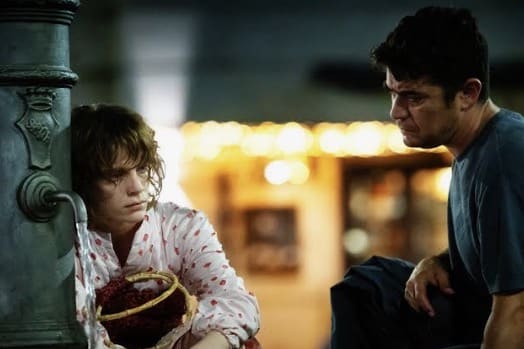


Dir: Susanna Nicchiarelli | Italy Fantasy Drama 2026
Happy Days is an intriguing, occasionally startling exploration of female identity, emotional repression and the unruly business of growing up.
Based on the graphic novel by ZUZU, the film takes the familiar territory of the coming-of-age drama and gives it a distinctly fantastic twist. Its central character, Claudia, is a twenty-year-old caught between past and future loves, still trying to discover who she is and what she wants. But when her emotions become too powerful — through excitement or anger — she transforms into a strange creature with white wings, tusks and feline paws. What might sound like an extravagant fantasy conceit becomes Nicchiarelli’s way of giving physical form to the darker, more unruly impulses that young women are expected to contain.
Nicchiarelli has long been drawn to women who resist easy categorisation. In Nico, 1988, her striking 2017 portrait of the final years of the singer Nico, she discarded the conventional rise-and-fall biopic in favour of a rawer, more unsentimental study of a woman attempting to reclaim her identity beyond the mythology of her former fame. The film’s austere compositions and refusal to romanticise its subject revealed a director interested in the uncomfortable distance between the public image and the private self.
Happy Days approaches a similar concern from the opposite direction: rather than stripping away an established persona, it imagines the monstrous, unruly self that lurks beneath the surface of an apparently ordinary young woman.
The visual premise is the film’s most immediately appealing feature. Claudia’s transformation offers Nicchiarelli an opportunity to move between everyday realism and something stranger, at once grotesque, comic and expressive. The creature is not simply a supernatural intrusion into an otherwise naturalistic story, but an external manifestation of feelings that Claudia cannot yet articulate or control. There is an evident imaginative pleasure in this collision between the recognisable awkwardness of early adulthood and the fantastic possibilities of the body. The film’s visual identity, shaped by Francesco Di Giacomo’s cinematography and Igor Gabriel’s production design, is central to its attempt to turn an internal psychological struggle into something tangible.
Yet a striking visual conceit is not necessarily enough to sustain a film. Nicchiarelli wants to tell a story about abuse and protection, about the painful process of growing up and the courage required to reveal oneself to others. These are substantial themes, and Claudia’s metamorphosis gives them an appealingly literal dimension. Her monster can be frightening, but also ridiculous and cumbersome: an inconvenient part of herself that she must learn to accommodate rather than simply suppress. The idea that self-acceptance requires acknowledging what is difficult, even dangerous, within us gives the film a welcome emotional ambition.
The question is whether the narrative develops with the same force as the central metaphor. The transformation provides an immediate hook, but it also risks becoming a substitute for the more complex work of character development. Claudia’s predicament is readily understood; making us feel the full weight of her choices, relationships and changing sense of self requires more than the ingenuity of the fantasy device. The danger is that the film’s episodes and ideas may accumulate without gathering into a sufficiently compelling dramatic progression.
Compared with the controlled, melancholy precision of Happy Days is a more openly playful and allegorical work. Its ambitions are different, and the shift towards fantasy is evidence of a director unwilling to repeat herself. But where the earlier film found depth in its attention to the contradictions of a difficult, damaged woman, this new work must make its symbolic invention resonate as lived experience.
Happy Days has an arresting premise and a perceptive understanding of the awkward, sometimes frightening business of becoming oneself. Its most interesting idea is that the monster is not necessarily an enemy to be defeated, but a part of the self that must be recognised. Whether that idea shines as a fully satisfying narrative is another matter. The film’s imaginative energy is clear; the challenge is to make its visual and psychological conceits add up to a story with equal emotional conviction.
WORLD PREMIERE | Rome Film Festival 2026