
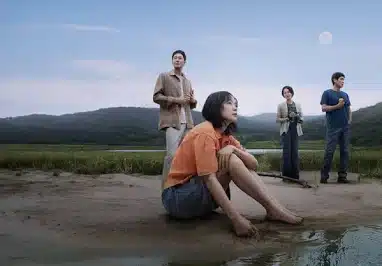

Dir: Lee Chang-dong | Drama 164’ 2026
Lee Chang-dong’s Possible Love is the kind of film that seems to be doing very little until, almost imperceptibly, it gets under the skin. Eight years after Burning, Lee returns with a 164-minute drama about two married couples whose apparently casual encounter exposes the fault lines of class, money, marriage, desire and self-worth. It is slow, watchful and deliberately withholding—but, crucially, it is not as serene as its surface suggests.
The story begins with Ho-seok (Sul Kyung-gu), a former factory worker whose life has been wrecked by redundancy following a corporate takeover. His wife Mi-ok (Jeon Do-yeon) struggles to keep their family functioning while he retreats into bitterness and depression. Their paths cross with Ye-ji (Cho Yeo-jeong), an affluent documentary filmmaker making a film about workers affected by mass layoffs, and her wealthy, enigmatic husband Sang-woo (Zo In-sung). What begins as a documentary encounter develops into an uneasy friendship, culminating in a visit to Sang-woo’s luxurious seaside house where the emotional and economic differences between the couples become impossible to ignore.
Lee is less interested in conventional plot than in the gradual accumulation of discomfort. His characters rarely announce what they want; they reveal it through glances, silences, awkward questions and seemingly insignificant acts. The documentary camera becomes particularly important: Ye-ji claims to be observing other people’s suffering, yet increasingly becomes an intruder into it. The film consequently turns its own gaze upon the filmmaker, asking whether exploiting somebody else’s pain for art is really so different from exploiting them economically.
Visually, Possible Love is classic Lee Chang-dong: restrained, naturalistic and almost stubbornly undemonstrative. Kim Ji-yong’s cinematography favours muted interiors, ordinary streets and long observational passages rather than conspicuous visual flourishes. Yet the apparent simplicity is deceptive. One of the film’s most striking sequences finds Ho-seok outside a restaurant, watching another family through a window. Lee keeps the camera at a distance, turning the glass into a barrier between the life Ho-seok has and the life he imagines other people possess.
The film’s visual language becomes more expressive as the relationships deteriorate. Flashbacks and documentary footage complicate our understanding of Ho-seok’s past, while the repeated presence of Ye-ji’s camera creates an uncomfortable question about who is actually watching whom. The style is never flashy, but it is extraordinarily precise.
The weakness is also bound up with the film’s strengths. At nearly three hours, Lee sometimes allows the material to become too deliberately significant. The beach-house section in particular can feel engineered to produce revelations, and some of the wealthy Sang-woo’s behaviour edges towards social caricature.
But the performances rescue any danger of schematic storytelling. Jeon Do-yeon is especially impressive, giving Mi-ok an extraordinary mixture of insecurity, loyalty, frustration and eventual resilience. Sul Kyung-gu avoids turning Ho-seok into a standardised portrait of the embittered working man: his silence becomes almost more eloquent than dialogue.
Does it work as a drama? Yes, though more as a drama of accumulation than revelation. The film isn’t conventionally gripping, and viewers expecting the psychological mystery of Burning may find it comparatively static. But Lee understands that marriages and friendships rarely collapse because of one enormous event. They fray through envy, humiliation, money, attraction and the things people choose not to say.
The title proves increasingly ironic. Possible Love is not really asking whether love is possible in the romantic sense. It asks whether genuine human connection is possible when people are separated by wealth, resentment and the desire to possess what somebody else has.
That makes this a quieter and more sober film than Parasite, with none of Bong Joon-ho’s darkly comic fireworks. Lee instead lets class resentment seep into domestic life until the personal and political become inseparable. The result isn’t quite another Burning, nor perhaps Lee’s masterpiece, but it is an intelligent, unsettling and remarkably mature drama about the things people covet—and the damage caused by discovering that getting close to another person doesn’t necessarily mean understanding them.
SCREENING DURING BFI LONDON FILM FESTIVAL