

Dir:: Andrey Zvyagintsev | USSR Thriller 135′
After nearly a decade away from feature filmmaking, the Russian director of Leviathan and Loveless returns to Cannes in the main competition with this slick moral thriller.
Gleaming, brutal, and believable Minotaur sees adultery, state violence, and masculine humiliation fuse into something mythic and monstrous the beast of its title.
The premise is classical. Gleb, played with terrifying stillness by Dmitriy Mazurov, is a wealthy provincial businessman whose brittle domestic life collapses after he suspects his wife Galina (Iris Lebedeva) of having an affair. But this is not merely a chamber piece about jealousy. Gleb is simultaneously tasked with selecting workers from his company for military mobilisation during Russia’s war against Ukraine, a bureaucratic horror that turns his private rage into political pathology. The film’s title becomes literal: the beast is not hidden in the labyrinth but seated behind a manager’s desk.
What makes Minotaur so fascinating is the way it openly converses with La Femme infidèle, Claude Chabrol’s exquisitely poisonous 1969 study of bourgeois marriage. In Chabrol’s original, starring Michel Bouquet, Stéphane Audran, and Maurice Ronet, adultery becomes a scalpel used to dissect middle-class hypocrisy with clinical precision. The husband’s murder of his wife’s lover paradoxically restores marital intimacy; crime becomes the glue of bourgeois order. Critics long regarded the film as quintessential Chabrol: cool, ironic, and merciless toward the rituals of privilege.
Zvyagintsev keeps the skeleton of Chabrol’s narrative but injects it with the gangrene of contemporary Russia. Gone is the manicured suburban malaise of Pompidou-era France. In its place: a spiritually exhausted country where corruption, militarism, and patriarchy have merged into a single social language. Chabrol observed the bourgeoisie as if through a microscope; Zvyagintsev films modern Russia like a collapsing empire viewed through cracked ice.
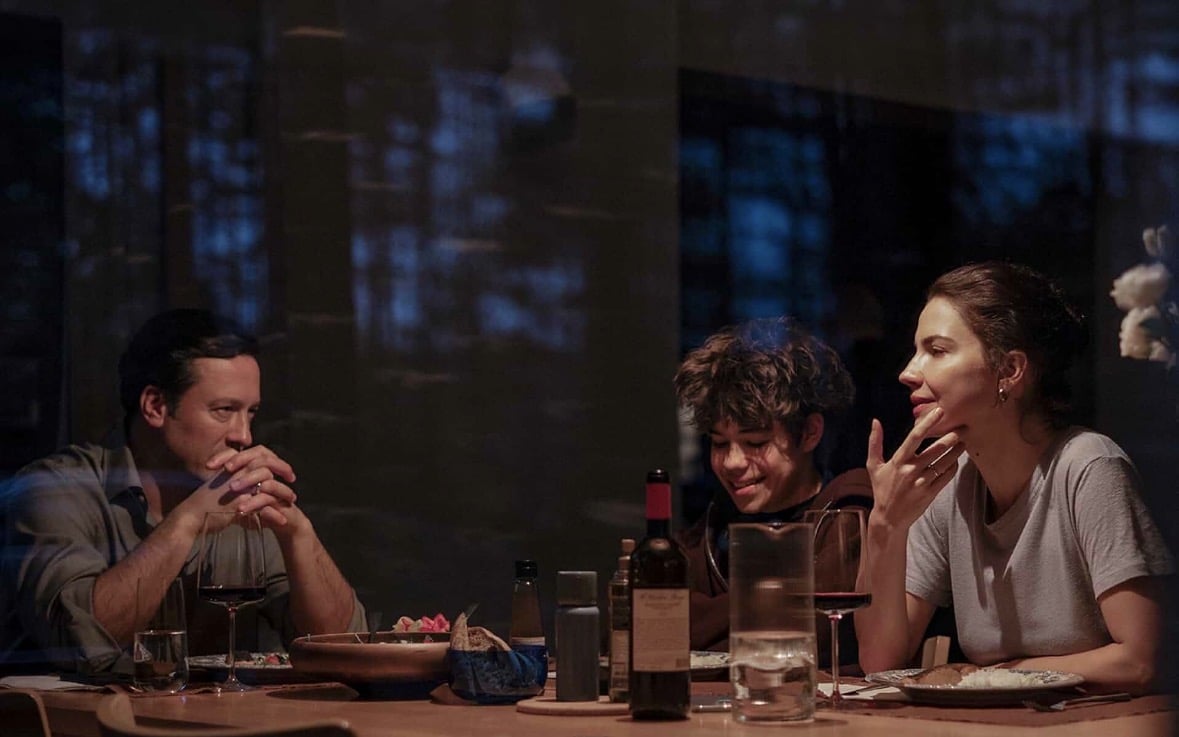
The film’s visual style is all drained daylight and oppressive interiors: The family live in a luxurious country house in the midst of woodland leading down to a lake. Gallina is a stay at home wife – infact she only seems to go out accompanied by Gleb, the couple have a young son who seems fairly independent and self-contained. Zvyagintsev has always excelled at portraying emotional austerity, but here the tone softer and more tender. Our sympathies lie with both sides; Galina is clearly a bored housewife and needs to get a life outside the family unit, but Gleb is not blind to her feellings and clearly still loves her.
Yet Minotaur never collapses into mere allegory. Its power lies in how intimately it understands humiliation: the humiliation of a betrayed husband, of workers treated as expendable bodies, of citizens trapped inside systems too vast to resist. Like the best of Chabrol, the film recognises that bourgeois civility is often only violence with better table manners.
The result is a thunderously bleak noir — part marital autopsy, part state-of-the-nation lament — yet perhaps Zvyagintsev’s most mature film to date. Not because it shouts, but because it barely raises its voice at all.
CANNES FILM FESTIVAL 2026 | In COMPETITION