

Dir: Koji Fukada | Japan Drama 2026
Premiering in Competition at the 2026 Cannes Film Festival, Nagi Notes confirms Kōji Fukada as one of contemporary Japanese cinema’s most quietly rigorous observers of emotional dislocation. Yet if the film consolidates his long-standing thematic concerns, it also exposes the limits of his austere way of filmmaking, producing a work of delicate beauty that occasionally fails to come alive on the screen.
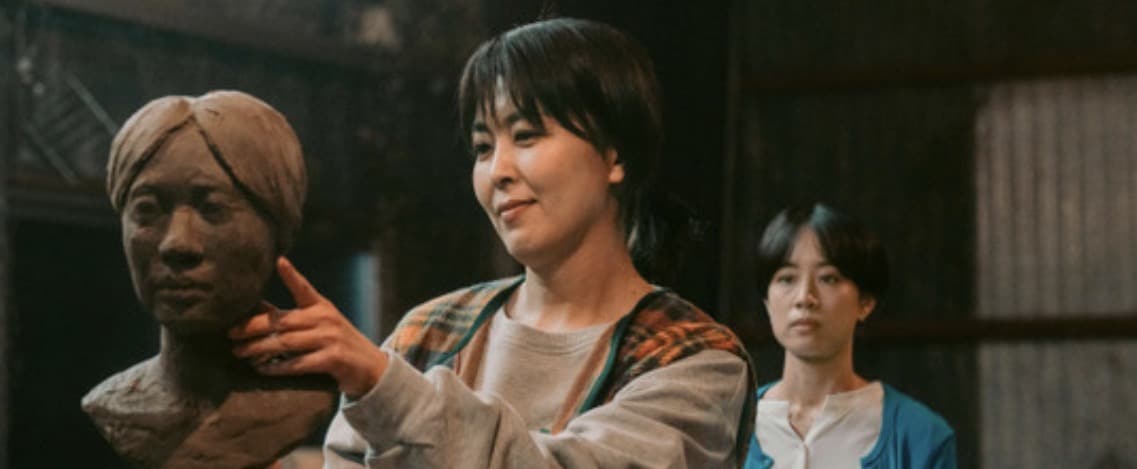
Yoriko, a sculptor, lives in a small mountain village in Nagi where she haunted by an unresolved love affair. When Yuri, a recently separated architect, travels from Tokyo to visit her friend and former sister-in-law, both women find themselves at a crossroad, each searching for ways to let go of the past and define their identities. Yuri’s brief escape from the city settles into a quiet confrontation of loss and probing for the two women in bucolic Nagi.
Fukada returns to a quieter style with this rural chamber piece adapted from Oriza Hirata’s play Tokyo Notes, itself loosely inspired by Tokyo Story. This premise—deceptively slight—encapsulates Fukada’s enduring interest in the friction between interior lives and social roles. As in his earlier films, the drama unfolds less through overt conflict than through the slow erosion of emotional defences.
Fukada allows time to accumulate meaning: gestures repeat, conversations circle, and pauses expand until they become expressive in their own right. This temporal strategy recalls both Yasujirō Ozu’s compositional restraint and the improvisatory looseness of Jacques Rivette, an influence Fukada has explicitly acknowledged.
Visually, Nagi Notes is marked by a muted, contemplative aesthetic. The rural landscape is not romanticised but rendered as a space of emotional suspension—neither escape nor prison. The cinematography favours stillness over movement, framing bodies within interiors that seem to absorb and reflect unspoken tensions.
Performance, too, is central. Takako Matsu brings a restrained fragility to Yoriko, while Shizuka Ishibashi’s Yuri operates as both catalyst and mirror. Their interactions—often halting, occasionally elliptical—generate the film’s most compelling moments.
Yet this same commitment to subtlety can feel self-limiting. But because Fukada’s script doesn’t escalate drama in the conventional way, its emotional impact feels less powerful. His earlier work—particularly Harmonium—derived tension from the intrusion of the unexpected, Nagi Notes remains rigorously controlled, almost hermetically sealed. The result is a work that invites contemplation but resists urgency.
Ultimately, the adaptation from theatre is sometimes too evident. The film’s spatial and dramatic economy, while intentional, can verge on theatrical inertia, with scenes that feel less like evolving encounters than variations on a single emotional note.
CANNES FILM FESTIVAL | IN COMPETITION