

Dir: Dominga Sotomayor | Chile 2026 110′
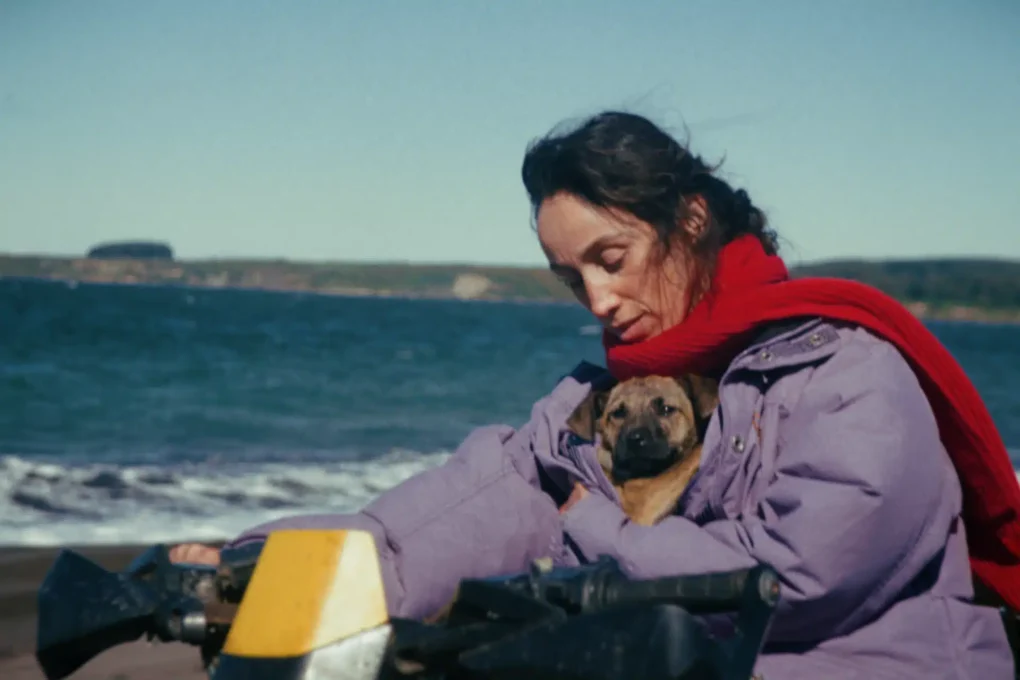
On a remote, windswept island in the Pacific, Silvia lives in a ramshackle hut and earns a precarious living harvesting seaweed. When she adopts a stray puppy her days fill with joy and love for the helpless animal, at least at first. But the dog’s sudden disappearance also re-awakens a haunting childhood trauma, forcing Silvia to confront a past she has never truly left behind.
Inspired by Pilar Quintana’s source novel La Perra inhabits the sunlit, maritime vastness the Chilean coast, the grassy hinterland and cragged shoreline are not merely backdrop but sentient presences, bearing witness to lives lived at the edge of subsistence and solitude in this isolated community. Sotomayor, best known for her awarding winning film Too Late to Die Young avoids a conventional narrative, instead drifting with the rhythms of a place where land and sea can change from moment to moment.
So Silvia’s existence and identity is very much defined by her laborious existence and inseparable from the rough hewn terrain she inhabits. Manuela Oyarzún plays her with an opacity that feels deliberate: Silvia is not so much revealed as observed, her inner life withheld, as elusive as the shifting tides. The image of the puppy, named Yuri, waiting for her mistress to return becomes one of the film’s most quietly devastating moments, a fragile articulation of dependency and care.
Sotomayor’s camera circles the island with a fluid, almost hypnotic motion, fusing sea, land, and sky into a continuous, breathing organism. Flora and fauna blur into one another, life unfolding as part of an unbroken ecological cycle. In this context, human drama feels secondary, almost incidental. A rough storyline surfaces: New Year’s fireworks, and the arrival of an outsider family and their two little children. They seem to be building a large house—but these events register less as plot than as disturbances in a delicate equilibrium.
When Yuri vanishes, spooked by the noise, a subtle dread infiltrates the film’s previously carefree texture. This unease deepens with the disappearance of a young boy, Nicolas, in the island’s caves, pushing the narrative toward something resembling a thriller, though Sotomayor resists any easy outcomes. Yuri’s return, her subsequent litter, and Silvia’s decision to give her away, along with the puppies complicate what we imagined was much wanted ‘motherhood’. Silvia remains distant, her motivations enigmatic. The harsh local landscapes seems to have shaped these people and made th resilient but also unyielding. In the end, Sylvia is as unknowable as the island itself—wild, self-contained, and resistant to interpretation.
Sotomayor offers no catharsis, only the lingering sense of a world that continues, indifferent and immense, driven by the cycles of nature, which offer the only sense of certainty, in this world beyond the limits of human understanding A beautiful but desolate film that leaves us with so many questions about the struggle to survive for small communities who live on the edge of a precarious world
DIRECTORS’ FORTNIGHT | CANNES FILM FESTIVAL 2026