

Dir: László Nemes | Cast: Bojtorján Barabas, Grégory Gadebois, Andrea Waskovics, Elíz Szabó | Hungary/France/Germany/United Kingdom 133′ 2025
Reviewed by Ian Long
Four years after the end of WWII, Holocaust survivor Klára arrives at an orphanage to take her son, Andor, back to their Budapest apartment. Eight years later, after the failed uprising against the Hungarian Peoples’ Republic, the city is tightly controlled by the Soviet military, along with a fearsome homegrown bureaucracy and secret police force (the ÁVH, or colloquially, the razzia).
Now twelve, Andor (Bojtorján Barabas) is preoccupied with his absent father. He broods over tickets salvaged from his agent’s booth near the family’s apartment, communes in his imagination with him in a sepulchral underground boiler-room, and endlessly practices the signature – ‘Hirsch’ – which he finds inscribed in one of his father’s Hebrew books. The fact that neither Andor nor his mother can read the book distances him from a Jewish heritage he doesn’t quite know how to embrace, although it seems poignantly ready to welcome him.
Andor’s friend Sári (Elíz Szabó), another Jewish child, while ostensibly happy and carefree, harbours anxieties of her own. Her elder brother Tamás, deemed an ‘enemy of the people,’ is hiding in a demolished house, hunted by the razzia, hoping to escape to America. Aided only by his mother (one of Klára’s co-workers in a grocery stolen from her family during the war) and a few other local people, Tamás’ life is hanging by a thread.
A middle-aged butcher, Berend (Grégory Gadebois), appears amidst all this – swollen, swine-like , and claiming some intimate connection to Andor’s mother which appals the boy, even if it’s barely comprehensible to him. At first it seems that Berend’s only demand on Andor is to be accepted as a father-substitute. A horrible enough idea in itself, but it soon escalates, with Berend claiming that he actually is Andor’s father. A nauseating suggestion which propels Andor into full-on existential crisis.
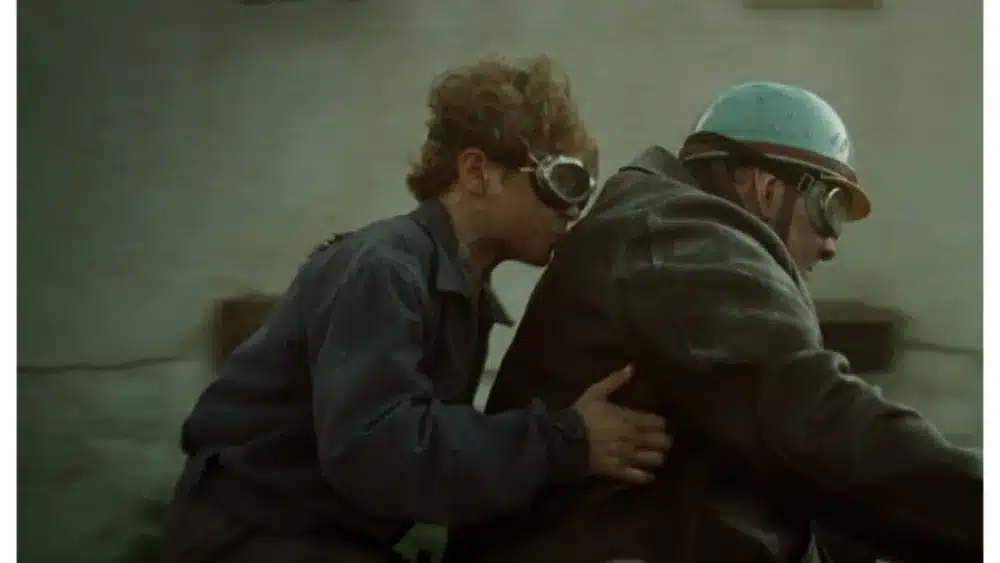
Orphan’s detailed visual recreation of the streets, shops and domestic interiors of postwar Budapest – battered, dowdy, but characterful and ripe with atmosphere – is a tapestry of creams, browns and greens, like the colours of a period photograph. Particularly in the first half of the film, cinematographer Mátyás Erdély pares down the constrained, almost-square aspect ratio even further with semi-obscured framings, offering a visual parallel to Andor’s imperfect grasp of events.
Visually, it’s reminiscent of Gordon Willis’ work with shadows and obstructions in films like Alan J. Pakula’s Klute, which gave Willis the nickname ‘the Prince of Darkness.’ The method isn’t overused in Orphan, though, and has the effect of focusing the attention of the audience even more closely on the characters’ emotional journeys.
The acting is uniformly strong, but Bojtorján Barabas as Andor is outstanding. He embodies all the intensity and vulnerability of near-adolescence, when fierce opinions co-exist with deep ignorance of the world. It’s a performance which can easily stand alongside other remarkable cinematic juveniles like Jean-Pierre Léaud in The 400 Blows, Jodie Foster in Taxi Driver, and Jonathan Kahn in The Sailor Who Fell from Grace with the Sea.
Grégory Gadebois as Berend is also notable. He plays the butcher with brutish physicality, a massive, fleshy tube of a man apparently twice the width of a normal person. Digital processing appears to have lowered his voice a degree or two, making it almost unnaturally resonant while amplifying every semi-human grunt and snort, giving us a child’s-eye view of corrupted adulthood. But Gadebois finds humanity even in such a monstrous figure. Despite his appearance and actions, at some level he genuinely wants to give and receive love.
This is an outstanding film which deserves to be seen by a wide audience. Entertaining, engaging, visually powerful and a delight from beginning to end, it barely puts a foot wrong, and its numerous strands build towards an extended, suspenseful and bittersweet finale whose details shouldn’t be divulged: they need to be seen.
IN CINEMAS NATIONWIDE