

Dir: Alex Huston Fischer and Eleanor Wilson | Fantasy Drama 2026
Olivia Colman has built a career out of making eccentricity feel entirely human, and Wicker offers her another opportunity to turn social awkwardness into something both funny and unexpectedly touching. Part folk tale, part romantic comedy, it takes a gloriously absurd premise and uses it to poke at the conventions governing love, beauty and respectability.
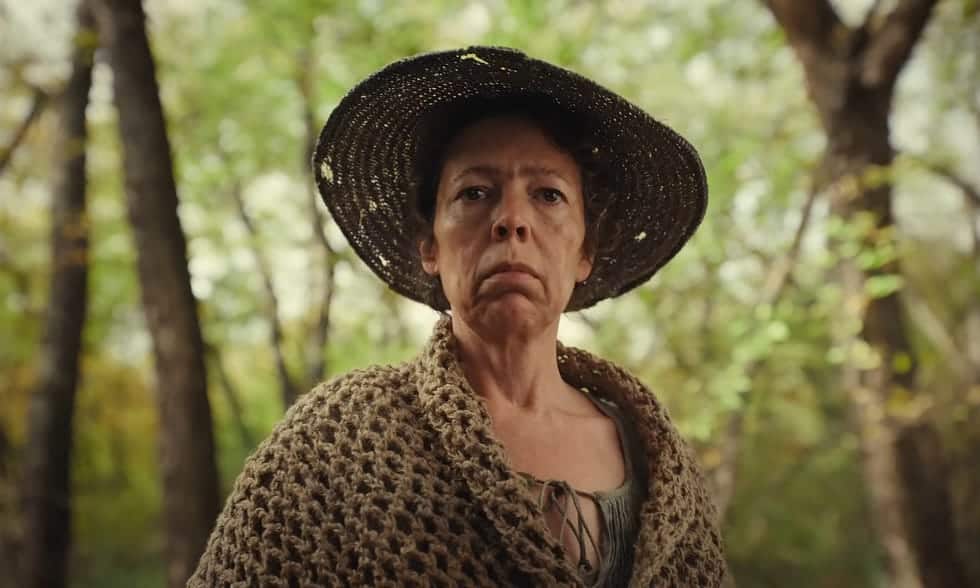
The story centres on Colman’s lonely fisherwoman, who, dismissed by her neighbours as an outsider, commissions a basketmaker to fashion her a husband from wicker. When her creation comes to life, the result is a handsome and attentive companion whose existence throws the village into a state of moral confusion. What begins as a personal solution to loneliness becomes a challenge to the community’s established ideas about marriage, attraction and what constitutes a proper relationship.
Co-directors Alex Huston Fischer and Eleanor Wilson, adapted the screenplay from Ursula Wills-Jones’s short story The Wicker Husband. Their supporting cast is particularly interesting: Alexander Skarsgård brings physical presence and unexpected tenderness to the wicker creation, while Peter Dinklage lends the basketmaker an intriguing mix of craft and character. Elizabeth Debicki adds a sharper, more calculating note as the tailor’s wife, with Richard E. Grant, Nabhaan Rizwan, Marli Siu and Ella Bruccoleri further enriching the village’s eccentric social landscape. The combination of distinctive performers gives the directors plenty of scope to balance the film’s fantastical premise with its comedy of mann
Colman is ideally suited to the role, finding the wounded pride beneath her character’s prickly exterior without sacrificing the comedy of her predicament. Her gift lies in making the ridiculous entirely plausible: a glance, a pause or a flicker of indignation can tell us more about her character’s emotional life than pages of dialogue. The supporting performances add further complications to a story in which conventional appearances prove a distinctly unreliable guide to human worth.
Visually, the film inhabits a curious space between historical fantasy and an illustrated fairy tale. Its coastal environment, textured materials and carefully constructed settings give the action a tangible quality, while the wicker figure himself provides an arresting contrast between the organic and the artificial. The visual approach is crucial: the more physically convincing this extraordinary creation becomes, the easier it is to accept the emotional logic of the romance.
The narrative works best when it allows the central absurdity to expose the absurdities of ordinary society. The villagers’ reactions become a running commentary on conformity, sexual jealousy and the policing of women’s choices. There is an appealing irreverence in the suggestion that a woman might find greater tenderness in an unconventional creation than in the supposedly respectable men available to her. Occasionally, the fairy-tale conceit threatens to overwhelm the emotional argument, but the underlying questions about isolation and acceptance give the comedy substance.
Ultimately, Wicker is less interested in the mechanics of its fantastical romance than in the freedom it offers its heroine. Beneath the oddball humour lies a defence of those who refuse to measure their happiness against society’s expectations. With Colman providing the emotional ballast, this is a distinctly unconventional love story whose greatest pleasure lies in asking who, exactly, gets to decide what normal looks like.
NOW IN UK CINEMAS