


Dir: David Bickerstaff | UK Doc 2026
Reviewed by Meredith Taylor
Celebrating the 250th anniversary of their births, two British iconic artists come together in a new documentary that explores the artists’ intertwined lives and legacies alongside the current exhibition at London’s Tate Gallery.
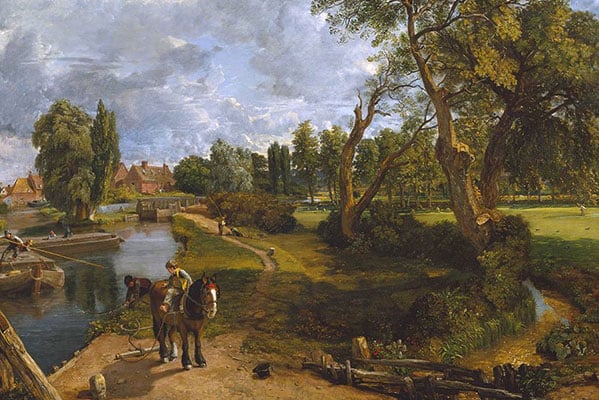
Famously described by critics as a clash of ‘fire and water’, Turner and Constable’s respective styles were both bold yet starkly different. JMW Turner (1775-1851) and John Constable (1776-1837) were at work at a time when Britain was at war with France so their landscapes reflect their island home and became vital and treasured by the people of England, Scotland and Wales. At the same time, the artists were rivals using landscape painting to chronicle the changing world that surrounded them.
Once again filmmaker David Bickerstaff is behind the camera, avoiding a traditional narrative structure preferring to bring the subject to life vividly on screen by comparing and contrasting the artists’ work using valuable insight from curators and art specialists. What we discover are unexpected details of the painters’’ lives behind the canvas by way of their sketchbooks and personal items that show how the artists redefined landscape painting, and paved the way for Impressionism.
Turner, whose first Royal Academy exhibition was in 1790, evokes urban and rural landscapes studying light and Impressionism, whereas Constable was all about the Suffolk. He was dedicated to the nature and scenes of this eastern county where he was born, entering the Royal Academy in 1799 and becoming a fully fledged RA in 1829. Born in the heart of London, Turner inhabited the dark narrow streets of Covent Garden and spent his childhood in this bustling commercial part of the city, an area full of theatres, drinking establishments, and the red light district. His youth was formed by an awareness of things being bought and sold. With a businessman father Turner was made acutely aware from a young age that Art is a not jut a creative output but a way of making money in a capital full of possibilities that can be monetised. And Turner’s father hung his son‘s watercolours in the window of his barbershop to give him the support he needed.
Constable, by contrast is very much a country boy, born into an affluent family in rural Suffolk, surrounded by open fields and vast landscapes. His father ran a successful milling and grain exploitation business and so Constable’s background is one of health and security. Turner, being a Londoner, had easy access to the relatively new Royal Academy, and the Royal Academy of Arts had only been founded in 1768. It was the most dominant prestigious body in the art world at the time and an influential platform for exhibitors. To be a Royal Academician was to have your name as an artist showcased to an elite world, enabling the artist to command the highest prices, to move in the most influential circles, and acquire wealthy patrons.
Turner and Constable took part in a British school of art that was stepping out of the shadows of the European counterparts with work that was uniquely British in style and tone. Both artists follow this path albeit at slightly different times of their life. Turner was a child prodigy aged just 14 years old when he was admitted to the Academy School and he enjoyed a meteoric rise gaining Academy admission and becoming a full RA at 27. On the other hand, Constable had a more slow-burn approach entering aged 23. He was more at home in the Suffolk fields drawing, and sketching, and his awareness of business came much later.
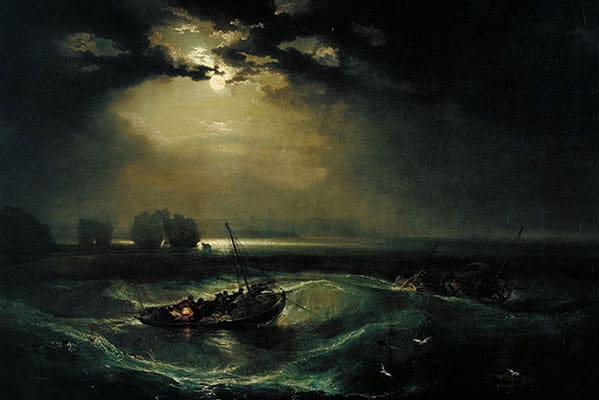
Although Turner and Constable were both essentially landscape painters, when it comes to painting styles they were very different. Constable focused on capturing the literal, atmospheric reality of the British coast, whereas Turner creates a very emotional view, using the sea to explore deep forces. His seascapes were abstract and evocative, often giving a sense of the turbulent water, an impression of an oncoming storm, and the wildness of the cliffs, giving him the nickname ‘prince of the rocks’.
1798 was a particularly special year for artists exhibiting at the Royal Academy as it offered the first opportunity to attach lines of poetry or description to the titles of paintings in the exhibition catalogue. Both artists loved poetry so this was a way forward. For Turner, particularly this was a great opportunity to embellish some of the feelings he was trying to convey in his landscape paintings.
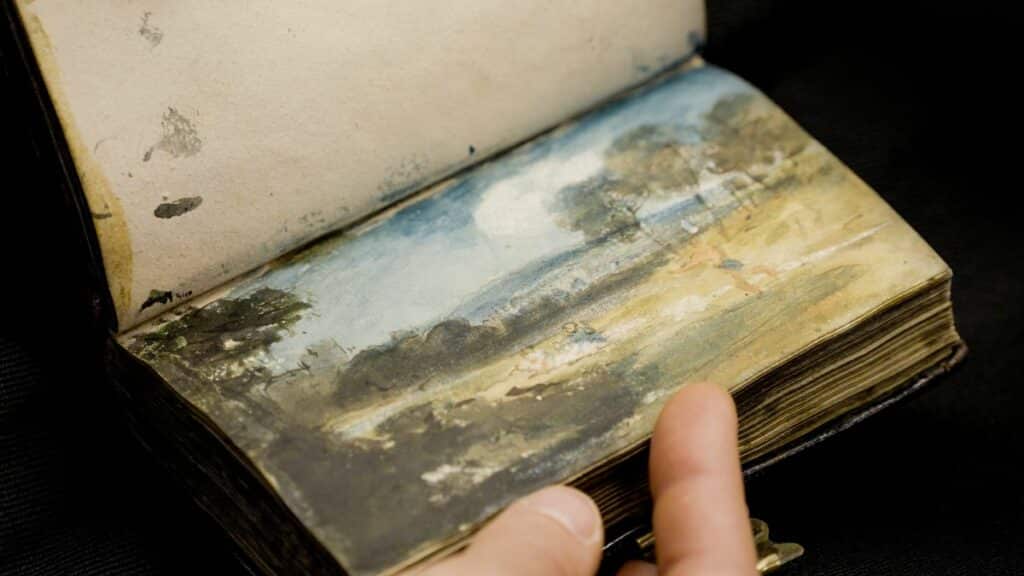
The painters were cut off from travelling to the continent due to the Napoleonic wars so their focus in depicting more dramatic countryside had to be closer to home. The Lake District and Wales had the mountains and wild scenery enabling the two to depict light and shade in that dramatic environment. Turner’s sketchbooks were filled with a great intensity, he was compelled to draw and sketch everything. Inquisitive, his sketches really give a sense of an artist who is absolutely thrilled to be out on the road, capturing the dazzling vibrancy of life as he moved along. Whereas Constable roots his entire practice in a sensory record of atmospheric effects in places he knows really well, and can truly be called a ‘plein air’ painter.
In 1781 a company in England called Thomas and William Reeves started to commercially manufacture blocks of ‘ready to use’ watercolour paints with the key ingredient of honey to keep the paint moist. This was a revolutionary change in how artists could create watercolour paintings while out and about. And this allowed both artists to elaborate their signature study of light, the white underneath illuminating the colour that they could apply on top. Turner could paint a watercolour every day, and then perhaps colouring in the canvas at night when inside his lodgings. He particularly favoured chrome yellow and cobalt blue which was a colour developed in France around 1802.
Constable is an incredibly emotional painter – an intense impression of his feelings is almost impregnated in the paint. In one painting, of Brighton, you can sense the pain he’s experiencing when his wife Maria Bicknell is dying of tuberculosis in 1828, aged 41. Their marriage had been bitterly apposed by her parents, but eventually she had seven children with Constable. Scattered with red highlights, he really packed a raw visceral punch in his 1828 painting of the sea at Brighton. His grief and despair is palpable within this dark wall of falling rain.
One word that characterised the era was change, and both artists are acutely sensitive to the potential for change. Nowadays we think of the arts and sciences are being diametrically opposed and very different disciplines but that distinction wouldn’t have existed during the 19th century. There is much more crossover. There is an incredible interest in reforming the political system, the disparity between the power and wealth. There are the beginnings of writings and discussions about about prison reform. There is the the abolition of slavery and these are massive seismic changes in society and stabilisation.
Turner comes across as intellectually curious and he owns a wide range of books within his personal library, with publications on chemistry on print technology on mathematics, geography and geology, and he reads these to help him understand the forces that shape the landscape. Both enjoyed friendships with people like Michael Faraday and Marie Somerville, some of the big names in scientific inquiry at the time. Constable was deeply interested in the clouds he saw above Hampstead Heath and he was fascinated to understand the science behind this and other ways of codifying meteorology and the skies. He was keen to learn the whether you might need a jumper, or possibly an umbrella, but with Turner you need all the protective gear that you can get at the same time.
For over sixty years Turner and Constable shared a timeline. But in 1837 Constable suddenly and unexpectedly died during his sleep. Turner would live another fifteen years, in Twickenham near the river Thames where he chose to build himself a house. It still exists as Turner’s only complete architectural project, a place where he could withdraw from the professional pressures of life and a retirement home for himself and his father. He had children but never married, possibly a reflection of the overbearing character of his mother.
Both of them challenged the conventions that dominated landscape painting in the British art scene at the time and the film and exhibition now offer the chance to experience these great artists, side by side, as were so often in life, on the big screen, globally, for the first time.
NOW ON EXHIBITION ON SCREEN | In cinemas from 10 March 2026