

Dir: Kai Stänicke. Germany, 2026. 122’
Returning home after fourteen years away, only to discover that nobody recognises you, provides the disturbing premise for Kai Stänicke’s striking feature debut. Trial of Hein unfolds as a modern folk-horror parable about identity, collective memory and the tyranny of communal conformity. Set against the bleak, windswept isolation of a North Sea fishing island, it constructs an increasingly sinister world in which the familiar becomes hostile and the past refuses to remain buried.
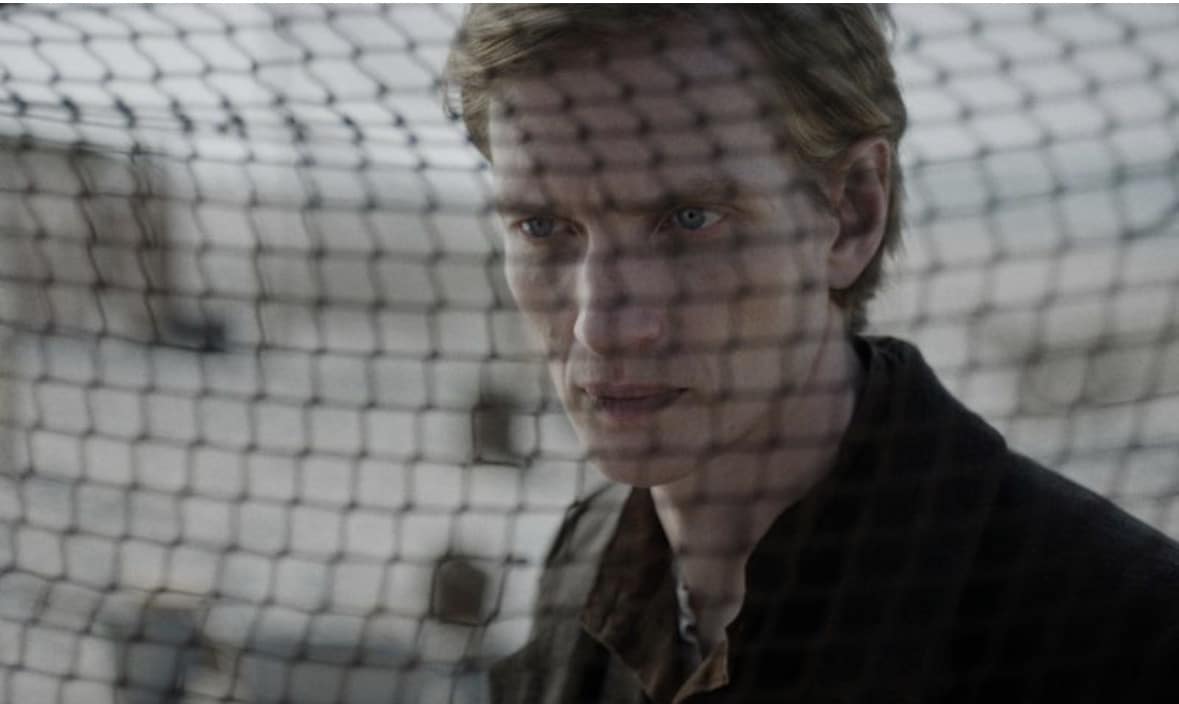
Hein (Paul Boche) goes back to the village of his birth from the mainland, expecting to resume his former life. Instead, his family, childhood acquaintances and neighbours all insist they have no recollection of him. What initially appears to be an extraordinary misunderstanding gradually assumes the proportions of a collective conspiracy. Is Hein really who he claims to be, or has the village uncovered some truth that he himself cannot acknowledge? Ostracised and denied the most fundamental right to belong, he demands an open-air trial in which his identity can be established. Yet the proceedings become less an exercise in justice than a chilling demonstration of how readily a community can manufacture its own version of the truth.
Stänicke develops this deceptively simple premise with considerable assurance, drawing on the theatrical austerity of Lars von Trier’s Dogville and the historical ambiguities of The Return of Martin Guerre, while establishing a distinctly individual atmosphere of menace. The exposed landscape, unforgiving weather and claustrophobic village society create a world in which everyone appears to know everyone else’s business, yet nobody is prepared to question the collective wisdom. The film’s formal severity reinforces its oppressive mood, as the village trial develops into a ritual of accusation, suspicion and public humiliation.
At its centre is a mesmerising performance from Paul Boche, whose Hein combines bewilderment, wounded dignity and mounting desperation. He is a man fighting not simply for recognition but for the right to possess his own history. Around him, the villagers become an unsettling chorus, their certainty increasingly difficult to distinguish from self-interest and fear. As conflicting memories and long-concealed secrets emerge, the film becomes an absorbing examination of the fragile foundations upon which personal identity and communal history are constructed.
What makes Trial of Hein particularly meaningful to a mainstream audience is its refusal to treat the village’s behaviour as merely an aberration. Its real subject is the ease with which societies exclude those who disturb an established narrative, and the uncomfortable possibility that belonging is conditional upon accepting the version of events sanctioned by the majority. The result is an austere, occasionally enigmatic but consistently compelling work whose psychological implications linger long after its final reckoning.
Winner of the Teddy Jury Award at the 2026 Berlinale, Stänicke announces himself as a filmmaker of considerable promise. A haunting debut in which the rituals of village life conceal something far more sinister: the terrifying power of a community to decide who you are, and whether you have the right to exist.
NOW ON RELEASE IN NEW YORK’s Film Forum