

Dir: Christopher Hampton | UK 70’
These Violent Delights: When Dance Becomes Tragedy
Christopher Hampson’s These Violent Delights sets itself an intriguing challenge: how do you make Shakespeare’s Romeo and Juliet feel urgent when its story, characters and tragic conclusion are already so deeply familiar? The answer lies in abandoning the idea that the play must be retold in recognisable dramatic form. Instead, Hampson, working with co-director Oscar Sansom, uses the expressive possibilities of ballet and cinema to explore the emotional forces that propel two young people towards destruction.
The film’s starting point is not the innocent excitement of first love but its terrible aftermath. From this position, the narrative moves through fragments of memory, desire and foreboding, inviting us to experience events through Juliet’s consciousness. It is an effective device because it shifts attention away from the mechanics of the plot towards the psychological experience of its heroine. We are less concerned with what happens next than with understanding how love, rebellion and despair become so dangerously entangled.
Hampson’s interest in the project also reflects a wider ambition to take ballet beyond the theatre and discover what the cinematic medium can contribute to choreography. A stage performance necessarily unfolds before a stationary audience; the camera, by contrast, can dictate our attention, isolate a gesture or turn a movement into something unexpectedly intimate. Through changes of perspective, close framing and energetic editing, the film makes the dancers’ physical expression central to its storytelling. This is not simply ballet recorded for posterity, but a work that attempts to exploit cinema as an artistic medium in its own right.
The visual world is one of its principal attractions. The contrasting environments of family authority and nocturnal freedom create a recognisable contemporary landscape while retaining a heightened, almost surreal quality. The nightclub sequences are particularly effective, releasing the choreography into a space of colour, rhythm and sensual abandon. Here, movement becomes a form of liberation, even as the audience senses that such freedom cannot last. The film’s visual sophistication gives it an immediate appeal, making it accessible even to viewers who might feel intimidated by ballet’s conventions.
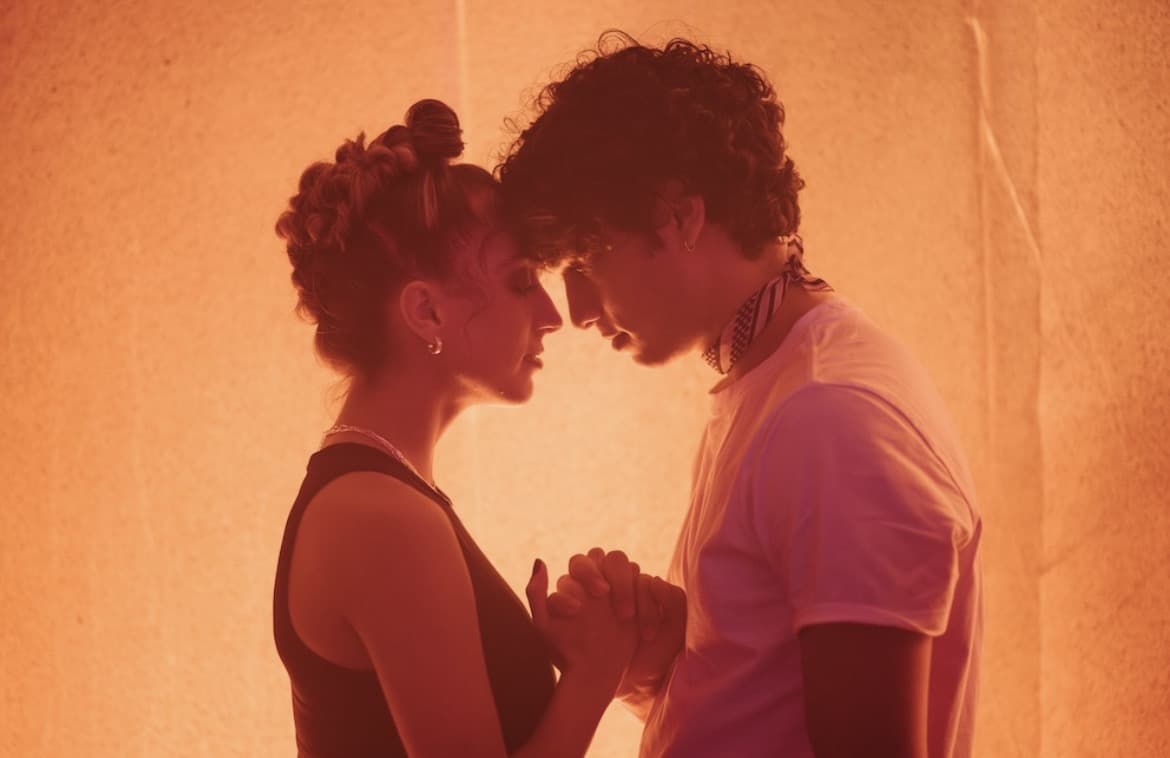
At the heart of the work is Juliet, whose predicament becomes more than a familiar story of forbidden romance. Her struggle is against the expectations and restrictions of a world that appears determined to dictate her future. Kayla-Maree Tarantolo brings considerable intensity to the role, communicating vulnerability and defiance through the movement of her body. Ishan Mahabir-Stokes’s Romeo provides the corresponding energy of youthful attraction, and their encounters convey the exhilaration of falling in love without relying on spoken explanations. Their physical chemistry gives the relationship credibility and emotional immediacy.
Yet the film’s greatest strength is also the source of its occasional weakness. Its commitment to visual intensity sometimes comes at the expense of narrative clarity. The movement between reality, recollection and fantasy can be difficult to follow, while the accumulation of dramatic images occasionally leaves insufficient space for tenderness or reflection. Dance is capable of expressing emotional complexity with extraordinary precision, but cinematic storytelling still requires a sense of progression. At moments, the film seems more interested in sustaining its atmosphere than in developing the relationships that give the tragedy its meaning.
Nevertheless, the underlying conception is persuasive. Shakespeare’s lovers are not destroyed by passion alone; they inhabit a society in which inherited hostility and parental authority leave little room for individual choice. By presenting their relationship within a contemporary visual framework, Hampson makes this conflict feel immediate rather than remote. The tragedy becomes a confrontation between the desire to determine one’s own life and the forces that prevent such freedom.
Does These Violent Delights succeed? As visual entertainment, emphatically so. Its choreography, cinematography and production design create a distinctive and often mesmerising experience. As storytelling, it is more uneven, occasionally sacrificing clarity to mood, but it retains enough emotional force to sustain its central argument. Hampson has not discovered a new Romeo and Juliet so much as found another way of making its familiar tragedy speak.
The film’s real achievement is to remind us that a story’s familiarity need not diminish its power. By replacing Shakespeare’s words with the eloquence of the moving body, These Violent Delights makes a persuasive case for ballet on screen—and demonstrates that the most enduring tragedies are those in which the audience knows the ending but still hopes, against all reason, that it might be otherwise.
In cinemas from Wednesday 21 October 2026, with an accompanying 24-minute Q&A with directors Oscar Sansom, Christopher Hampson, lead Kayla-Maree Tarantolo and producer Beth Allan. Moderated by journalist and dance critic Kelly Apter.