
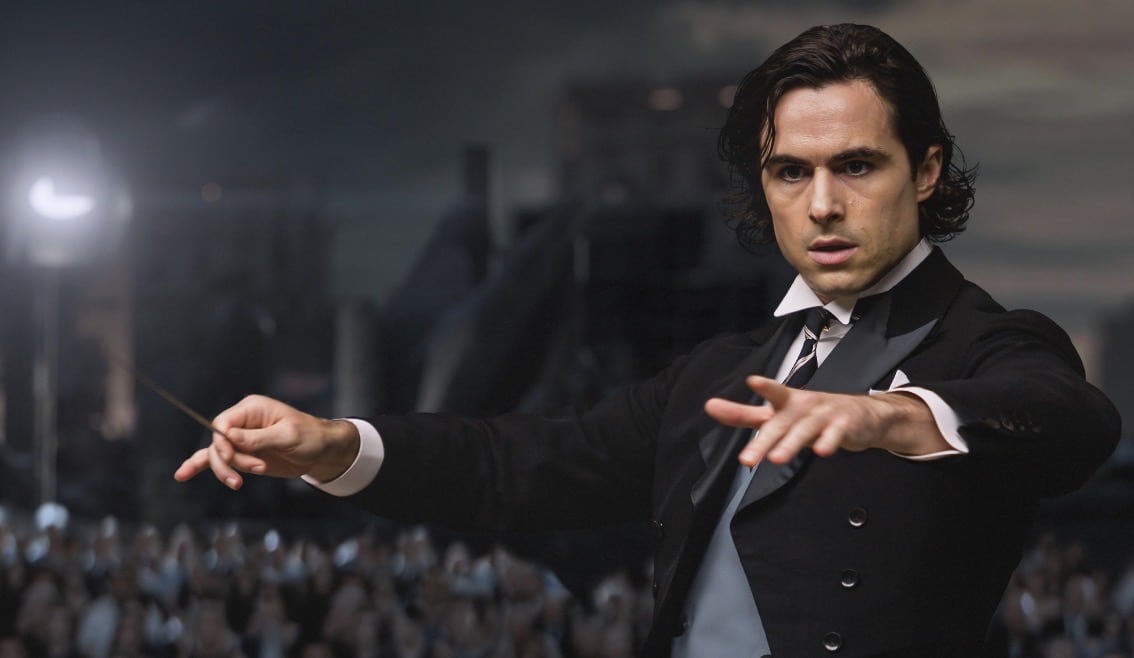

Dir: Serge Ioan Celebidachi | Biopic, 145’
The Yellow Tie is an ambitious, lavishly mounted biopic about a man who believed that music was too precious to be captured on record. There is a tantalising contradiction at its heart: how do you make a film about an artist who insisted that the true experience of music could exist only in the moment? The answer, unfortunately, is not always as illuminating as the question.
Based on the extraordinary life of Romanian conductor Sergiu Celibidache, this is a film with genuine scale, a distinguished cast and a passion for classical music that is infectious. Yet its reverence for its subject sometimes gets in the way of the more probing, entertaining film that his complicated personality might have inspired.
Celibidache’s story begins in Romania, where his stern, ambitious father expects him to pursue a respectable political career. Instead, the young Sergiu follows his passion for music, breaking with his family and eventually making his way to Berlin. There, against the turmoil of wartime Europe, his formidable talent takes him towards international prominence and, after the Second World War, the prestigious post of principal conductor of the Berlin Philharmonic.
But Celibidache is no conventional musical hero. A fiercely independent perfectionist, influenced by Zen Buddhism, he believes that recorded music cannot reproduce the transcendent experience of a live performance. His uncompromising principles bring him into conflict with the commercial music industry and complicate his professional life.
Ben Schnetzer plays Celibidache in his younger years, with John Malkovich taking over as the older maestro. The yellow tie of the title, originally intended by his father as a symbol of a very different future, becomes an emblem of rebellion, family conflict and the price of artistic independence.
Directed and co-written by Celibidache’s own son,, the film is both an epic musical biography and an intensely personal family portrait. That connection lends the project emotional investment, but also raises a question about how far the filmmaker is prepared to interrogate his father’s less appealing qualities.
Celibidache was famously demanding, fiercely controlling and difficult to accommodate; a more searching film might have explored the human cost of his perfectionism alongside the brilliance that made him exceptional. Instead, the portrait sometimes feels carefully protective. His convictions are given plenty of room, while the contradictions that might complicate our feelings about him receive less attention. The result is an affectionate tribute rather than a fully rounded psychological study.
Visually, this is an impressive production. The handsome period reconstruction moves between the streets of wartime Berlin, elegant interiors and the imposing grandeur of concert halls. The production design and costumes help create a convincing sense of a life lived across several tumultuous decades, while the large-scale reconstructions give the film a cinematic ambition beyond the usual television-style biopic.
But the orchestral sequences are the main event. The camera’s attention to the conductor’s gestures, the musicians’ concentration and the physical intensity of performance brings the film closest to its subject’s artistic philosophy. Sound is not simply a decorative backdrop but the film’s emotional centre. There are moments when the visuals become rather grandiose, and some of the historical spectacle feels more illustrative than dramatically necessary. Nevertheless, this is a film that deserves to be experienced on a cinema screen, where the scale and sound can do their work.
John Malkovich brings a formidable presence to the role of the older Celibidache, conveying the maestro’s hauteur, obstinacy and almost theatrical certainty in his own genius. He is never less than watchable, although his performance can tip into mannerism, making the older conductor seem more of a caricature than a mystery.
Schnetzer arguably has the more interesting task. He captures the energy, ambition and rebelliousness of a young man determined to escape his father’s expectations. His performance gives the film much of its forward momentum, and the early career sections are often more engaging than the later portrait of the established maestro.
Sean Bean makes a strong impression as the domineering father, while Miranda Richardson and Kate Phillips contribute to the family story as Celibidache’s wife, Ioana, at different stages of her life. Anton Lesser also appears as the Buddhist mentor Martin Steinke. The cast is a considerable asset, even when the script doesn’t give everyone sufficient depth.
The main problem is pacing. At 145 minutes, the film has room to breathe, but it also has room to meander. Its chronological sweep sometimes resembles a procession of significant episodes rather than a story building towards a compelling dramatic reckoning. The philosophical debate about live performance versus recordings is fascinating, yet the film tends to present Celibidache’s position as a declaration of artistic faith rather than seriously testing it.
It’s entertaining, particularly if you enjoy classical music, period dramas or performances by Malkovich and Schnetzer. The film has genuine visual polish, an evocative musical dimension and a remarkable life at its centre.
But don’t expect the psychological penetration of a great artist’s biopic. The film is too respectful of its protagonist, too willing to let pronouncements stand in for character development, and not quite willing enough to ask whether artistic greatness excuses personal arrogance.
Its most intriguing idea is also its most frustrating missed opportunity: if music is an experience that cannot be reproduced, how can cinema convey that experience without reducing it to spectacle?
The Yellow Tie comes tantalisingly close to answering its own question, particularly in the concert scenes, before retreating into conventional biographical storytelling.
A handsome, musically rich and intermittently moving biopic, elevated by two committed central performances but hampered by its reverence for its subject. Worth a cinema visit for the music and spectacle, but not quite the transcendental experience its subject demands.
NOW IN UK CINEMAS