

Dir: Bryan Forbes | UK Drama 1967
The Whisperers: Bryan Forbes’ haunting portrait of old age still has plenty to say
There is something quietly devastating about Bryan Forbes’ The Whisperers, a film that looks unflinchingly at the indignities of growing old in a society that has little time, patience or sympathy for its elderly. Made in 1967, this bleak but remarkably tender piece of British social realism remains an uncomfortable watch precisely because so little of its central argument has dated.
At its heart is Margaret Ross (Dame Edith Evans), an impoverished, increasingly isolated elderly woman living alone in a shabby Manchester tenement. Estranged from her feckless husband Archie (Eric Portman), she occupies a world increasingly shaped by suspicion, fantasy and the voices she imagines are conspiring against her. Her principal consolation is the expectation of a substantial inheritance from a father whose supposed fortune exists largely in her imagination – but if it did, would undoubtedly be taxed to within an inch of its life by our swingeing government .
When her criminal son Charlie (Ronald Fraser) deposits stolen money in her flat, she mistakes it for the long-awaited windfall. For a brief moment, she believes her fortunes have finally changed. In reality, the people around her are more interested in exploiting her vulnerability than protecting her.
Forbes, directing from Robert Nicolson’s novel, builds a portrait of psychological disintegration that is as much about social neglect as individual illness. Margaret’s deteriorating grip on reality is never treated simply as a medical curiosity. It is inseparable from the grinding poverty, loneliness and casual humiliations that have reduced her existence to a series of small domestic rituals. Her letters, her conversations with imaginary adversaries and her elaborate recollections of a more privileged past become desperate attempts to preserve some sense of identity and dignity.
The film’s most striking achievement is Edith Evans’ extraordinary performance. Known for her formidable theatrical presence and imperious delivery, Evans strips away almost every vestige of the grand dame to reveal a woman at once pathetic, calculating, proud and heartbreakingly vulnerable. Her Margaret is not designed to be conventionally lovable. She can be irritating, deluded and wilfully difficult, but Evans finds the humanity beneath the eccentricity without ever sentimentalising it. There is something particularly affecting in the contrast between her carefully maintained airs of gentility and the squalid circumstances in which she lives.
Eric Portman is equally impressive as Archie, the shabby, self-serving husband whose return offers Margaret the possibility of companionship but little genuine security. Ronald Fraser brings a nasty, convincingly casual selfishness to Charlie, while Avis Bunnage makes an effective impression as one of the familiar faces in Margaret’s impoverished social circle. Nanette Newman, as the young woman living upstairs, provides an intriguing glimpse of another generation and another kind of life, although her role is comparatively small.
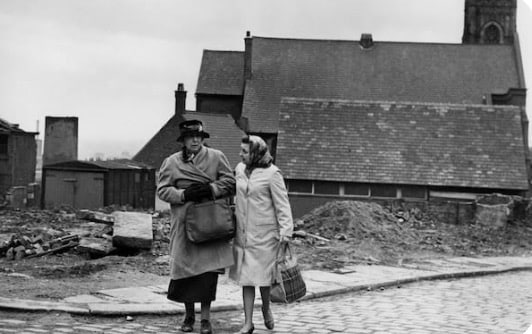
Visually, the film is a masterclass in unshowy atmospheric filmmaking. Gerry Turpin’s black-and-white cinematography makes Manchester a landscape of grimy streets, decaying housing, cramped interiors and institutional indifference. Forbes is particularly alert to the expressive possibilities of domestic detail: a cluttered room, a kettle that needs coaxing into action, the accumulated debris of a life that has gradually contracted. The camera observes rather than embellishes. There is little conventional cinematic beauty here, but an extraordinary sense of place and emotional enclosure.
The title is especially telling. The whispers are both the voices Margaret hears and the unspoken judgements of a society that has effectively abandoned her. Forbes occasionally allows the narrative to become more melodramatic than its central character study requires, particularly through the subplot involving the stolen money. Yet the film repeatedly returns to its most powerful subject: the terrifying possibility of becoming invisible while still alive.
And is it still relevant? Uncomfortably so. The circumstances of elderly poverty have changed, but the underlying questions have not. Who looks after people who have no family willing or able to help? How do we distinguish eccentricity from illness, and independence from abandonment? What happens when an individual’s need for human contact is met with bureaucracy, impatience or exploitation?
Watching The Whisperers today, it is difficult not to think about contemporary debates surrounding social care, dementia, loneliness and the precarious position of older people living alone. Forbes may occasionally lean too heavily on the conventions of British social-problem cinema, but his central insight remains potent: old age is not merely a biological condition; it is also a social experience, and one that can become brutally isolating.
Ultimately, this is Edith Evans’ film. Her performance gives it a tragic dignity that transcends its period setting. More than half a century later, The Whisperers remains a haunting, often distressing reminder of how easily a life can be reduced to an inconvenience in the eyes of everyone else. It deserves to be seen again.
SCREENING 1 NOVEMBER 2026 at Crouch End Cinema London N8