

Dir;: Amos Gitai | Doc 2026 76’
The Road to Jericho is a subtle yet powerful hybrid of documentary, archive and essay film, directed by Israel’s Amos Gitai
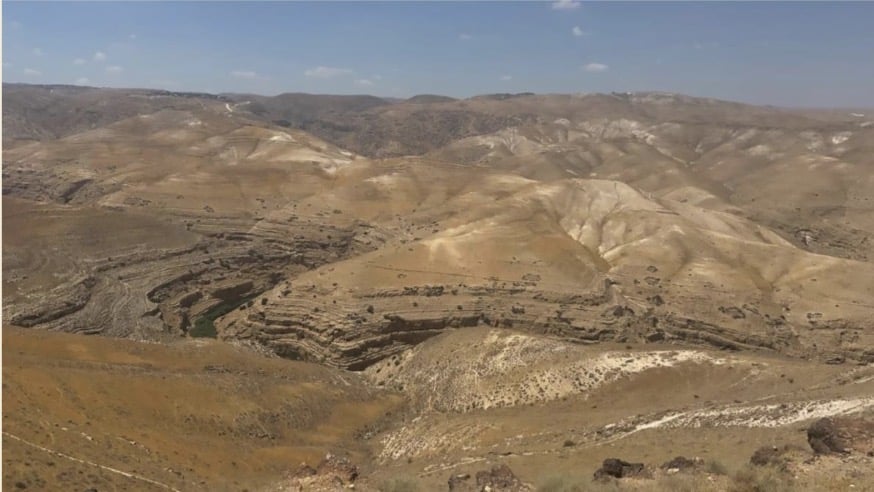
Rather than constructing a conventional political documentary, the filmmaker creates a cinematic journey along the road from Jerusalem to Jericho, allowing landscape, memory and testimony to accumulate meaning.
The film’s method is deliberately associative. Archival images from earlier works are placed in dialogue with the present, while the voices of figures such as Samuel Fuller, Jeanne Moreau, Arthur Miller and Yitzhak Rabin haunt the contemporary landscape. Their words and memories become a kind of counterpoint to what we see: the desert road, the ruins and, most significantly, the Bedouin community of Khan El Ahmar.
There is a particular strength in the film’s refusal to over-explain. The spectacular austerity of the Judean desert is set against the fragile architecture of Khan El Ahmar, where a school and a small community have been constructed from earth and discarded tyres. The children, filmed within this precarious environment, provide some of the film’s most affecting images. Their quietness and apparent happiness contrast sharply with the political forces threatening to remove them.
Yet the film is not simply an indictment of contemporary Israeli policy. Its deeper subject is the persistence of history — and the uneasy relationship between political idealism and present reality. The road to Jericho carries the memory of the Oslo process, while the reference to Josephus Flavius and the Roman wars stretches the film’s temporal horizon far beyond the contemporary conflict. History here is not background; it is a physical presence in the landscape.
The memory of Yitzhak Rabin gives the film its emotional and political centre. The director recalls conversations with Rabin in 1994, when Gaza and Jericho represented tentative steps towards an entirely different future. Rabin’s doubts, reservations and determination to give peace a chance are recalled against the present threat to Khan El Ahmar. The juxtaposition is deliberately painful: a community associated with the Oslo landscape now facing displacement.
The film’s greatest achievement is perhaps this movement between the intimate and the historical. Khan El Ahmar becomes more than a single threatened settlement. The community is presented as a microcosm — a small, vulnerable human world through which the failures and unfinished promises of the peace process can be contemplated.
At times, however, the film’s poetic approach risks aestheticising political reality. Its beautiful desert imagery, archival fragments and carefully orchestrated voices can create a distance from the immediate human consequences of displacement. The film asks to be experienced as meditation rather than reportage, and viewers looking for detailed political analysis may find its elliptical structure frustrating.
But that is also what gives The Road to Jericho its distinctive identity. Like the director’s earlier films House, Wadi and Ananas, it is constructed through encounters between places, memories and voices rather than through conventional exposition. The filmmaker becomes both witness and wanderer, moving through a landscape in which the past continually interrupts the present.
Ultimately, The Road to Jericho is less a film about a road than about what the road carries with it: ancient violence, political memory, lost possibilities and the fragile persistence of ordinary human life. Its most haunting question is not simply what will happen to Khan El Ahmar, but what becomes of the possibility of peace when the physical traces of that possibility are themselves being erased.
VENICE Film FESTIVAL 2026