

Dir: Mariko Minoguchi | Adventure thriller 2026
The Other Side (Die andere Seite) takes the familiar nightmare of a deadly pandemic and turns it inside out. Rather than following the healthy as they barricade themselves against infection, this unsettling German-Austrian drama sides with those society has decided must be sacrificed to preserve its own security. The result is a stark survival story that doubles as a chilling examination of exclusion, fear and the fragile boundaries of human solidarity.
Nina Hoss plays Hanna, a doctor whose life has been devastated by a lethal epidemic. Having lost her family, she is herself infected and capable of transmitting the virus, even though she has survived its worst effects. In a society determined to protect the uninfected at any cost, carriers are treated as pariahs and forcibly confined. Hanna refuses to submit. Instead, she retreats into the Alpine wilderness, living as a fugitive while taking painstaking precautions not to endanger others. Freedom, however, comes at the price of almost total isolation.
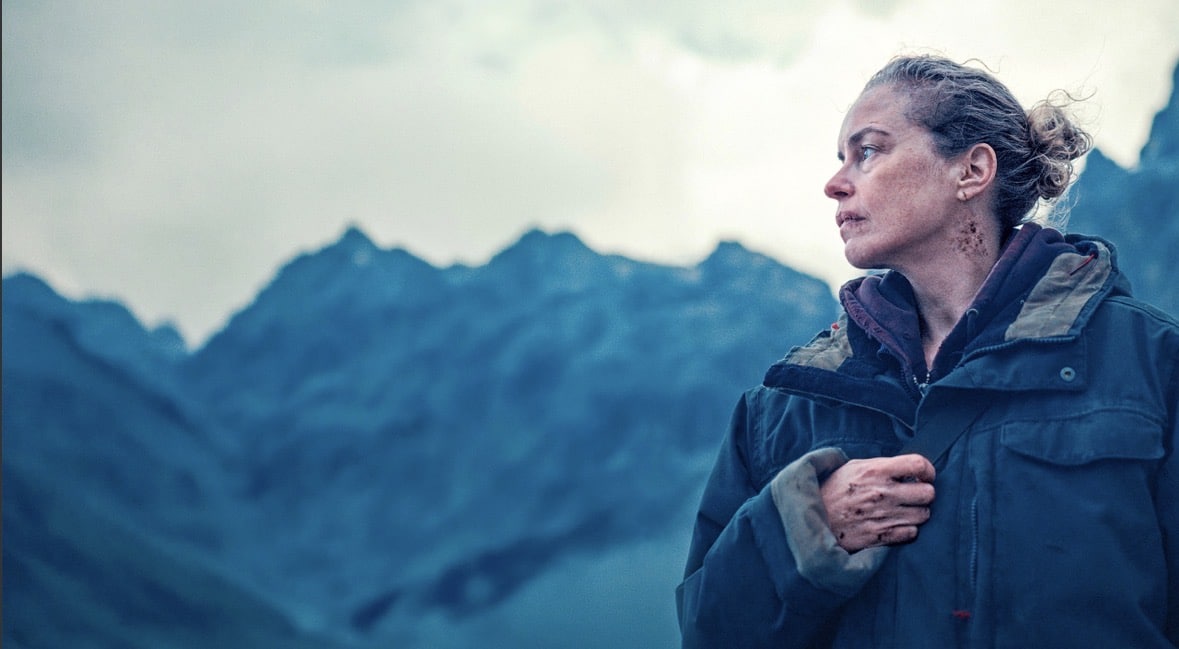
Minoguchi makes a bold formal choice in allowing the opening half-hour to unfold with scarcely any dialogue. Hanna’s struggle is conveyed through movement, observation and the daily mechanics of survival. It is a physically demanding role, but Hoss, one of European cinema’s most compelling actors, brings a remarkable precision to the performance. Her face becomes a landscape in itself: watchful, guarded, exhausted, yet never entirely emptied of feeling. She conveys the psychological cost of being regarded as a threat without resorting to grandstanding or self-pity. It is an intensely internal performance, its emotional force accumulating through small gestures and silences.
The film’s trajectory changes when Hanna encounters a young pregnant woman, Lila (Precious Mariam Sanusi), who also belongs to the despised community of carriers. With the military closing in and the prospect of indefinite confinement hanging over them, the two women embark on a dangerous journey across the Alps towards the south, where they hope to find a place in which they might live freely. Hanna’s medical training gives her a reason to help Lila, but their developing relationship also challenges the defensive solitude that has become her means of survival. Barbara Petritsch, as an older woman who offers Hanna unexpected assistance, provides another glimpse of humanity surviving amid collective panic.
The visual approach is integral to the film’s impact. Cinematographer Felix Pflieger sets Hanna’s vulnerability against the formidable scale of the Alpine landscape, its beauty offering little reassurance. Wide vistas suggest the possibility of escape, yet the exposed terrain can feel as threatening as the society she has fled. The contrast between the immense natural world and Hoss’s solitary figure gives the film a haunting physical dimension. These are not landscapes that simply invite contemplation; they make the human body look precarious, temporary and painfully alone.
Minoguchi, whose debut feature Mein Ende. Dein Anfang. explored grief, fate and the possibility of connection, again gravitates towards characters forced to reconsider what binds people together. Here, the premise carries unmistakable contemporary resonance without reducing the drama to a straightforward pandemic allegory. The question is not merely who survives, but who is permitted to belong. When fear becomes the organising principle of society, the supposedly healthy can prove as morally compromised as the people they condemn.
There is a risk that the film’s deliberate pacing and extended stretches of silence will test viewers expecting a conventional chase thriller. Yet its restraint is also its strength. Rather than continually manufacturing incident, Minoguchi lets tension emerge from the precariousness of every encounter and the uncertainty of whether trust is possible.
The Other Side ultimately finds its most affecting material in the uneasy movement from self-preservation towards responsibility for another. Hoss supplies the film with its emotional centre, while Minoguchi’s austere visual storytelling turns the journey through the mountains into something larger than a bid for physical escape: a search for a world in which survival need not depend on excluding someone else.
VIENNALE FILM FESTIVAL 2026