
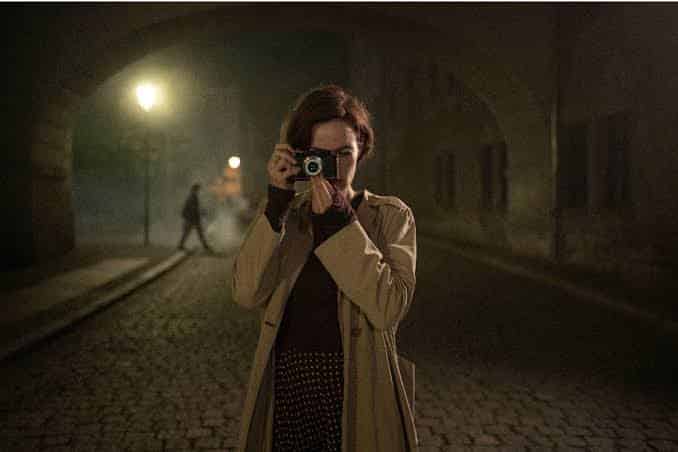

Dir: Alina Marazzi | Italy/Germany | 118’ | Orizzonti, Venice 2026
Alina Marazzi’s The Girl with the Leica turns the final day of Gerda Taro’s life into a haunting meditation on youth, politics, love and the intoxicating belief that history can still be changed.
Opening Venice’s Orizzonti competition, the film takes place largely on July 14, 1937, in Paris, as Taro prepares to return to the Spanish Civil War with her Leica and the man who remains both her lover and creative rival, Robert Capa.
But Marazzi wisely refuses the conventional biopic structure. Instead, the Parisian present becomes a doorway into Taro’s fragmented past: her political awakening in Leipzig, escape from Nazi Germany, exile in Paris, friendships among a generation of displaced intellectuals, and the electric relationship with Capa. Memory is fluid rather than explanatory, with the past continually intruding upon the apparently carefree summer day.
The result is a portrait of a woman who refuses to remain merely the woman beside Capa. Taro emerges as politically committed, fiercely independent and increasingly conscious of the camera as something more powerful than a means of recording events. Her Leica becomes an instrument of resistance — a way of looking, witnessing and intervening in a world sliding towards catastrophe.
Emilia Schüle gives Taro an appealing mixture of exhilaration and impatience. She is not presented as a solemn historical icon but as a young woman who still wants love, friendship, laughter and adventure even while recognising that the political world around her is becoming impossible to ignore. That tension gives the film much of its emotional charge.
Marazzi’s greatest strength is her sensitivity to the atmosphere of a generation living on borrowed time. Paris in 1937 is still full of possibility, yet the knowledge of what is coming hangs over every conversation. The film’s central irony is devastating: these young refugees have escaped one tyranny only to discover that history is following them.
The Capa relationship is consequently more than a romantic subplot. Their intimacy is charged by competition, admiration and the question of who gets to frame reality. Photography becomes an extension of their personalities — and for Taro, a means of claiming an identity that history might otherwise have denied her.
Based loosely on Helena Janeczek’s Strega Prize-winning novel, Marazzi’s film is less interested in reconstructing Taro’s life with encyclopaedic precision than in recovering its emotional texture. Her cinema has long been concerned with memory, archives and women’s stories, and that sensibility is particularly well suited to a figure whose own images survived while her name was too often eclipsed by that of Capa.
There are moments when the associative structure risks becoming overly romanticised, and the film occasionally seems almost too conscious of the tragedy that awaits its heroine. Yet this is also its purpose: to capture the strange brightness of a moment immediately before innocence disappears.
Taro would be killed on the Spanish battlefield only days later, becoming the first female photojournalist to die in combat. Marazzi does not allow that fate to define her. Instead, The Girl with the Leica asks us to look at Taro while she is still alive — ambitious, political, in love, restless and convinced that photography might help alter the course of history.
It is a film about the last moment before the future closes in. And its most poignant achievement is to make us feel not simply the tragedy of Gerda Taro’s death, but the extraordinary possibility of the life she had barely begun to live.
VENICE FILM FESTIVAL 2026