

Dir: Karel Kachyňa | Thriller 1970
The Ear — The sound of a regime listening to itself
There is something almost perversely appropriate about calling Karel Kachyňa’s The Ear a political thriller when so little of its terror comes from anything as conventional as pursuit, interrogation or physical violence. The film’s real antagonist is uncertainty: the possibility that every wall has ears, every silence is loaded, and even intimacy has become a form of surveillance.
Made in 1970, but withheld from the public for two decades, The Ear belongs to that remarkable strain of Czechoslovak cinema in which political oppression seeps into the smallest spaces of private life. Yet what makes it feel startlingly modern is the way Kachyňa turns ideology into an acoustical problem. His characters are not merely watched; they are listening for evidence that they are being watched.
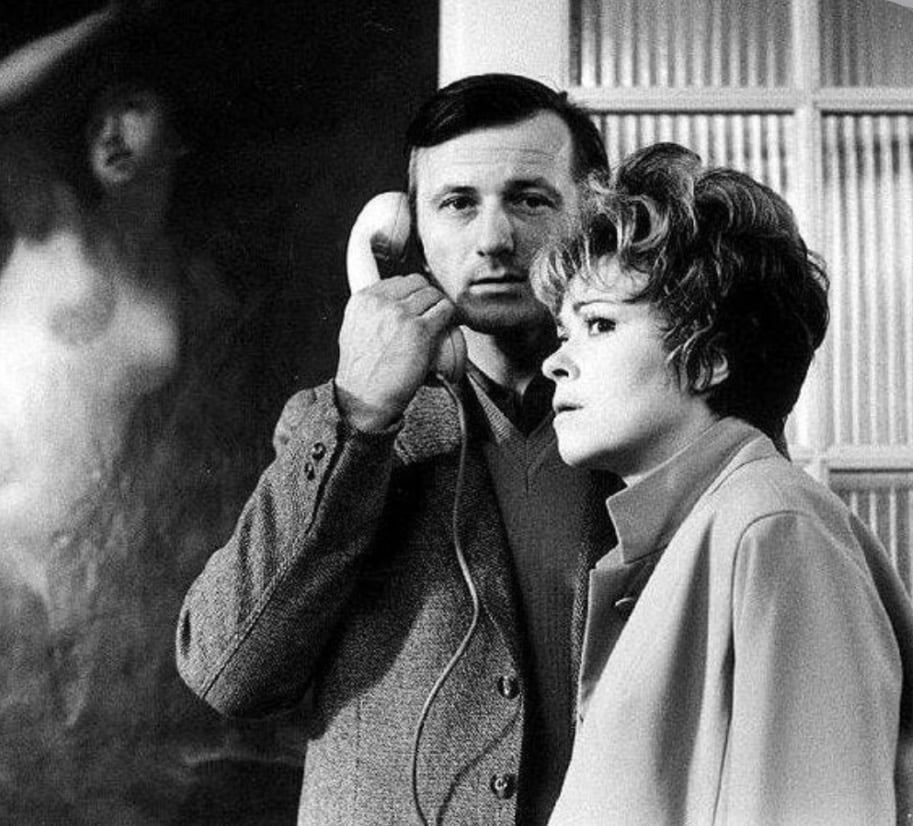
The entire film unfolds over a single night. A senior Communist functionary and his wife return from a party at which careers, loyalties and possibly lives have been rearranged behind closed doors. Their house should represent privilege and security. Instead it becomes a trap. The electricity appears to have been cut. The telephone is dead. Doors behave suspiciously. The husband discovers signs that someone has been inside. His attempts to reconstruct what happened at the reception become increasingly frantic, while his wife’s anger and humiliation turn their marriage into another arena of interrogation.
It is a brilliantly claustrophobic conceit, but Kachyňa does something more interesting than simply tightening the screws. He makes political paranoia indistinguishable from domestic resentment. The couple have years of grievances to exhume, and the night’s political crisis gives them permission to do so. Every accusation operates on two levels: Did you betray me? and Did you betray the Party? Gradually, the distinction becomes meaningless.
That is where the film’s real originality lies. The Ear is not simply about a totalitarian state spying on its citizens. It is about what happens when people who have learned to survive through complicity and suspicion bring the logic of the state into their own emotional lives. The surveillance apparatus does not need to be permanently visible because it has already been internalised.
Kachyňa and screenwriter Jan Procházka exploit the house almost like a piece of expressionist architecture. Corridors become threatening voids; darkness is not an absence of information but information in itself. The camera moves with nervous purpose, frequently denying us the reassuring geography that classical thrillers provide. We are forced to inhabit the couple’s uncertainty rather than observe it from a safe distance.
And then there is the sound. The title is almost a joke with a sinister afterlife: the ear is everywhere precisely because it cannot be located. Footsteps, switches, telephones, voices behind doors and fragments of remembered conversation acquire the weight of clues. Silence becomes one of the film’s loudest effects. Long before contemporary cinema made paranoia into an atmosphere, Kachyňa understood that surveillance is most effective when nobody can establish exactly where the microphone is.
The film also complicates the familiar Western image of the dissident. Its protagonist is not an innocent crushed by an evil system. He is part of that system, a beneficiary of it, and possibly a perpetrator within it. His terror therefore contains an uncomfortable recognition: the machinery he fears is the machinery that has sustained his own position. He is frightened not merely because the state might destroy him, but because he knows exactly what the state is capable of.
This gives The Ear a different relationship to the Czech New Wave’s better-known absurdism. Where films such as The Firemen’s Ball expose authority through comic incompetence, Kachyňa strips away the laughter without abandoning the movement’s fascination with bureaucratic absurdity. The result is something closer to a domestic horror film in which ideology has replaced the supernatural.
Seen now, the film also has an uncanny kinship with our own age of ambient surveillance. Yet it would be a mistake to turn it into a simple prediction of contemporary life. Its terror depends on a very specific historical system: a political order in which proximity to power offered protection one moment and vulnerability the next. What feels contemporary is not the technology but the psychology — the exhausting awareness that someone else may possess information about you that you do not possess about yourself.
That makes The Ear more than an important document of the Czechoslovak New Wave. It is a film about power becoming intimate. The state does not merely enter the home; it changes the grammar of marriage, memory, speech and silence once it gets there.
The final irony is devastating. For a film built around the fear of being overheard, its most revealing conversations are between two people who have almost nothing left to hide from each other. The state may be listening, but so are they. And neither knows which confession will prove more dangerous.
LONDON’s MADE IN PRAGUE FESTIVAL | CZECHOSLOVAK NEW WAVE