
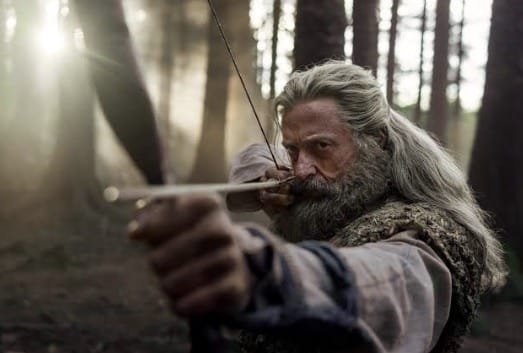

Dir: Michael Sarnoski | Adventure drama 2026 122’
Michael Sarnoski’s The Death of Robin Hood is a deliberately unheroic farewell to one of cinema’s most familiar legends. Forget the jaunty outlaw, the Merry Men and the romance of Sherwood Forest. Sarnoski begins with a Robin Hood who is old, brutalised and exhausted by the life he has led. His great act of revision is to ask what might remain when the heroic story has been stripped away — and whether a man responsible for so much violence can ever deserve redemption.
Hugh Jackman is superb as Robin, giving the role an extraordinary physical and emotional weariness. Buried beneath the beard and weather-beaten appearance is a man who seems almost surprised that he has survived so long. Jackman resists the temptation to make Robin conventionally sympathetic. His silences, stiffness and flashes of violence suggest someone who has spent decades suppressing whatever humanity remains in him. It is a performance built less around speeches than presence, and one of the film’s strongest achievements.
Jodie Comer provides an important counterweight as Sister Brigid, the woman who offers Robin refuge. Her performance is notably restrained: compassionate without becoming saintly and strong without theatricality. Their relationship gives the film its emotional centre, particularly because Sarnoski wisely avoids turning it into a conventional romance. Bill Skarsgård’s Little John is another striking presence, bringing a rough physicality and sense of shared history to Robin’s old companion, while Noah Jupe and Murray Bartlett add quieter dimensions to the film’s meditation on guilt, suffering and the possibility of starting again.
The film looks magnificent. Northern Ireland stands in for a medieval Britain of bog, stone, rain and unforgiving wilderness, with cinematographer Pat Scola finding beauty without prettifying the landscape. The visual design makes the world feel lived-in rather than picturesque. Sarnoski also changes the film’s visual proportions as Robin moves from the harshness of his former existence towards the relative sanctuary of the priory, subtly suggesting that his emotional world is beginning to open.
That visual confidence is matched by an unusually austere tone. Sarnoski is interested in the consequences of violence rather than its excitement. When Robin kills, the film refuses to turn him into an action hero; violence is ugly, intimate and damaging. This is where the film connects most convincingly with Sarnoski’s earlier work. Like Pig, it takes a seemingly familiar genre framework and gradually reveals something more melancholic and psychologically complicated underneath. After the larger-scale demands of A Quiet Place: Day One, this feels like a much more personal film.
But it is not without problems. The film’s seriousness occasionally becomes self-conscious, and the long stretches of introspection can make the drama feel static. Robin’s remorse is interesting as an idea, but Sarnoski sometimes keeps him at such a distance that it becomes difficult to feel the full emotional force of his transformation. The film is considerably more successful at creating an atmosphere of guilt and mortality than at making every aspect of Robin’s redemption convincing. That tension helps explain why reactions to the film have been divided: its craftsmanship and performances are widely admired, while some critics have found its sombre approach overly prolonged.
Nevertheless, The Death of Robin Hood is a bold addition to Sarnoski’s small but distinctive canon. Pig remains the more surprising and emotionally precise film, while A Quiet Place: Day One demonstrated his ability to operate within a larger commercial machine. Here he finds a middle ground: a recognisable property reshaped into something intimate, severe and unmistakably his own.
The film’s greatest achievement is therefore not reinventing Robin Hood as an antihero but questioning why we need him to be a hero at all. Sarnoski turns the legend into an examination of violence, responsibility and the stories people construct to make violent lives bearable. It is sometimes too sombre for its own good, but its ambition is admirable, Jackman is excellent, and its weather-beaten visual world lingers. In Sarnoski’s canon, it feels like a substantial step forward — less polished than Pig perhaps, but more confident in its conviction that even the oldest stories can still be made strange again.
In UK cinemas from 4 September