
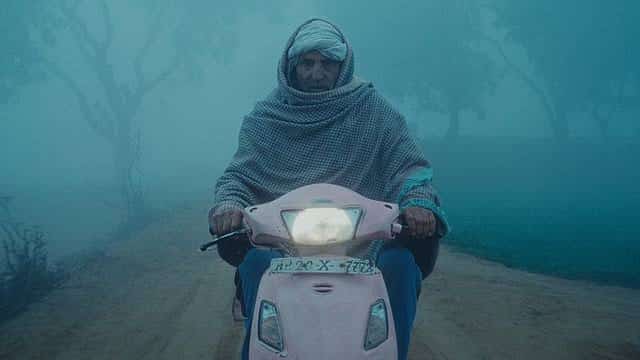


Dir: Ankur Hooda | India Drama 77’
Ankur Hooda’s captivating first feature The Calf Doll is a film that finds poetry in a world seemingly disappearing before our eyes. Set amid the fog-bound landscapes of Haryana, it is ostensibly a story about farming, but its concerns are much larger: the erosion of rural life, the lure and necessity of migration, and what happens to those who remain when the younger generation leaves for the cities. We are lucky to be able to alive at a moment when the world is rapidly evolving and to experience both sides of the story
Hooda’s approach is intriguingly hybrid. His grandparents play improvised versions of themselves, giving the film the quality of a para-fiction while retaining the intimacy of an observational documentary. There is no sense of actors performing a conventional drama; instead, Hooda allows people, places and small incidents to accumulate meaning. His camera watches rather than dictates, finding drama in faces, silences, domestic routines and the rhythms of agricultural life.
Visually, the film is a small marvel. The Haryana landscape is frequently enveloped in mist, the muted imagery turning fields, animals, houses and distant figures into almost dreamlike tableaux. Yet this beauty is never merely decorative. The fog becomes an apt metaphor for a rural future that is increasingly difficult to see clearly. Hooda has an unusually patient eye, allowing shots to breathe and trusting the audience to discover what is happening rather than constantly explaining it.
This is slow cinema in the best sense: unhurried but never inert. Its story gradually gathers emotional force, with seemingly modest encounters acquiring significance as the film progresses. There is a gentle humour too, and a warmth towards its elderly protagonists that prevents the film from becoming a solemn lament for a vanishing way of life.
What makes The Calf Doll particularly significant is that the plight it describes is hardly confined to India. Across the world, farming communities are being squeezed by economics, changing patterns of employment, industrialisation and the movement of younger generations towards urban life. The British countryside has its own version of this crisis: farmers struggling with costs, regulation, land pressures and uncertain futures, while the rural communities that once depended upon them steadily change. The landscapes may be radically different, but the underlying anxiety is remarkably familiar.
Hooda never turns this into a polemic. Instead, he makes the disappearance of a way of life tangible through observation. The film’s most moving quality is its sense of people carrying on, even as the world around them changes beyond recognition.
At just under eighty minutes, The Calf Doll is perfectly judged and intriguingly titled, drawing you into its well-structured story. It rewards patience, attention and an appreciation of cinema that can communicate through atmosphere as much as dialogue. Above all, it announces a filmmaker with a distinctive visual sensibility and an instinct for finding the universal within the intensely local.
A simply told, quietly absorbing film about farming, family and the uncertain future of the countryside — and a remarkably assured arrival from Ankur Hooda.
SCREENING DURING BFI LONDON FILM FESTIVAL 2026