

Mike Leigh | UK Drama 2026
By returning to the intimate dramas of ordinary people, the veteran British filmmaker delivers a quietly affecting meditation on friendship, ageing, social responsibility and the things that hold us together.
There is something moving about Mike Leigh, now 83, returning to the modest domestic canvas on which he first established his reputation. After the historical grandeur of Mr Turner and Peterloo, and the bruising domestic warfare of Hard Truths, Tender Loving Care feels like a filmmaker taking stock, stripping away the superfluous to focus on the essential business of living. Leigh has suggested this may be his final film, lending its quieter moments an unmistakable poignancy.
The journey has been a long one. From his 1971 debut, Bleak Moments, through the explosive family revelations of Secrets & Lies, the social conscience of Vera Drake and the exuberant optimism of Happy-Go-Lucky, Leigh has consistently explored the fault lines beneath everyday working-class English life. His distinctive working method, developing characters with actors through extended improvisation before shaping the material into a screenplay, has produced some of the most painfully recognisable people in modern cinema.
With Tender Loving Care, however, he seems less interested in detonating family secrets or driving his characters towards emotional catastrophe. Instead, he lets life unfold in all its untidy, frequently hilarious, occasionally heartbreaking ordinariness.
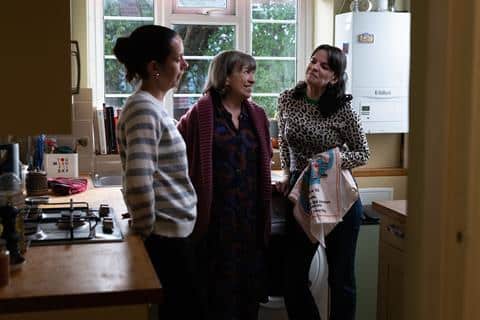
Set in contemporary west London, the film revolves around two close friends approaching 40, both employed in social services. Amy, played by Kate O’Flynn, moves in with her upbeat friend Rosie, portrayed by Alice Bailey Johnson, following the breakdown of a relationship. Meanwhile, Amy’s ageing parents, Birdie and Geoff, played by Marion Bailey and Paul Jesson, negotiate the increasingly uncomfortable realities of later life, including Geoff’s declining health.
There is no grand dramatic machinery here, no convenient revelations or neatly engineered climaxes. Leigh builds his picture through conversations, shared meals, affectionate teasing and the tiny irritations that accumulate between people who know one another almost too well. The four central characters form a loose, affectionate family unit in which friendship and kinship become almost interchangeable.
Beneath the domestic comedy, however, runs a deeper current of anxiety. Amy struggles to be honest with her parents about her romantic disappointments, while Geoff’s physical frailty brings the prospect of loss into even the most carefree exchanges. Rosie and Amy’s professional lives expose them to vulnerable older people, troubled families and the limitations of the care system.
Leigh is particularly alert to the contrast between the loving support available within this small circle and the precarious lives of those they encounter at work. Compassion is not an abstract virtue but something practised daily, often imperfectly, through patience, attention and simply turning up when needed.
The performances are beautifully judged. O’Flynn gives Amy a breezy, joking exterior that occasionally falters to reveal disappointment and vulnerability. Bailey Johnson brings warmth and determination to Rosie, whose professional empathy contrasts with the frustrations of everyday life. Marion Bailey and Paul Jesson are especially touching as Birdie and Geoff, an older couple whose enduring affection has a quiet, lived-in credibility. Their scenes possess the tenderness of a relationship that has survived the years without losing its capacity for amusement.
Indeed, some of the film’s most affecting moments are also its funniest. Leigh has always understood that embarrassment, affection and absurdity frequently occupy the same room. A private joke, an awkward confession or an impromptu singalong can reveal more about a relationship than pages of explanatory dialogue. Here, such moments feel wonderfully unforced, as though the camera has stumbled upon something it was never meant to witness.
Visually, Tender Loving Care remains recognisably Leigh territory. Lucy Bristow, taking over from the late Dick Pope, Leigh’s longtime cinematographic collaborator, favours close observation and carefully composed interiors. Faces become landscapes of experience; pauses and glances carry as much weight as dialogue. The measured rhythms and tableau-like compositions occasionally suggest a filmed play, but the camera’s intimate attention to small changes in expression gives the material a distinctively cinematic life. Gary Yershon’s restrained score adds a reflective undertow without insisting on emotions the actors are already communicating.
Is this a departure, then, or simply business as usual? In many respects, it is quintessential Leigh: meticulously observed social rituals, apparently inconsequential conversations that gradually expose deeper truths, affection for flawed individuals and the conviction that people are rarely as simple as they first appear. Those expecting the combustible confrontations of Secrets & Lies or the unrelenting domestic tension of Hard Truths may find the film comparatively subdued.
But subdued does not mean slight. There is a noticeable softening of the gaze, a greater willingness to let tenderness rather than confrontation dictate the emotional temperature. Even the melancholy is tempered by humour, companionship and the possibility of small consolations. If Hard Truths examined the damage people inflict upon one another, Tender Loving Care asks what sustains them when life becomes difficult.
The result feels both entirely characteristic and subtly different: less a summation of Leigh’s career than a distillation of its deepest concerns. His fascination with ordinary people remains undiminished, but their vulnerability seems to matter more here than their capacity to wound. In an age of cinematic bombast, his faith in the dramatic potential of a conversation over supper feels almost radical.
If this really is Leigh’s farewell, he leaves us with a simple, resonant thought: our lives are measured not merely by what we achieve, but by the care we offer and receive along the way. Tender Loving Care may lack the explosive force of his most celebrated films, but it possesses something equally precious — a generous, bittersweet humanity that lingers long after the final close-up.
GOLDEN SHELL AWARD | San Sebastián Film Festival