
Dir: Maurice Tourneur
Maurice Tourneur’s elegant wartime Maigret Mystery occupies a fascinating place in French cinema. Adapted from a novel by Georges Simenon and featuring the famous detective Inspector Maigret, the film was directed by Maurice Tourneur during the final months of the German Occupation of France.
While it is not generally regarded as one of Tourneur senior’s masterpieces, it remains an engrossing example of his craftsmanship and visual sophistication, demonstrating why he was considered one of the great stylists of early cinema.
Maurice Tourneur was already a veteran filmmaker by the time he directed Cécile Is Dead!. Born in Paris in 1876, he initially worked as an illustrator and stage designer before entering the theatre and eventually moving into the infant film industry. His career took him from France to the United States, where during the silent era he became one of Hollywood’s most respected directors, celebrated for visually rich films such as The Blue Bird and The Last of the Mohicans. Unlike many silent-era filmmakers whose careers collapsed with the arrival of sound, Tourneur successfully adapted, returning to France in the 1920s and continuing to work steadily through the following decades. By the 1940s he was an elder statesman of French cinema, bringing a lifetime of technical experience to projects such as Cécile Is Dead!.
The film was produced by Continental Films, the German-controlled studio operating in occupied France. Shot in early 1944 and released just three months before the Allied landings in Normandy, it was among the last major productions to emerge from that controversial company. Despite the circumstances of its production, the film avoids overt politics and instead concentrates on a densely plotted detective story.
The story begins with the timid and awkward Cécile Pardon, who repeatedly visits police headquarters seeking help. She insists that someone has been entering the apartment she shares with her elderly aunt, Madame Boynet. Inspector Maigret dismisses her fears as the imaginings of a nervous woman. His indifference soon becomes a source of regret when Madame Boynet is murdered and Cécile herself turns up dead inside police headquarters. Realising that he has overlooked a genuine cry for help, Maigret throws himself into solving a mystery involving hidden identities, family secrets and multiple murders. As the investigation progresses from Paris to the Atlantic coast, the detective gradually untangles a complicated web of motives and deceptions.
At the heart of the film is Albert Préjean’s Inspector Maigret. Préjean does not play the detective as the imposing, pipe-smoking giant familiar from later interpretations. Instead, he offers a more agile and energetic version of the character, combining authority with flashes of humour and impatience. His performance gives the film momentum and credibility, especially as Maigret’s initial scepticism turns into personal determination. Contemporary and later commentators have generally regarded Préjean as a convincing Maigret, bringing both presence and personality to the role.
Santa Relli makes a strong impression as Cécile despite having comparatively limited screen time. She effectively conveys the character’s vulnerability and social awkwardness, making her tragic fate more affecting. Germaine Kerjean, as Madame Boynet, contributes a sharp-edged portrayal of the difficult aunt whose death launches the investigation. Among the supporting players, André Gabriello provides welcome comic relief as the detective Lucas, helping to lighten a story that could otherwise become excessively sombre. The ensemble as a whole performs with brisk efficiency, reflecting the film’s emphasis on plot and movement.
Where the film truly distinguishes itself is in its visual design. Tourneur and cinematographer Pierre Montazel elevate what is essentially a conventional detective narrative through careful composition and camera movement. Deep-focus photography gives the interiors unusual depth, while the apartment building’s staircases and corridors create an atmosphere of confinement and unease. Long, deliberate tracking shots and slow pans glide through rooms, connecting characters and spaces with remarkable elegance.
At times the visual sophistication exceeds the demands of the script, suggesting a master filmmaker applying his full arsenal of techniques to relatively modest material. The black-and-white cinematography creates a distinctly noir-like mood, even though the film predates the classic French policiers of the post-war period.
Box-office wise, on its original release, Cécile Is Dead! appears to have been received as a solid and faithful adaptation of Simenon’s novel rather than as a landmark work. It was appreciated for its intricate mystery and dependable performances, though it never achieved the critical stature of Tourneur’s greatest silent films or some of the more celebrated French productions of the Occupation era. Later assessments have tended to be respectful rather than enthusiastic. Critics often praise the atmosphere, cinematography and staging while acknowledging that the plot is sometimes overly convoluted and strains credibility in its final revelations. Yet even detractors usually concede that Tourneur’s direction gives the film a polish and visual intelligence that keep it engaging throughout.
Viewed today, Cécile Is Dead! is less valuable as a definitive Maigret adaptation than as a showcase for Maurice Tourneur’s enduring artistry. It reveals an experienced director applying the lessons of a remarkable international career to a compact crime drama produced under difficult wartime conditions. The mystery may occasionally tie itself in knots, but the film’s atmosphere, elegant camera work and assured performances ensure that it remains an intriguing and rewarding rediscovery from the final chapter of Occupation-era French cinema.
NOW ON BLURAY
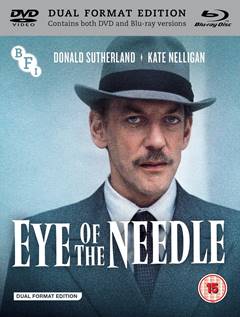 Dir: Richard Marquand | Cast: Donald Sutherland, Kate Nelligan, Christopher Cazenove, | Action Drama | UK |