


Dir: Alexis Alexiou | Drama 2026
Alexis Alexiou’s Sea of Glass arrives in Edinburgh with a noir-ready premise: a woman escapes a suffocating marriage, retreats to a deserted Greek seaside resort, and meets a younger woman trapped in a more overtly violent family prison. What begins as escape becomes an uneasy alliance against domestic violence, provincial conformity, and male authority.
Vangelio, 65, has spent years confined to her home, caring for her bedridden husband and estranged from her sons. His death brings abrupt, disorienting freedom. She travels to Evia in March, when the resort feels abandoned. There she meets 23-year-old Vicky, who runs the family fish tavern while enduring an alcoholic father. When Vangelio intervenes in an episode of violence against her, their lives become dangerously entangled.
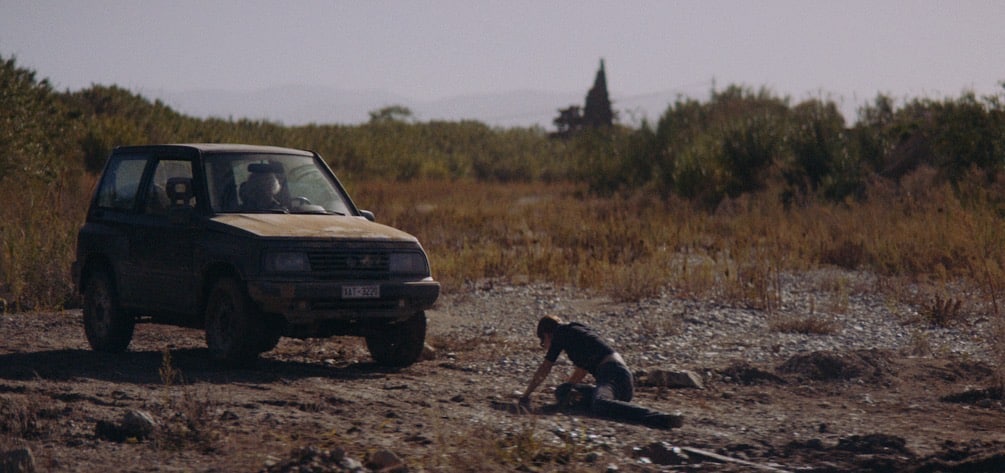
Alexiou is less interested in social realism than in turning the Greek landscape into a country-noir psychological space. The film is framed as a hybrid of rural gothic, road movie and neo-noir, with Thelma & Louise and The Postman Always Rings Twice as reference points. Its key idea is a road movie where movement feels impossible: characters are surrounded by roads, sea and open horizons, yet remain psychologically trapped.
That tension becomes the film’s central metaphor. The seaside resort — usually a site of escape — is stripped of function. In March, with shuttered businesses and empty beaches, the Mediterranean idyll becomes an excavation site for buried lives.
Visually, this may be where Sea of Glass is strongest. Cinematographer Simos Sarketzis (Little England, Behind the Haystacks) renders Evia not as postcard Greece but as a bruised, elemental terrain. Sea, marshes and weathered buildings take on a Gothic weight, externalising the women’s confinement. The landscape becomes emotional architecture.
The title is telling: glass suggests clarity and fragility, but also reflection and enclosure. A “sea of glass” is still and beautiful on the surface, yet conceals depth and danger — an apt image for Alexiou’s provincial world.
Narratively, the film favours accumulation over exposition. Vangelio and Vicky are not simply victims; their relationship becomes the means through which each recognises her own imprisonment. The generational contrast is key: Vangelio has adapted to decades of containment, while Vicky still half-imagines escape but cannot act on it. Their bond is less partnership than collision of survival strategies.
The risk is clear: the film may carry more symbolic weight than its story can support. Domestic violence, patriarchy, economic decay, generational entrapment and female solidarity converge within a noir framework of violence and retaliation. The question is whether Alexiou keeps his characters contradictory, or turns them into carriers of a thesis.
The reported 130-minute runtime may prove decisive. (EIFF) Alexiou’s Wednesday 04:45 showed control of atmosphere and genre tension, and Sea of Glass extends that approach into a rural setting. But slow-burn structure cuts both ways: if emotional development deepens, the length may feel immersive; if not, its emptiness risks inertia.
Still, the premise resists a simple “women fight back” reading. Escape is not freedom. Vangelio carries the architecture of her former imprisonment; Vicky remains rooted in a home she cannot leave. They occupy opposite ends of the same trap.
Ultimately, the film hinges on a simple question: can it sustain its ideas without over-explaining them? Its noir references, stormy coastline, off-season setting and domestic violence all suggest a clear design — and a risk that symbolism outruns emotion.
Alexiou’s genre instincts may prevent that. His work tends to filter psychology through thriller form rather than overt commentary. If that holds, the politics may emerge through atmosphere and behaviour.
If Evangelia Adreadaki and newcomer Christiana Matelska Toka carry the emotional weight, and if Sarketzis’s Evian landscapes remain integral rather than decorative, Sea of Glass could emerge as one of EIFF’s more compelling entries: a Greek feminist noir in which the sea offers no easy passage to freedom.
PREMIERE 18 SEPTEMBER 2026