
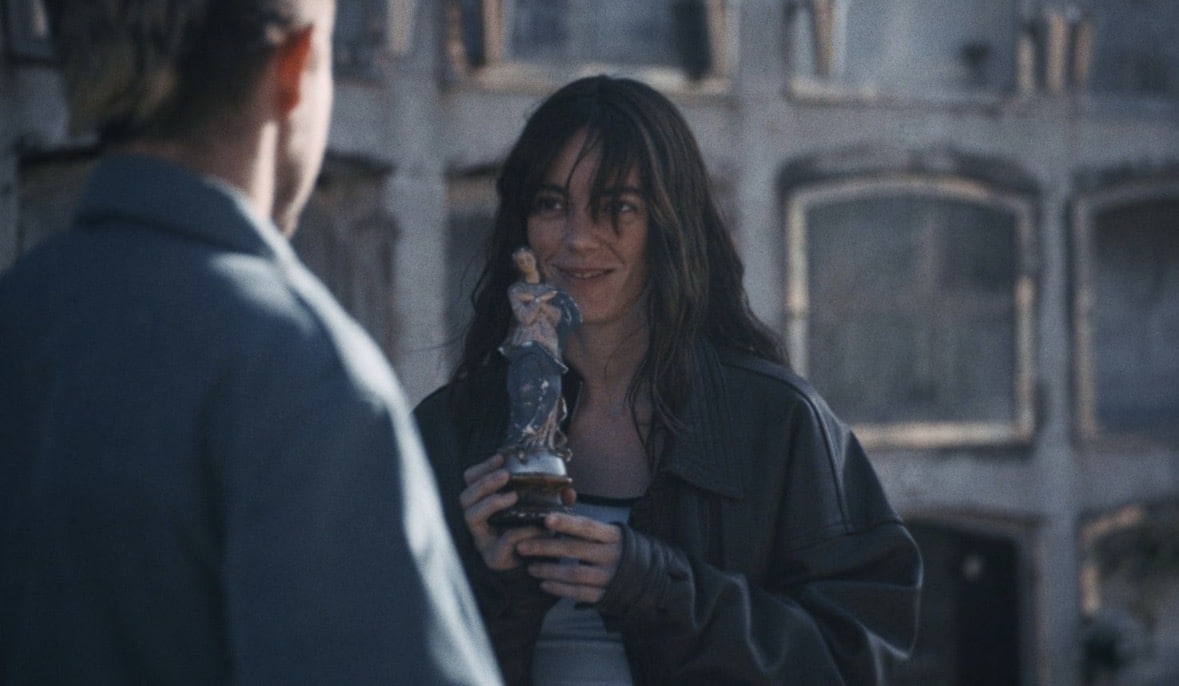

Dir: Milkel Gurrea | Drama 2026
Spanish cinema has come on in leaps and bounds recently and this thriller from Mikel Gurrea is another strong contender, starring Vittoria Luenga who we recently met in Rodrigo Saragoyen’s Cannes competition entry The Beloved
There’s a rough, grainy, almost tactile quality about the world of Saints – Saints. From its scuzzy opening images, the film seems to rub up against its characters rather than simply observe them. Restless images and an insistent taste for extreme close-ups give the drama a claustrophobic physicality, as though the camera itself is struggling to find breathing space.
At the centre, as Lali, Victoria Luengo exudes an edgy mixture of vulnerability and barely contained aggression. Her life is being squeezed from two directions: her mother is approaching death, while Lali has become involved with a gang stealing religious statues from churches and cemeteries. Gurrea makes the two strands feel less like separate plotlines than different manifestations of the same unease — mortality, guilt, money and the desperate need to escape an existence that seems to be closing in.
The religious imagery could easily have tipped the film into something overly symbolic, but Saints is most effective when it stays grubby and immediate. The stolen saints are not presented as lofty objects of faith but as physical commodities: heavy, awkward, sometimes grotesque presences that have to be handled, transported and hidden. There is a pleasingly illicit quality to the whole enterprise.
Gurrea’s camera rarely allows us the comfort of distance. Faces fill the frame; bodies are cropped; gestures and fragments of expression become almost more important than conventional establishing shots. The grainy texture reinforces that intimacy, giving the images a slightly battered, analogue feel. At times it is as though we are watching Lali’s world through a layer of dust and anxiety. The effect is particularly potent around her mother: death is not romanticised but made horribly physical, something occupying the same cramped domestic spaces as everything else.
The result is a drama that keeps shifting between the intimate and the unsettling. Gurrea has an instinct for finding tension in apparently mundane physical details — a room, a body, an object being moved — and his close-up style turns these details into sources of menace. Even the religious figures acquire an uncanny life of their own.
What gives Saints its bite, though, is Luengo. She makes Lali difficult to pin down: frightened but reckless, emotionally bruised but capable of sudden hardness. The film refuses to turn her into either victim or antihero. Instead, she seems to be improvising her way through grief, financial pressure and moral compromise, making increasingly dangerous choices because the alternatives appear even worse.
There are moments when Gurrea pushes the visual intensity a little too hard, and the deliberately rough surface can feel mannered. Yet the conviction behind the style is unmistakable. Saints is not a polished psychological drama but something dirtier and more tactile — a film in which grief, crime and religious imagery collide at very close range.
At this year’s San Sebastián, it announces Gurrea as a filmmaker interested less in explaining his characters than in getting under their skin. The film’s grain, its intrusive close-ups and its physical sense of space become more than stylistic flourishes: they are the means by which Sants makes a woman’s increasingly constricted world almost palpably uncomfortable.
SAN SEBASTIAN FILM FESTIVAL 2026