
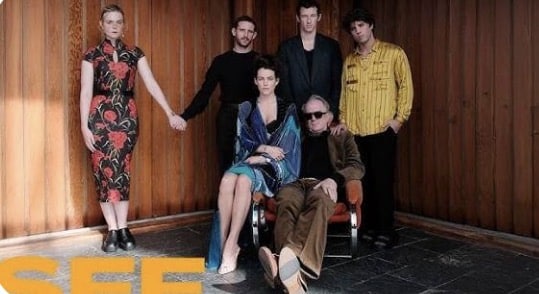

Dir: Karim Aïnouz | Drama 97’
Rosebush Pruning arrives wrapped in the promise of elegant provocation: an ensemble drama that dissects privilege, emotional inheritance and the brittle architecture of family life. Loosely orbiting a wealthy clan gathered at an isolated estate, the film gradually peels back layers of repression, exposing long-buried resentments and desires with a mix of deadpan humour and psychological unease. The title itself becomes an apt metaphor—pruning away the ornamental surface to reveal something far thornier beneath.
Aïnouz orchestrates the ensemble with characteristic confidence. The performances are uniformly committed, with each actor navigating the film’s shifting tonal register between biting satire and bruising emotional confession. Rather than encouraging grand theatrical outbursts, the director favours restraint, allowing awkward silences, uncertain glances and carefully measured dialogue to carry the emotional weight. The result is a cast that feels genuinely interconnected, their shared history communicated as much through body language as words.
Visually, the film is immaculate. The camera glides through pristine interiors and meticulously ordered gardens whose geometric perfection quietly mocks the emotional disorder simmering underneath. The production design leans into muted luxury, while natural light lends the country house an inviting warmth that increasingly feels claustrophobic as tensions escalate. Aïnouz and his cinematographer repeatedly frame characters through windows, mirrors and doorways, reinforcing themes of surveillance, performance and emotional entrapment.
Narratively, however, Rosebush Pruning proves more elusive than revelatory. Rather than building towards conventional dramatic peaks, the film unfolds in a series of conversational encounters and emotional excavations that accumulate atmosphere more readily than momentum. The screenplay delights in ambiguity, often withholding motivations or allowing scenes to dissolve before reaching satisfying conclusions. Admirers will see this as an invitation to participate; sceptics may find it an exercise in deliberate opacity.
The film’s greatest strength—its refusal to simplify complicated relationships—is also its principal weakness. Characters frequently speak in elliptical fragments that hint at profound histories without always earning their emotional impact. Several intriguing narrative threads are introduced only to drift away unresolved, creating the impression that the screenplay is more interested in posing questions than pursuing answers. By the final act, the accumulation of unresolved tensions risks feeling less like sophisticated ambiguity than narrative hesitation.
Tonally, Aïnouz walks an increasingly precarious line between absurdist comedy and chamber drama. At its best, the collision produces moments of delicious discomfort, exposing the rituals of wealth and civility as elaborate performances masking profound loneliness. At other times, the shifts can feel abrupt, leaving individual scenes searching for an emotional register before moving on to the next encounter.
Yet even when it falters, Rosebush Pruning remains a fascinating work. Its intelligence lies less in plot mechanics than in observation: the subtle humiliations embedded within family rituals, the corrosive effects of inherited privilege and the impossibility of completely escaping the roles assigned by blood and class. Aïnouz demonstrates once again that he is a filmmaker deeply attuned to emotional landscapes, even if this particular journey occasionally loses its way within them.
The result is a polished, intellectually ambitious ensemble piece whose visual sophistication and finely calibrated performances compensate for a screenplay that sometimes mistakes ambiguity for depth. It is likely to divide audiences, but it possesses enough style, confidence and thematic richness to ensure the conversation continues long after the final frame.
NOW IN UK CINEMAS