

Dir. Lance Hammer. UK/USA. 2026. Cast: Tom Courtenay, Juliette Binoche, Anna Calder-Martin, Florence Hunt | 121′
Directing with an impressive grasp of contemporary London and its political and social zeitgeist, American filmmaker Lance Hammer describes his dementia drama Queen at Sea as a reference to a monarchy in a complete mess – its social structures no longer serving its people.
Looking at the film from a straightforward angle, there are questionable elements that I found disturbing: a university professor renting in social housing while owning a second home (depriving those in need); a daughter adrift in her own marriage questioning and disrupting the sex life of her mother and step-father (of eighteen years) her motives were questionable but there was no backstory offered; already stretched police and social services having time to visit a couple and arrest the husband for having intercourse with his wife (with dementia) who has not raised any kind of complaint to her daughter, or anyone else, for that matter. An intrusive and unwanted medical examination proves everything is normal for Leslie. That is the state of the UK today. A nation ‘at sea’.
Michael Haneke tackled dementia back in 2012 in his award-winning drama Amour (2012). It had Jean-Louis Trintignant lovingly taking care of his wife (Emmanuelle Riva) with Alzheimer’s. The focus was on the deep and exclusive feelings they shared for one another. Vortex (2021) also portrayed the disease in a similar vein.
Enduring love is never questioned in any of these films, but here Lance Hammer addresses the stage in dementia where love and dedication is simply not enough: the time when those closest are no longer capable of looking after of a loved one who needs complex care.. So where do you draw the line? It’s not easy, and he tackles why in this unflinching and unsentimental second feature.
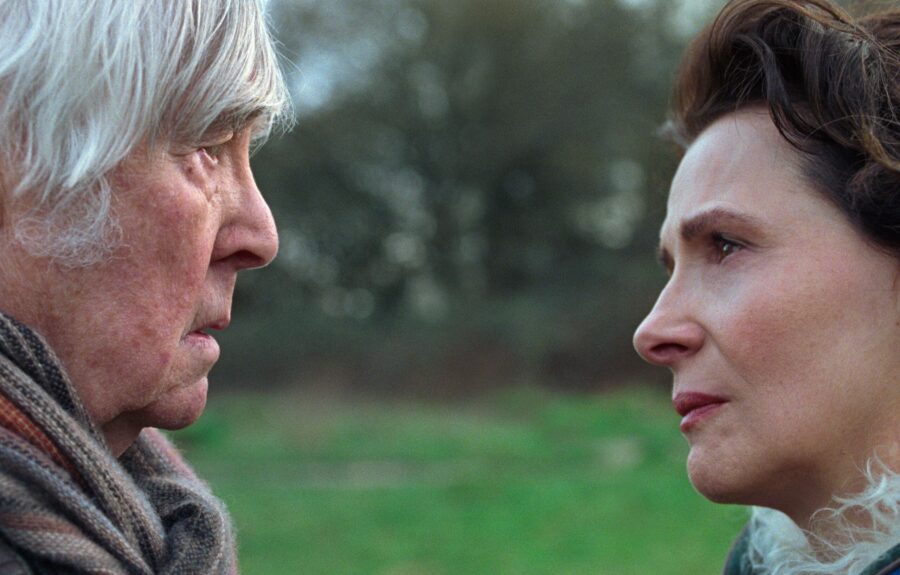
Struggling with a teenage daughter, a marriage breakdown and a mother with dementia, Juliette Binoche’s Amanda is at the centre of a maelstrom only too recognisable for viewers affected. Martin, her father in law, is capably looking after his wife Leslie, and we watch them enjoying a companionable day to day routine with their pills and love of classical music that brought them together. Martin has already been told he must avoid sex with his wife as, apparently, she is no longer able to express consent. There are differences of opinion and Martin claims to know his wife best, but their GP has other ideas.
Amanda, who has taken time out from her life in Newcastle, plans to move Leslie into a care home. She finds Martin and Leslie ‘in flagrante’ one day and, berating him, calls the police. Being French, Amanda is seemingly unaware of the consequences of unleashing the powers of the UK police and social services who launch a full-scale investigation, she is horrified.
Martin is completely crushed. His arrest means leaving his home, and Leslie (Calder Maxwell). Amanda moves in with her mother, suddenly realising her own life and that of her daughter Sara (Hunt) will be affected. Meanwhile Sara is playfully larking about on the internet and discovering sex for the first time with James (Molko), a friend from school. She speaks her mind and criticises Martin openly (the way young kids do nowadays), having already shared pictures of her grandparents in bed together with all and sundry. We all know where this going.
Tom Courtenay, as Martin, gives a stunning and complex performance that conveys the grief and confusion of an ageing husband who is still capable but will soon lose control as his wife’s disease inevitably progresses. And that’s the cruel and intractable truth of dementia. Everyone is affected.
A brilliant cast work-shopped with all the relevant social services to create authenticity in their flowing performances, and despite differences of opinion, there are no heated arguments. In the press conference, Anna Calder-Maxwell revealed that she studied the illness in care homes and is herself married to a sufferer.
There are twists and turns in this compulsive social realist ‘horror’ story that pictures the stark reality, and there are graphic scenes. No one could avoid being deeply disturbed by Martin’s reaction when he visits Leslie’s care home, and the negligence here is another story, and one that deserves another film. Dementia is a disease that now affects 1 in 5 people above 65. This is an important film that needs to be seen, but not on a date night.
Winner | Best Supporting Actors – Anna Calder-Marshall and Tom Courtney BERLINALE 2026 | COMPETITION 2026