

Reviewed by Peter Herbert
Dir: Marco Berger | Cast: German Flood, Juan Ramos | Drama, Argentina 2026
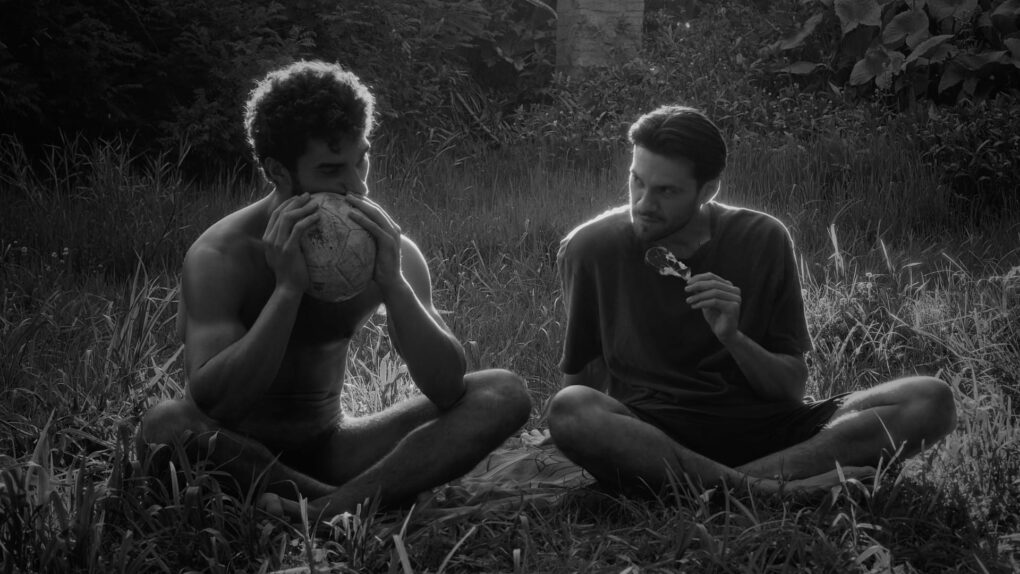
Perro Perro begins with the sounds of nature and a collage of exotic flowers filmed with luscious widescreen monochrome camerawork. Two men in a canoe paddle down a river and a woman shoos away what appears to be an old naked man foraging around a woodland house. The scene is set for a holiday away from the city by two couples.
Perro Perro is based on Marco Berger’s experience of writing a script while on holiday when he was befriended by a stray dog. The script reimagined his major theme of male infatuation for another through replacing the male object as a man playing a beautiful dog. Although the phrase ‘parallel universe’ is widely used there is no other way to describe this film’s charming double layer. As with the way Francois Ozon reflects on the state of mind in The Stranger, Berger also provides a masterly use of monochrome with Perro Perro reflecting an imagined world without the colours of everyday reality.
Berger avoids what could easily have slipped into sentimental whimsy through well-developed skills with actors, assured dialogue and the careful framing of scenes. The two central performances are remarkable, with German Flood as the master Juan from whom the craving for food by the young stray dog Max will be more than compensated.
Juan Ramos plays Max, the handsome young dog entirely nude throughout the film, with all of the graceful physical hallmarks of mimed silent cinema. Communication between both actors is through eye contact expressing a range of feelings including anxiety. Physical detail includes finely observed movement of muscles of the eyebrow and stroking of the dog’s head, with Ramos providing a tour de force at the film’s centre as unique as the film itself.
Although the film is gorgeous to look at and feels both light and gentle, there are deeper undertones made more subtle by Berger’s ability to keep these undercover. His themes of love, loyalty, sexuality and companionship are hinted at until some will gradually surface. The fleeting nature of a summer relationship bringing temptations to stray from routines of life contains remarkable scenes of deeply-felt melancholic tenderness.
The film has the feel of the surrealist Mexican master Luis Bunuel, although probing moral questions are entirely consistent with Berger’s previous films. These include a delicate horny comedy of sexual manners in The Astronaut Lovers which was already a move away from vague and inconclusive studies of the obsessive male gaze in Taekwondo and Horseplay.
Perro Perro opens up new territory for Berger and is assured, professionally at ease filmmaking given the difficult current arts funding structure of Argentina. It has the elements to succeed with distribution not adverse to risk-taking involving one of Latin America’s key gay filmmakers.
The 2026 BFI FLARE LGBTQIA+ Film Festival