

Dir: Jannis Lenz. Germany/Austria. 2026. 94 mins.
With his striking feature debut Oasis, director Jannis Lenz positions himself as a sharp-eyed chronicler of modern societal anxiety.
Premiering in Venice’s Orizzonti section, this German-Austrian co-production takes a premise that could easily have devolved into a formulaic Hollywood thriller and instead refines it into something far more subtle, nuanced, and deeply disquieting.
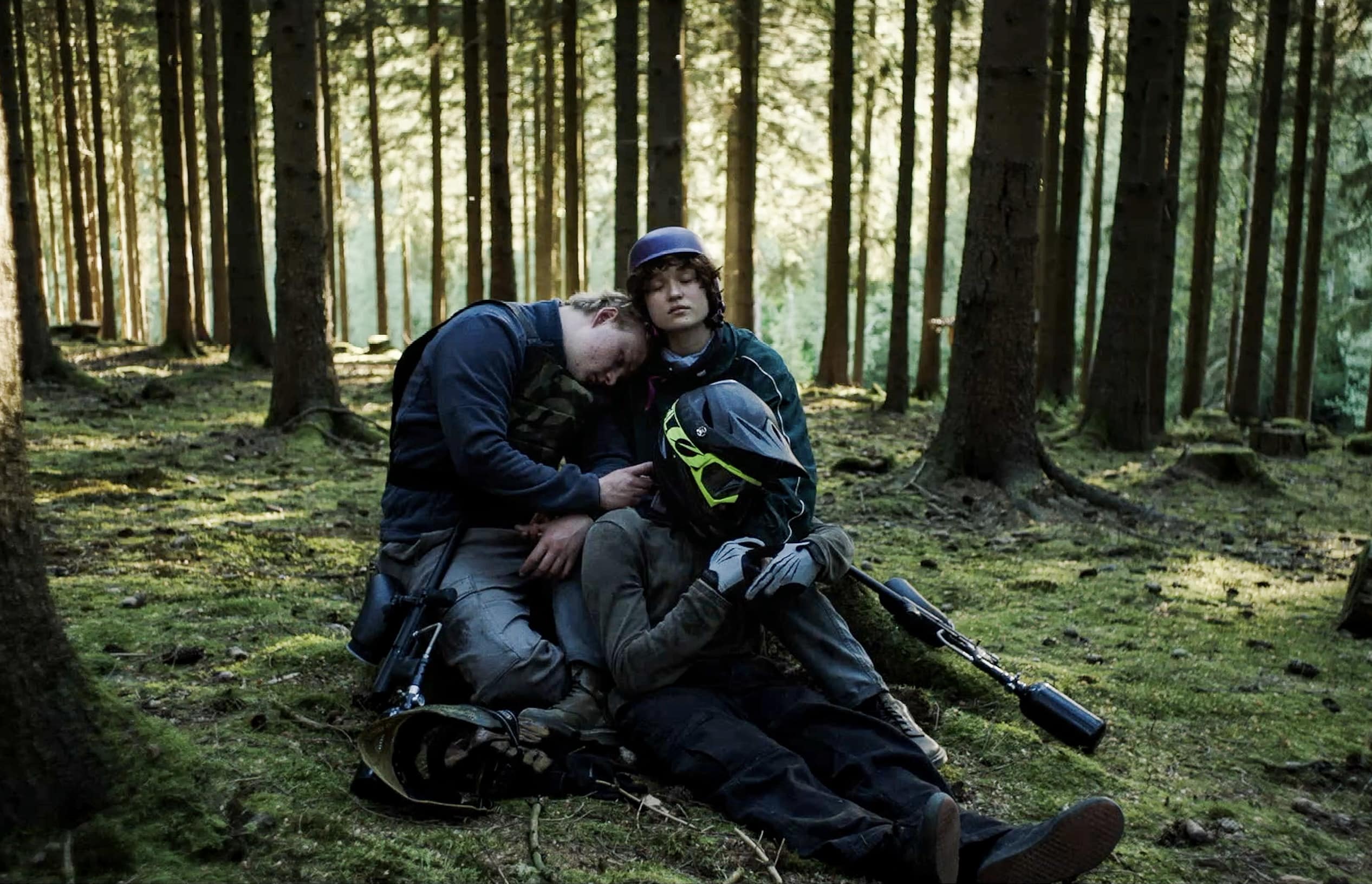
The catalyst is a single, viral event: a troubled student posts a vague but terrifying threat online, instantly throwing a high school into a state of collective hysteria. But rather than following the immediate fallout within the school walls, Lenz trains his camera on three teenage outcasts who choose to flee. Retreating into a dense, nearby forest, they attempt to build a sanctuary—an oasis—shielded from the suffocating pressure of reactionary parents, bureaucratic school officials, and an increasingly hostile peer group.
Lenz, who co-wrote the screenplay, demonstrates a remarkable refusal to indulge in cliché. Anyone expecting a straightforward, predictable origin story of a school shooter will find themselves challenged by the film’s deliberate ambiguity. Oasisunderstands that toxicity in the digital age does not always explode in a single moment; instead, Lenz shows how hostility spreads through a community like a slow-moving virus.
What begins as an idyllic, almost feral escape for the three protagonists gradually curdles. As the external pressure mounts, the sanctuary of the woods begins to mirror the claustrophobia of the outside world. The film is at its most challenging when exploring the psychological coping mechanisms of its subjects. Physical pain becomes a disturbing currency for the trio—a tangible outlet for an internal anguish they lack the vocabulary to express.
The young cast delivers exceptionally raw, naturalistic performances, anchored by Lenz’s patient direction. Crucially, the film refuses to paint its characters with a broad brush. There are no easy villains here. Lenz treats the teenagers with immense empathy, but he is equally fair to the terrified, overreaching adults, whose demands for absolute security drive the exclusion of the vulnerable.
The cinematography contrasts the harsh, sterile, fluorescent-lit interiors of the school with the moody, organic, yet increasingly ominous textures of the forest. The sound design is equally meticulous, substituting cheap jump-scares for a low-frequency hum of ambient dread that perfectly matches the characters’ internal state.
Oasis is a demanding watch, but an entirely rewarding one. It marks Lenz as a vital new voice in European cinema, capable of examining the darkest corners of adolescent alienation with absolute precision and profound human intelligence.
VENICE FILM FESTIVAL 2026