
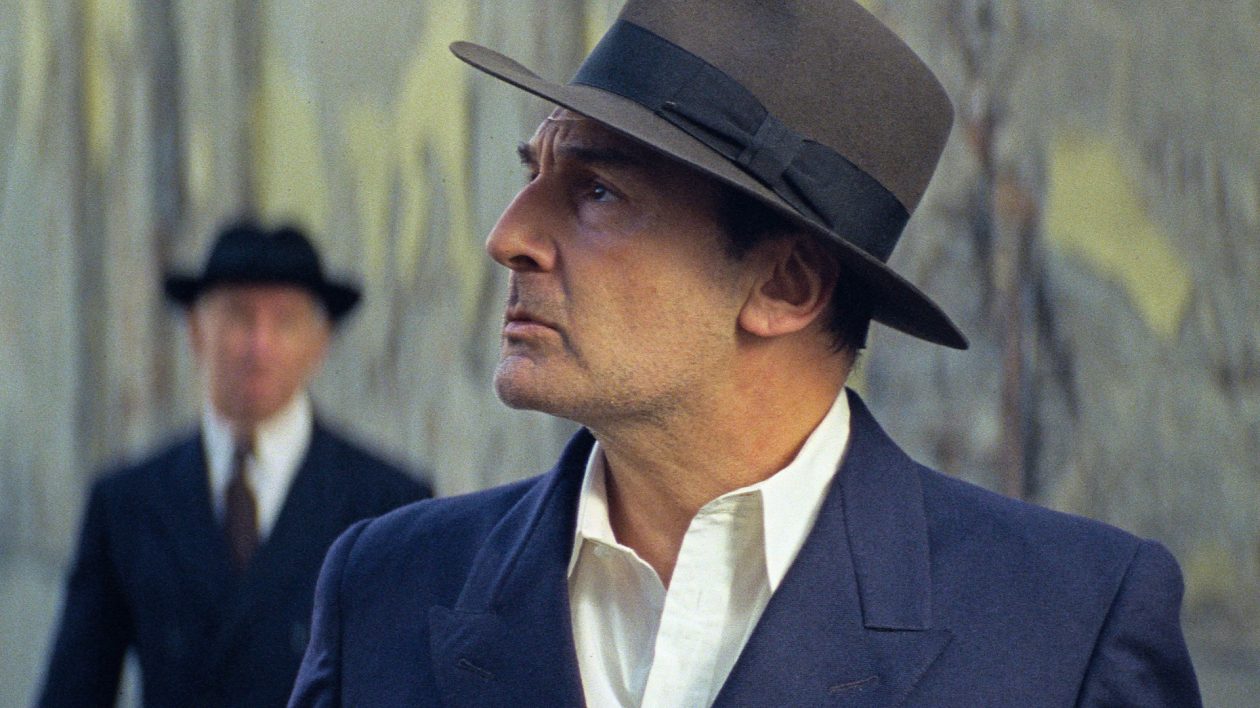

Dir: László Nemes | Hungary Historical drama 2026
At the Cannes Film Festival, a film about the French Resistance was always going create buzz on the Croisette. Competing for the Palme d’Or László Nemes’ Moulin world premiered as a film that was already a classic.
Stories circulated before the first screening about the sheer physical weight of the production: the film, shot entirely on 35mm and processed through an elaborate silver-retention bleach-bypass method, was reportedly too heavy to be transported by air and had to be driven to the festival by vehicle. In an age of frictionless digital delivery, Nemes had delivered not merely a movie but a material artefact — dense, metallic, stubbornly analogue. That tactile severity defines the film itself.
More than a decade after Son of Saul transformed Holocaust cinema through radical proximity and sensory imprisonment, the Hungarian director once again turns his gaze to the Second World War with a film equally obsessed with confinement, moral endurance, and the mechanics of evil. But where Son of Saul took place inside the infernal machinery of Auschwitz, Moulin explores occupied France and the final days of Resistance hero Jean Moulin.
The historical context is inseparable from the film’s tension. By June 1943, France was reduced to fragments: divided between collaboration, occupation, and clandestine resistance networks that often mistrusted one another as much as the enemy.
Moulin — dispatched by Charles de Gaulle to unify the fractured Resistance movements — had become one of the most important covert figures in Europe. Nemes begins not with triumph but with paranoia. Messages are coded. Names are false. Every café conversation feels contaminated by betrayal.
Gilles Lellouche plays Moulin with remarkable restraint. Rather than constructing the Resistance leader as a monument of patriotism, he gives him the exhausted vigilance of a man who knows history is closing in around him. Lellouche’s square, weathered face becomes the film’s moral landscape: bruised, guarded, nearly unreadable and slightly vulnerable. Nemes keeps the camera close to his main character, often trapping him within narrow corridors, smoke-filled rooms, and interrogation chambers where even silence acquires physical weight.
Opposite him, Lars Eidinger delivers one of the festival’s most unnerving performances as Klaus Barbie, the Gestapo chief later known as “The Butcher of Lyon.” Gone is his weird hairdo from Visitation. His Barbie is sneering, theatrical, occasionally almost charming — which only deepens the horror.
Violence in Moulin is not presented as spectacle but as procedure. Interrogations become rituals of psychological dismantling. Torture happens in basements and behind doors, yet Nemes understands that what remains unseen can be more terrifying than explicit display. There are times when you really don’t want to look at what’s happening to these poor people: The screams echo through corridors, it’s pitiful and heart-wrenching to hear.
Moulin is spectacular to look at, and meticulously crafted. Nemes’ regular Cinematographer Mátyás Erdély captures occupied France in bruised metallic tones created through the bleach-bypass process, in which silver is retained in the film print rather than removed during development. The result is an image drained of conventional warmth yet shimmering with ghostly density. Blacks become cavernous; skin appears almost carved from ash and steel. Candlelight flickers against surfaces that seem permanently stained by war.
The aesthetic is not nostalgic. Nemes does not use 35mm as retro fetishism or cinephile decoration. The format gives the film grain, instability, and physical tension. Every frame feels chemically scarred. Nemes had a reason for preserving the silver in the print itself: Moulin is a film about memory under pressure, about history physically embedded into matter.
The supporting cast contributes to the sensation of a world closing in. Louise Bourgoin brings a mournful elegance to the Comtesse de Forez, while Félix Lefebvre and Christian Harting bring to life the frightened machinery of clandestine resistance and Nazi bureaucracy respectively. Yet the film increasingly narrows into a duel between Lellouche and Eidinger — resistance versus annihilation, silence versus confession.
What makes Moulin so unsettling at Cannes is not merely its historical subject but its contemporary resonance. Across Europe, where nationalism and authoritarian rhetoric have returned with alarming familiarity, Nemes presents fascism not as distant nightmare but as administrative logic. Men in offices. Papers exchanged. Civility masking barbarism.
The director has always been fascinated by the limits of representation — how cinema can confront atrocity without aestheticising it. Here, he walks that line with severe discipline. At times Moulin risks suffocation under its own formal rigour, but even its excesses feel purposeful. Nemes wants the audience to feel cornered. He transforms Moulin into a tragic hero, subjected to fear, exhaustion and pain but indomitable to last, even when he’s half-dead, transported back by train to Germany, against doctor’s orders, for further interrogation.
Moulin is not a comfortable return for László Nemes. The betrayed hero of the French Resistance was remembered thus by Andre Malraux: “Today, youth of France, think of this man as you would have reached out your hands to his poor battered face on its last day, to the lips that had not spoken: on that day it was the face of France”. This Palme d’Or hopeful is a harsh, deeply physical work, a film that seems developed not only in chemicals and silver but in dread itself.
CANNES FILM FESTIVAL 2026 | IN COMPETITION