


Dir: Sebastian Brameshuber | Austria, 120’, 2026, fiction, world premiere,
A 72-year-old Bobby offers a listening ear to his hitchhikers between Vienna and Salzburg in this Berlinale world premiere. An outwardly innocuous feature it grows increasingly more compulsive towards the end.
Vienna, where his journey starts, is well known as the birthplace of Freud, the 19th psychiatrist who practised on his patients in lugubrious apartments in Berggasse. It seems appropriate, therefore, that this discursive film unfolds in the Austrian capital, shuttling to Salzburg and back where Autumn is just showing its burnished tones in the surrounding countryside.
Sebastian Brameshuber’s latest film lies somewhere between drama and document offering a picture of modern Europe through the eyes of a series of strangers in their twenties and thirties. And the guise of a stranger allows for a unique form of soul-bearing; each can be candid about their lives. Bobby, a loner, clearly enjoys the company of strangers, these conversations enliven the drive, which he undertakes once or twice a week, to visit a friend in hospital. At first he remains tight-lipped but later he will become more voluble, with a quiet urgency to relate his past. Sometimes offering words of wisdom to what he considers ‘the younger generation’.
A soldier shares his thoughts about doing national service; a girl opens her heart about her sister; a dark-haired man offers practical information about running a small delicatessen; an Albanian talks about the recent conflict and the films he enjoys. describing Avatar as a ‘Marxist masterpiece’. His views turn out to be quite controversial but the driver listens patiently without judgement.
Fortified by coffee and strudel in a motorway cafe, Bobby gets a chance to stretch his legs. Some of the in-car conversions are difficult to decipher in the clever way the film is edited, this only adds zest to a narrative which is both informative but strangely unsettling as it gets to grips with Bobby himself. There are snatches of conversation that appear incomprehensible because the subject is cleverly not revealed. A Romanian girl wants a lift to petrol station, to meet her friend. With no German or English, a strange sign language takes over between driver and passenger. Then the first snow arrives and Bobby helps a stranded acquaintance who has broken down.
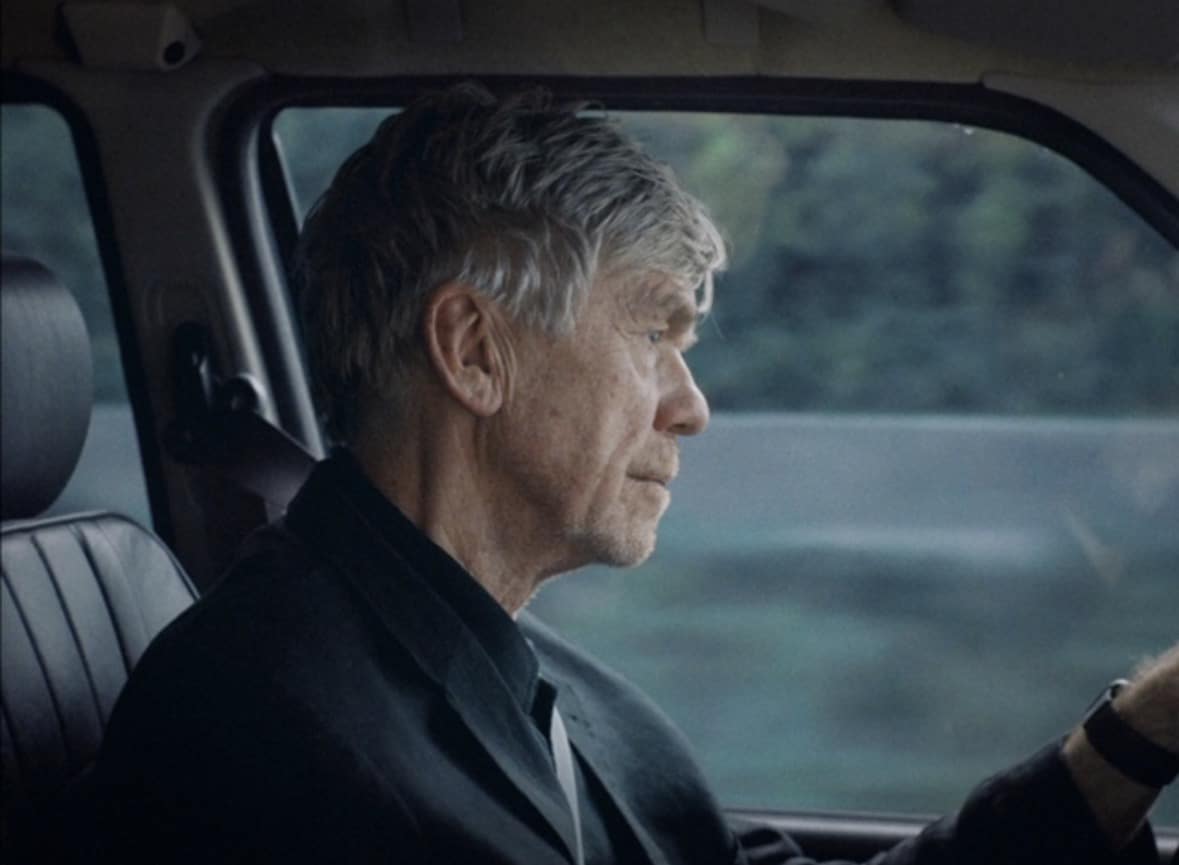
Gradually Bobby opens up about his own life and disappointments, and a foggy turn in the weather reflects this mournful change in tone to more sombre territory. The camera mostly remains fixed from the passenger’s perspective, focusing on the driver’s expression. Describing an incident where, just after the war, Bobby wore his hair long, he recalls his father’s shame at his appearance, considered him a failure. It was a time where Vienna was still like a village, everyone knowing each other. It still feels like a village; an intimate atmosphere full of dark secrets, yet proud and majestic.
Other conversations are painful, as speaker/listener roles are often reversed. Bobby verges on tears, particularly with one woman passenger, as he shares insights that surprise even himself, from the psychiatrist’s couch. A conversational exchange has worked both ways, the driver is now discovering himself, through the eyes of a stranger. Despite his lifelong desire for independence and privacy Bobby finds out that no man is an island – not least himself. An intelligent and absorbing film with a thrilling sting in its tail. But why London?
BERLINALE 2026 | 12 – 22 February 2026