


Dir| Marine Atlan | France Drama 2036
La Gradiva turns a school trip to Naples and the ruins of Pompeii into an evocative coming-of-age drama, where the turbulence of adolescence finds an unlikely mirror in a civilisation abruptly extinguished by Vesuvius. Against the heat and history of southern Italy, a group of teenagers negotiate the equally volatile territories of desire, sexuality, friendship and self-discovery. It is an ambitious, visually distinctive debut which looks to the past to illuminate the uncertainties of the present.
Atlan, an accomplished cinematographer making an impressive transition behind the camera, approaches her young protagonists with an observational intimacy that frequently blurs the distinction between fiction and documentary. Her largely unfamiliar cast brings an appealing awkwardness and spontaneity to the proceedings. At the centre are three teenagers whose emotional trajectories gradually intersect: Toni, a restless boy preoccupied with his family history; his charismatic friend James, whose sexual confidence conceals its own ambiguities; and Suzanne, an intelligent but socially marginalised girl whose acute powers of observation are matched by a fragile sense of self-worth. Around them, their Latin teacher Madame Mercier attempts to impose some intellectual order on a group increasingly absorbed by its own dramas.
The cultural significance of the title is central to understanding the film’s ambitions. La Gradiva refers to Wilhelm Jensen’s 1903 novella, in which an archaeologist becomes obsessed with the image of a woman depicted on an ancient Pompeian relief. Freud subsequently seized upon the story as a fascinating case study in desire, fantasy, repression and the projection of unconscious longing. It also became an important reference point for the Surrealists. Atlan takes this intellectual inheritance and transposes it into a contemporary coming-of-age story in which the past is never quite past, and where the act of looking becomes inseparable from the business of imagining.
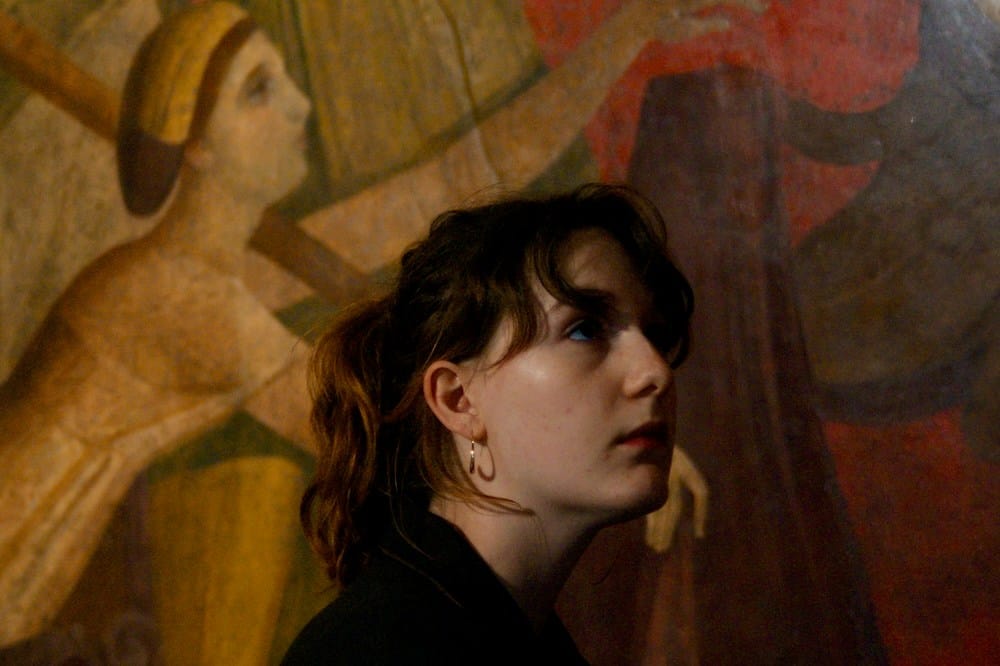
Pompeii is therefore much more than an exotic backdrop. Its frescoes, archaeological remains and plaster casts of bodies preserved by volcanic ash provide a compelling counterpoint to the young people’s own physical and emotional awakening. There is a particularly productive tension between the classical idealisation of the human body and the messy, uncertain realities of teenage sexuality. The teacher’s attempts to communicate the eroticism, complexity and social meaning of ancient art are set against students who are themselves struggling to understand their bodies and relationships. The irony is that they are surrounded by extraordinary examples of human history but are largely incapable of looking beyond the immediate intensity of their own lives.
Visually, Atlan demonstrates considerable confidence. Working alongside cinematographer Pierre Mazoyer, she favours a loose, mobile camera, natural light and a deliberately grainy texture that gives the images a tactile, almost remembered quality. Southern Italy is captured in warm, languorous tones, with the movement of sunlight, the restless energy of Naples and the monumental stillness of Pompeii creating an intriguing visual counterpoint. There is no conventional postcard treatment of the location. Instead, the landscape seems to absorb the characters, its ancient history lending an almost mythological dimension to their comparatively small but overwhelming personal crises.
The visual strategy is not without its indulgences. The occasional dreamlike excursions and emphasis on atmosphere can feel a little too consciously poetic, while the 145-minute running time tests the patience of viewers less inclined to surrender to its unhurried rhythms. Yet the film’s formal ambition is also its greatest asset. Atlan understands that adolescence is rarely experienced as a neat succession of dramatic turning points. It is a condition of heightened awareness, of watching, waiting, misreading signals and attaching enormous significance to seemingly inconsequential encounters.
Emotionally, La Gradiva is at its most persuasive when it resists the temptation to manufacture sympathy. These are not particularly lovable teenagers, nor does Atlan attempt to sanitise their behaviour. Their conversations, flirtations, casual cruelties and shifting allegiances have the uncomfortable authenticity of a social environment in which status and desirability are constantly being negotiated. Toni’s emotional confusion and his complicated relationship with James are especially affecting because the film understands the humiliations of unrequited desire without turning them into melodrama. Suzanne’s position as both observer and outsider is equally revealing. Her gradual movement towards a more independent sense of herself is less a conventional triumph than a recognition that growing up frequently involves disappointment and disillusionment.
There is also something quietly significant in the film’s treatment of contemporary queer adolescence. Desire is presented as fluid, sometimes liberating but equally capable of exposing vulnerability and emotional dependence. Atlan is interested less in identity as a fixed category than in the awkward process of discovering what one wants, and what happens when those desires are not reciprocated.
Does it all ring true? For the most part, emphatically so. The young performers have an instinctive naturalism, and Atlan has an unusually sensitive ear for the conversational rhythms, posturing and casual nastiness of teenage social life. Occasionally, the film’s intellectual scaffolding threatens to overwhelm its human material, with the Freudian and classical references making the symbolism rather more explicit than necessary. But the underlying emotional observations are convincing. The intensity of first attraction, the cruelty of exclusion and the almost unbearable importance attached to friendship at that age are all recognisable without being reduced to nostalgia.
Ultimately, La Gradiva is about the instability of memory and the myths we construct to make sense of ourselves. Its teenagers arrive in Italy expecting to discover something about the past, only to find that their own assumptions, fantasies and carefully maintained self-images are destined to be challenged. Like Pompeii’s inhabitants, they are caught at a moment of sudden transformation, although their emotional eruptions are considerably less spectacular and perhaps more enduring.
A thoughtful, sensuous and occasionally overextended film, Atlan’s debut announces a distinctive new talent. Its greatest achievement is to recognise that the passage from adolescence to adulthood is itself an archaeological undertaking: a process of excavation in which buried desires, disappointments and illusions are unearthed, but never entirely laid to rest.
NOMINATED FOR LES LUMIÈRES FILM AWARDS 2026