
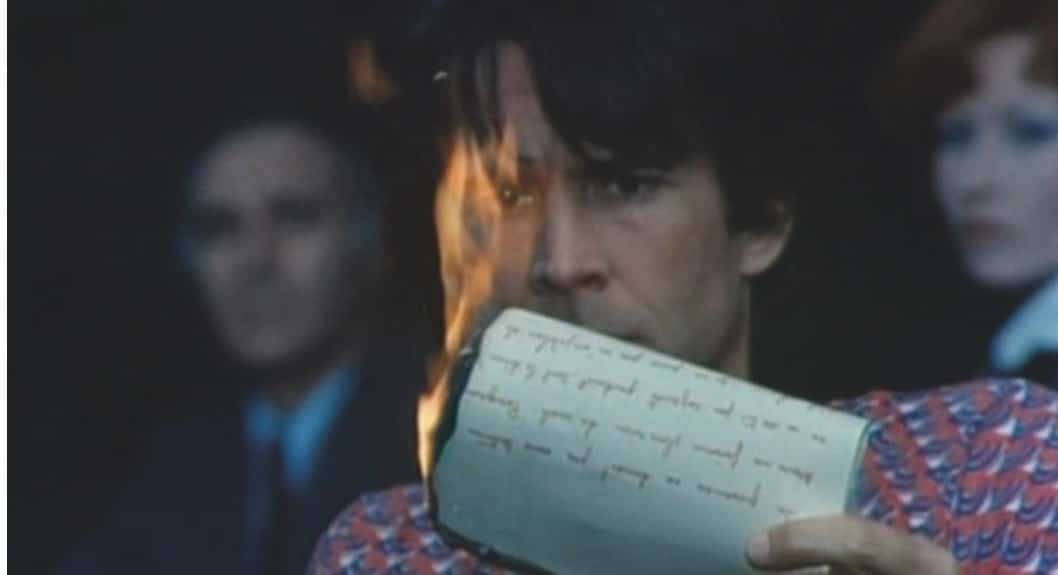

Dir: Claude Chabrol | Thriller | France, 1971 · 110’ | Cast: Michel Piccoli, Anthony Perkins, Orson Welles
Claude Chabrol’s Ten Days’ Wonder is one of those films in which respectability gradually reveals itself as a particularly elaborate form of madness. Adapted from Ellery Queen’s novel, it finds Chabrol in richly perverse territory: a closed world of wealth, privilege and family loyalty in which desire and repression are so tightly intertwined that murder begins to seem almost inevitable.
At the centre is Charles, a troubled young man plagued by blackouts and disturbing visions, who turns to his friend Paul for help in discovering what happens during the periods he cannot remember. But Chabrol is less interested in the mechanics of the mystery than in the poisonous emotional structure underneath it. The investigation becomes a descent into a family governed by an authoritarian patriarch whose appetites have corrupted everyone around him.
Michel Piccoli gives the film its unsettling centre of gravity, while Anthony Perkins is perfectly cast as a son trapped between dependence, resentment and submission. Then there is Orson Welles, whose immense physical and dramatic presence turns the patriarch into something almost mythological. His authority feels less like ordinary parental power than an ancient curse, and Chabrol increasingly makes the family resemble a modern Greek tragedy disguised as a murder mystery.
The director’s cool, precise style is particularly effective here. Violence and revelation are rarely treated simply as sensational events; instead, they emerge from an atmosphere of suffocating privilege. Beautiful houses, expensive clothes and cultivated manners only make the underlying brutality more disturbing. Beneath the polished surfaces lies a world where women are objectified, sexuality becomes another instrument of power, and male entitlement is allowed to pass for destiny.
There is something gloriously unhinged about Ten Days’ Wonder. Its twists can seem deliberately excessive, its psychology feverish and its melodrama almost operatic. Yet that excess is precisely what makes the film so compelling. Chabrol takes the conventions of the crime thriller and stretches them until they become a study of obsession, inheritance and patriarchal control.
Made in 1971, the film belongs to a particularly fertile period in Chabrol’s career, when his fascination with bourgeois corruption was becoming increasingly dark and psychologically elaborate. As in so much of his cinema, respectable society is not a refuge from violence but the environment in which violence is carefully concealed and allowed to flourish.
The result is an elegant, strange and thoroughly poisonous thriller: a film where the mystery ultimately matters less than the revelation of why everyone is so desperate to preserve the illusion that nothing is wrong.
AT THE BFI from SEPTEMBER 10, 2026