

Dir: Alexandre Smia | France, Political thriller 2026
The Button Nobody Wants to Press
Alexandre Smia’s Jupiter imprisons us in the most terrifying room in France: the subterranean command centre beneath the Élysée, where a handful of people have minutes to decide whether the world should continue to exist. A sleek, claustrophobic political thriller, Smia’s feature debut turns nuclear deterrence into chamber drama — and then steadily tightens the screws.
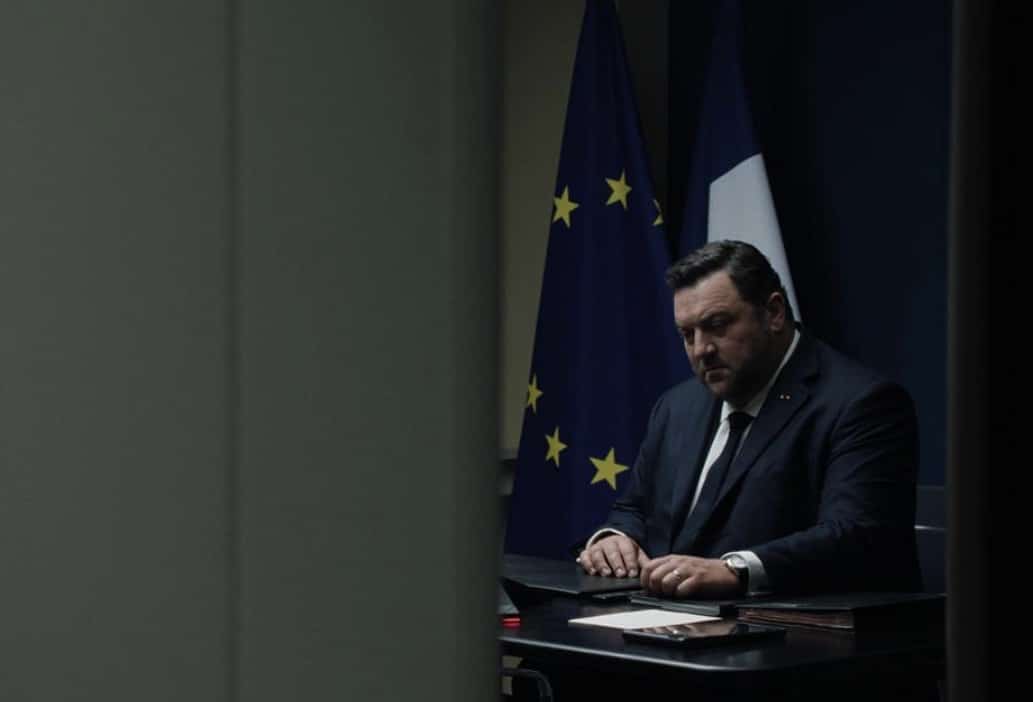
The premise of this curiously dry and uninvolving thriller is brutally simple. Newly elected French president Paul Archambault (Denis Ménochet) is barely into his presidency when an assassination attempt on the Russian president detonates an international crisis. Moscow blames Ukraine and issues a nuclear ultimatum threatening a French ally. Archambault retreats underground with his military and political advisers to the secret Poste de Commandement Jupiter, the presidential nuclear command bunker. As the possibility of escalation becomes horrifyingly real, the new president faces the impossible choice: retaliate, negotiate, wait — or risk catastrophe.
What makes Jupiter potentially more unnerving than the conventional end-of-the-world thriller is Smia’s refusal to make apocalypse spectacular. The drama is concentrated almost entirely on human beings staring at screens, listening to fragments of intelligence and trying to calculate consequences that no calculation can contain. Smia has described Jupiter as a “mythological” place where the French president makes his gravest decisions in absolute secrecy, and his ambition is less disaster movie than an autopsy of power.
The casting is formidable. Denis Ménochet gives Archambault the physical presence of a man who suddenly discovers that authority and certainty are very different things. Around him, André Dussollier, Reda Kateb, Dominique Blanc, Ella Rumpf, Frédéric Pierrot, Céline Sallette, Cédric Kahn and Jérémy Lopez create the political and military ecosystem in which every pause, disagreement and glance carries potentially lethal weight. The wider ensemble includes Clotilde Courau, Pascal Greggory and Valeriu Andriuta, among others.
The visual strategy is crucial. Cinematographer Nicolas Loir and production designer Jean-Philippe Moreaux make the bunker feel less like a futuristic Bond lair than an oppressive piece of functioning state machinery. Screens, corridors, sealed rooms and hard architectural surfaces create a world in which technology is everywhere but genuine knowledge is scarce. The camera has the unenviable task of making people sitting around a table feel as dangerous as missiles in flight — and the confined geography becomes its own ticking clock.
There is an appealingly French intelligence to the setup: Jupiter is interested not simply in whether nuclear war happens, but in the bureaucratic, psychological and moral machinery that might make it happen. The thriller derives its voltage from protocol colliding with instinct. Every military euphemism conceals a terrifying reality; every apparently rational option contains an irrational risk.
And the title becomes increasingly sinister. Jupiter is not merely a location. It becomes a metaphor for the extraordinary concentration of power inside one underground room — a tiny human space from which consequences radiate outward across continents.
Smia arrives with considerable genre credentials: he previously worked as a screenwriter on The Bureau and 13 Days, 13 Nights, before making the short The Last Night and co-creating the series A French Case. Jupiter is his feature directorial debut.
At 87 minutes, the film promises to be lean rather than sprawling, with Olivier Marguerit supplying the score and Pierre Deschamps editing. That economy could be one of its greatest strengths: no geopolitical lecture, no unnecessary globe-trotting, just the terrible intimacy of people deciding the fate of millions while sealed underground.
The danger, of course, is that a film about people talking in a bunker can become exactly that — people talking in a bunker – and that’s the downfall. But Smia’s premise offers something potent: a thriller about the unbearable gap between the appearance of control and the reality of uncertainty.
Jupiter looks set to make nuclear annihilation feel frighteningly mundane. No mushroom cloud required. Sometimes the most terrifying image is simply a room full of intelligent people, a telephone ringing, and somebody having to answer it.
VENICE FILM FESTIVAL 2026