


Dir: David Bickerstaff | Art Documentary 2026
There is a deceptively simple idea at the heart of Phil Grabsky and David Bickerstaff’s long-running Exhibition on Screen series: if audiences can’t get to the great museums, bring the museums to them.
But these films have become more ambitious than filmed gallery tours and this latest outing is amongst the best – a hugely enjoyable foray into the artist’s life and career enriched with history and social commentary, it’s certainly worth watching again and again.
Not so long ago, Bickerstaff and Grabsky came up with the brilliant idea to turn an exhibition into a cinematic biography, using paintings as clues to the artist’s personality, obsessions and place in history. James McNeill Whistler, made alongside Tate Britain’s first major Whistler retrospective in three decades, is very much in that tradition — an attempt not merely to display the pictures but to remind us why this particular American artist in London matters.
And Whistler is certainly a character worth rediscovering. Although born in Massachusetts in 1834, he felt deeply connected to the Deep South, he was raised partly in Russia and eventually seduced by Paris before making London his artistic home.
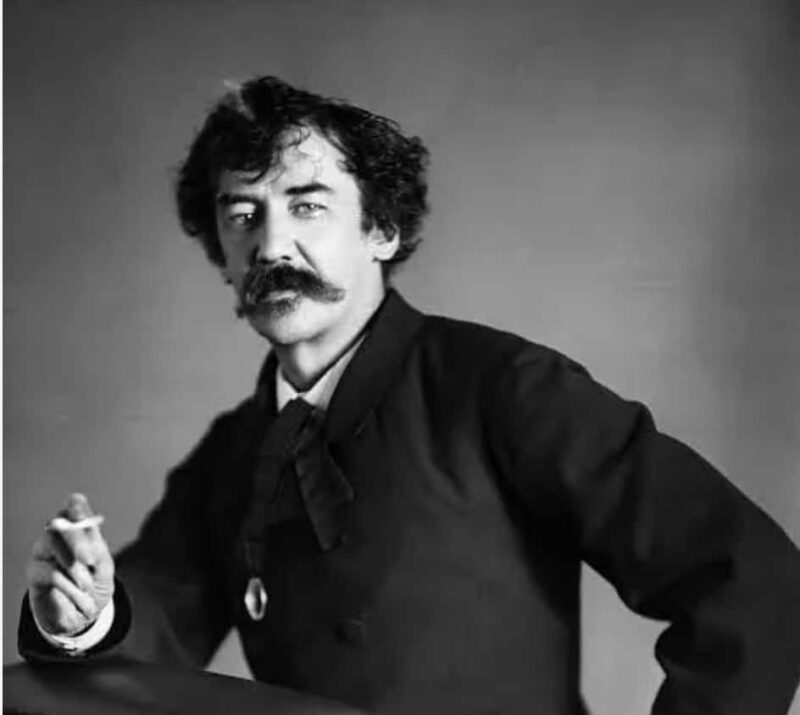
James McNeill Whistler was simultaneously an outsider and one of the great self-publicists of 19th-century art. He was provocative, vain, funny, combative and possessed of an almost pathological determination to control his own mythology. He treated his life as another work of art — complete with theatrical poses, elaborate titles, lawsuits, enemies and a cultivated persona that could be as carefully composed as one of his paintings.
Director/cinematographer David Bickerstaff astutely understands that this is not just incidental colour. Whistler’s personality is inseparable from his art. He wanted painting liberated from the tyranny of narrative and anecdote. His titles — Arrangements, Harmonies, Nocturnes — deliberately suggested music rather than literature, insisting that colour, tone and atmosphere could be sufficient unto themselves. His radical notion of “art for art’s sake” challenged the moralising Victorian assumption that a painting ought to tell you something edifying about the human condition. And that makes Whistler a surprisingly modern figure. He understood image, reputation and controversy as part of the same cultural currency. He was admired by Manet and, later, Van Gogh; yet his real achievement was perhaps even broader. He helped loosen painting from convention and opened the door to a new emphasis on sensation, surface, mood and artistic autonomy.
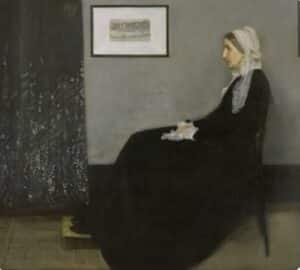
The film is at its most persuasive when it lets the paintings make that argument themselves. Arrangement in Grey and Black No. 1 — forever and rather reductively known as Whistler’s Mother — is so familiar that it has almost ceased to be looked at. Bickerstaff restores some of its strangeness: the severe geometry, the restricted palette, the extraordinary attention to tonal balance, the delicate brushstrokes. The joke is that one of the most famous pictures of motherhood in the world was never really intended as a sentimental portrait of motherhood at all.
The nocturnes are even more revealing. The mist-shrouded Thames paintings, apparently dissolving before our eyes, demonstrate Whistler’s extraordinary ability to turn industrial London into something almost abstract: smoke, water, light and darkness becoming musical rather than descriptive. The film makes a strong case for seeing these works not as pretty atmospheric pictures but as genuinely radical experiments in what painting could be.
There is inevitably a good deal of biography, and occasionally the film follows the familiar documentary formula a little too obediently — talking heads, gallery interiors, contextual explanation, masterpiece, repeat. But Whistler’s story has enough drama to survive the machinery. His spectacular feud with the critic John Ruskin, his determination to turn the artist into a celebrity and his capacity for simultaneously charming and infuriating almost everyone around him provide Bickerstaff with a ready-made narrative.
And among the contributors, art critic and writer Rachel Campbell-Johnston is easily the best. With her soothing voice and elegant delivery she brings something the more dutiful art-historical commentary sometimes lacks: an instinct for the human detail that makes a painting suddenly come alive. She is articulate without sounding rehearsed and, crucially, she looks at Whistler’s pictures rather than simply explaining them. Her discussion of Whistler’s Mother is particularly good, restoring the painting’s physical and emotional oddness beneath its familiarity. The film could happily have given her more room.
That is perhaps the slight frustration of James McNeill Whistler. There is so much in the artist — the wit, the ego, the feuds, the fashion, the Japanese influence, the London underworld of artists and models, the relationship between painting and music — that ninety minutes can only sketch the territory.
Yet that sketch is often wonderfully vivid. Bickerstaff films the works with the intimacy that cinema can provide: details become visible which might disappear in the gallery, while the larger compositions acquire a scale and presence that a reproduction rarely conveys.
The result is not quite a substitute for Tate Britain — nor should it be. It is something more useful: an invitation to look again. Whistler emerges not as the man who painted the world’s most famous mother, but as the restless, difficult, brilliantly self-invented provocateur behind her.
For an artist who spent his life insisting that art should make its own rules, that feels like an appropriately Whistlerian achievement.
IN UK CINEMAS from 15 September 2026 | Exhibition on Screen