

Dir: Danny Boyle | UK Political satire 2026
— Venice Film Festival review: the birth of the tabloid beast
There are films that tell us about history, and there are films that make us realise we are still living inside it. Danny Boyle’s Ink belongs firmly to the second category.
Opening the 83rd Venice Film Festival with a drama about Rupert Murdoch’s acquisition of The Sun in 1969 is a characteristically provocative choice. But Boyle and screenwriter James Graham have made something considerably more interesting than a conventional Murdoch biopic. Ink is really about the moment journalism discovered the intoxicating power of giving an audience exactly what it wanted. And what an exhilarating, uncomfortable ride it is.
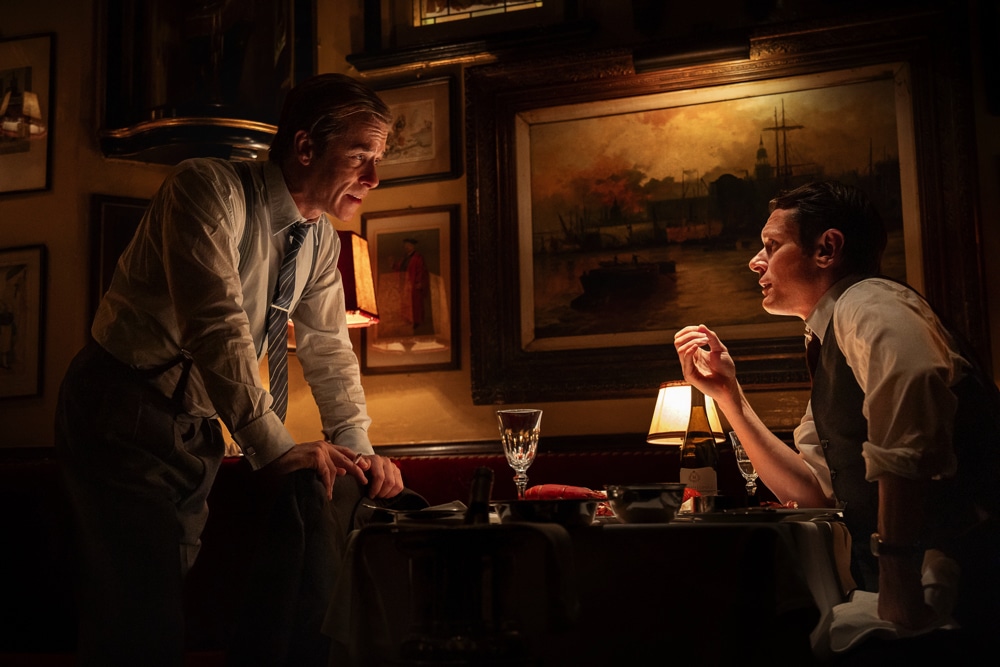
Guy Pearce plays Murdoch not as the pantomime villain one might expect, but as something considerably more unsettling: an intelligent, restless businessman who seems to understand before everyone else that the newspaper industry is about to change. Pearce gives him charm without making him particularly likeable, and ambition without reducing him to greed. There is always the sense that Murdoch is three moves ahead of everyone around him.
But it is Jack O’Connell as Larry Lamb who gives the film its beating heart. Lamb is the true outsider here — aggressive, funny, instinctive and utterly convinced that the old rules of Fleet Street are there to be broken. O’Connell throws himself into the part with the physical energy Boyle demands, making Lamb alternately magnetic and appalling.
The great achievement of Ink is that it doesn’t spend its time telling us that these men were bad. It shows us why they were so effective. That distinction matters. The creation of The Sun is presented almost like a revolutionary movement. Boyle turns the newsroom into a kinetic arena of noise, deadlines, instinct and competition. Pages are assembled, headlines sharpened and stories transformed into commodities. The excitement is infectious. For long stretches you can understand exactly why this new form of journalism conquered Britain.
And then comes the uncomfortable realisation: the techniques being invented here are essentially the techniques that dominate our media today. Celebrity. Outrage. Simplification. Sex. Personality. Instant reaction. The story that matters because everyone is talking about it.
What makes Ink so powerful is the distance between 1969 and now. Watching these men discover the commercial potential of outrage, you cannot help thinking about clickbait, social media and the modern attention economy. The film never needs to lecture us about the connection. It is sitting there in plain sight.
Claire Foy, meanwhile, provides a welcome counterweight to the testosterone-fuelled battle for circulation. Her presence broadens the film beyond the two men at its centre and reminds us that the transformation of journalism was never simply a game played between powerful men in a newsroom.
Boyle’s direction is energetic without being merely flashy. There is plenty of the visual and rhythmic exuberance associated with the director of Trainspotting, but here it serves a very precise purpose. The film wants us to experience the speed at which the rules are changing. It wants us to feel the seduction of the new. And that is precisely why Ink is more disturbing than a straightforward condemnation of Murdoch would have been.
Boyle has said he did not want to turn Murdoch into a villain, and that decision pays off. The film is much more interested in the culture that allowed Murdoch and Lamb to flourish than in assigning historical blame to a single man.
There are moments when the theatrical origins of the material show, and occasionally the film pushes its symbolism a little too hard. Boyle’s appetite for momentum can also make some of the quieter moral questions feel underdeveloped. But these are relatively minor reservations. What remains is a surprisingly gripping film about newspapers that becomes, almost by stealth, a film about the world we inhabit now.
The irony of watching it at Venice is hard to miss. This is a festival devoted to cinema as art, contemplation and cultural conversation. Ink arrives to remind us that another kind of entertainment — faster, louder and infinitely more commercially aggressive — was being invented at almost exactly the same moment.
In 1969, mankind landed on the moon. In a Fleet Street newsroom, something rather less noble but arguably just as consequential was taking place. The modern attention economy was being born.
Ink is exhilarating, intelligent and deeply uncomfortable. Boyle has made a film about Rupert Murdoch that is ultimately much more interesting than Rupert Murdoch himself
VENICE FILM FESTIVAL 2026