

Dir: Michiyoshi Doi | Drama, Japan 77′ 1958
Reviewed by Peter Herbert
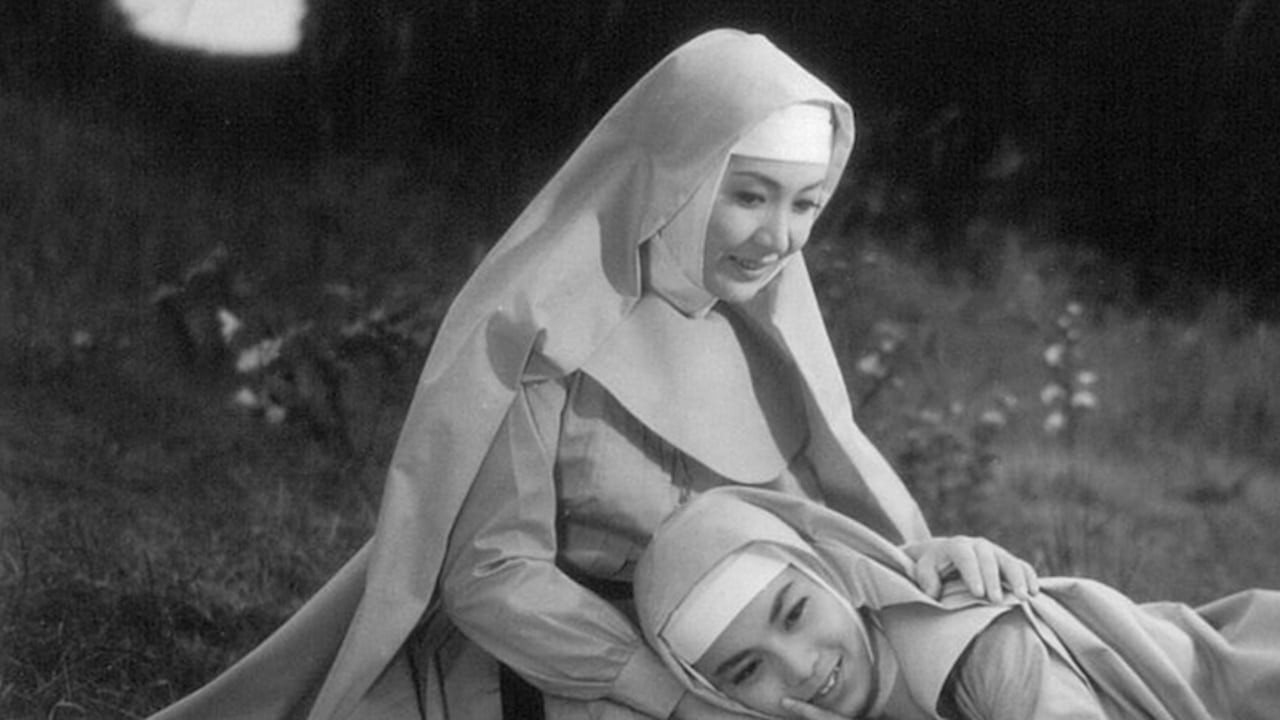
A wild tale of obsessive lesbian love built on a sensitive understanding of melodrama may have been out of step with Japanese audiences in 1958. Fortunately, Impure Nuns has now found a new audience more in tune with its gender-bending socio-sexual energy of which there is an abundance to be found in the earliest of director Michiyoshi Doi’s films.
A young woman, Eli, played by Miyuki Takakura is courted by a young man. She instead finds herself a victim of rape, with a hinted-at pregnancy posing an additional dilemma for her family. The choice, including abortion, is between leaving for the big city or entering a nunnery. Unable to make the decision herself she agrees to her father’s request and chooses the nunnery.
Years later, Eri oversees an intake of eager novice nuns. One of the girls played by Mayumi Ozora, forms an instant bond with her, bordering on pathological lust. Eri succumbs during clandestine meetings that hold few restraints. Although the relationship allows both to explore inner desires, it comes with a price.
The film’s remarkable understanding of female space and its sense of the properties of film melodrama are as sensitive as Douglas Sirk’s films made at the same time. Content is more likely to have been inspired by Leontine Sagan’s Madchen in Uniform (1931) with its secret lesbian love between teacher and pupil. It is also possible that the film’s exotic plants, tension involving nuns and vertiginous bell ringing tower are influenced by Powell and Pressburger’s Black Narcissus (1948).
Impure Nuns also anticipates the forbidden school girl crush and widescreen monochrome look of Radley Metzger’s Therese and Isabelle (1968) but is more in tune with the sensitive handling of lesbianism in John Cromwell’s women’s prison film Caged (1950). Both films view repressed desire heightened by the visual use of confined cells with bars. Plain prison clothing in Caged is echoed by religious robes although all of the sisters in Impure Nuns wear standard black high heel shoes. The clitter-clatter of shoes and robes provides fetish-like sound and visual patterns that would have made this ideal for screening in London’s Scala Cinema during the 1980s.
The troubled history of, what some consider, the first Japanese film involving lesbianism is linked to the film studio Shintoho which, by 1958, specialised in relatively low budget films and less than prestigious genres. Impure Nuns was made with the intention of marketing a sleazier type of film and was released with alternative titles including Dirty Flesh Body and Priestess with Sullied Flesh. Neither of these, including the regressive idea behind the words “Impure Nuns,” reflects the delirious progressive nature of the film Doi made. The film’s sensitive, gender-bending nature perplexed contemporary audiences and the studio went bankrupt in 1961 after releasing Nobuo Nakagawa’s notorious Hell / Jigoku. The film would only screen in sex-related Japanese cinemas and was not released worldwide, while Doi moved into more mainstream genres including his final work for television, the series Dai Chushingwa with Toshiro Mifune in 1971.
Film scholar James Cooper discovered Impure Nuns in 2025 and has championed a beautiful restoration as well as interviewing surviving actresses. The film invites further scrutiny with the film and director even eluding Alexander Jacoby’s excellent and comprehensive encyclopaedia A Critical Handbook of Japanese Film Directors (2008). This suggests that, as with every nation’s Arts culture, there are surprises to be found, enjoyed and added to our knowledge and understanding of the richness of film history.
2026 BFI FLARE LONDON LGBTQIA FILM FESTIVAL