

Dir: Sergei Loznitsa | Doc 176’
Sergei Loznitsa’s Imperium is an extraordinary 176-minute archival journey through the Soviet Union — a vast, ironic travelogue assembled entirely from footage shot between 1970 and 1973 by Italian filmmakers. There is no explanatory voiceover to tell us what to think. Instead, Loznitsa allows the images, their juxtapositions and their unsettling repetitions to expose the machinery of an empire.
It begins with something close to imperial theatre: Moscow presented in all its monumental pomp, ceremonies and carefully staged visions of Soviet power. The grandeur is almost overwhelming — until Loznitsa’s deadpan editing begins to puncture it. The official image of a confident superpower gradually gives way to another Soviet Union: exhausting, regimented and frequently grim, where human beings appear dwarfed by the systems of production, bureaucracy and ideology surrounding them.
From Moscow, Imperium spreads outward like an enormous map being unfolded. Factories thunder with relentless industrial labour; mines, construction sites and agricultural collectives demand punishing physical effort. The seasons themselves become part of the film’s structure — snow, mud, heat and harvest — giving the sense of a population endlessly working against an unforgiving landscape. What might once have been intended as celebratory documentation becomes, through Loznitsa’s selection, an almost blackly comic portrait of a society perpetually mobilised.
The irony is especially potent because nobody announces it. A smiling official ceremony can be followed by images of workers performing monotonous, gruelling tasks; a grand Soviet slogan seems to hang invisibly over a landscape of poverty and exhaustion. In his idiosyncratic style Loznitsa relies on us to recognise the contradiction. His refusal of commentary makes the satire sharper rather than softer.
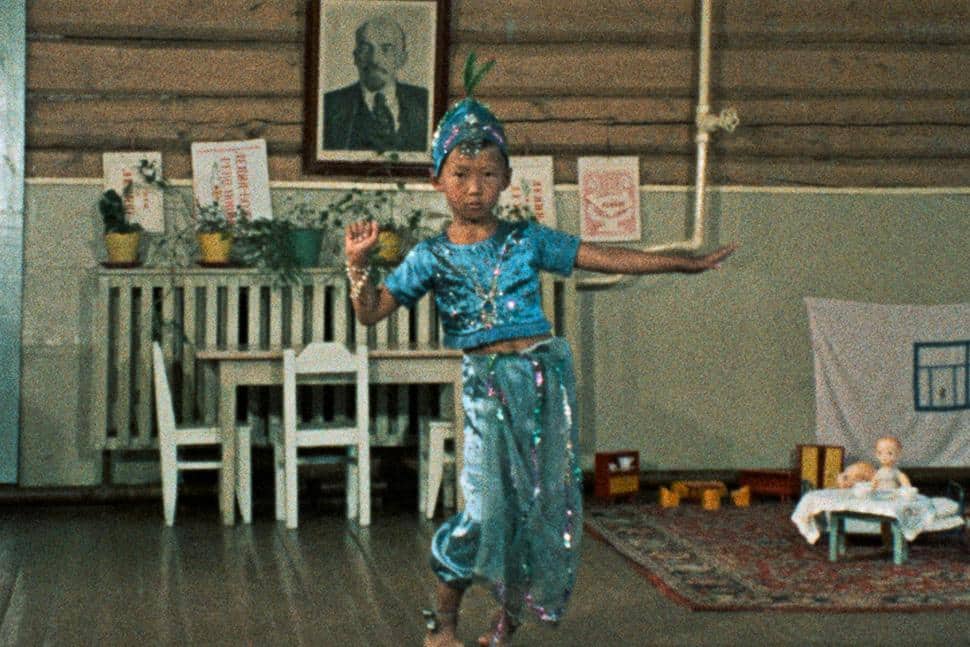
And then there is the extraordinary geographical sweep. Imperium travels through Tashkent and Central Asia, the Caucasus, Georgia and Baltic states, the Mongolian regions and remote territories, before reaching the more western republics, including Ukraine. The further the film travels from Moscow, the more its apparent unity begins to fracture. Languages, costumes, customs, architecture and ways of life reveal an extraordinary diversity beneath the Soviet idea of a single, harmonious people. The official empire may insist upon uniformity; the camera keeps finding difference.
This is where Loznitsa’s Ukrainian perspective becomes particularly resonant. Born in Belarus and raised in Ukraine, he has repeatedly used archival images to question the relationship between state power, historical memory and the individual. His characteristic strategy is to hold on images longer than conventional documentary grammar would permit, allowing crowds and individuals to reveal themselves through tiny gestures, glances and moments of apparent insignificance.
The most fascinating element of Imperium is therefore not simply what it shows, but the distance between what the original filmmakers presumably intended their images to communicate and what Loznitsa makes them communicate now. Material gathered to portray the Soviet Union becomes evidence against its own mythology. The empire is caught on film celebrating itself — and inadvertently documenting its contradictions.
There is also something hypnotic about the accumulation. At nearly three hours, the film deliberately demands patience. Yet its length becomes part of the argument: one begins to feel the sheer scale of the Soviet project, its vast distances and enormous populations, but also the repetitive nature of life within it. Work, ceremony, production, transport, agriculture, entertainment, military display: one system endlessly reproducing itself.
The result is neither conventional history lesson nor nostalgic reconstruction. It is closer to an archaeological excavation of an empire through images that have survived it. Imperium shows us the Soviet Union as it wanted to be seen — magnificent, productive, unified — while simultaneously revealing the human cost and cultural plurality that the official picture could never completely suppress.
Loznitsa’s great achievement is to make the archive itself ironic. The Soviet Union commissioned images of its own greatness; decades later, a Ukrainian filmmaker rearranges them into a portrait of imperial pomposity, endurance and absurdity. The further Imperium travels, the harder it becomes to believe in the seamless Soviet world that Moscow wanted to project.
A monumental film about a monumental lie — and a remarkably vivid journey through the people and places that existed beneath it.
VENICE FILM FESTIVAL 2026