
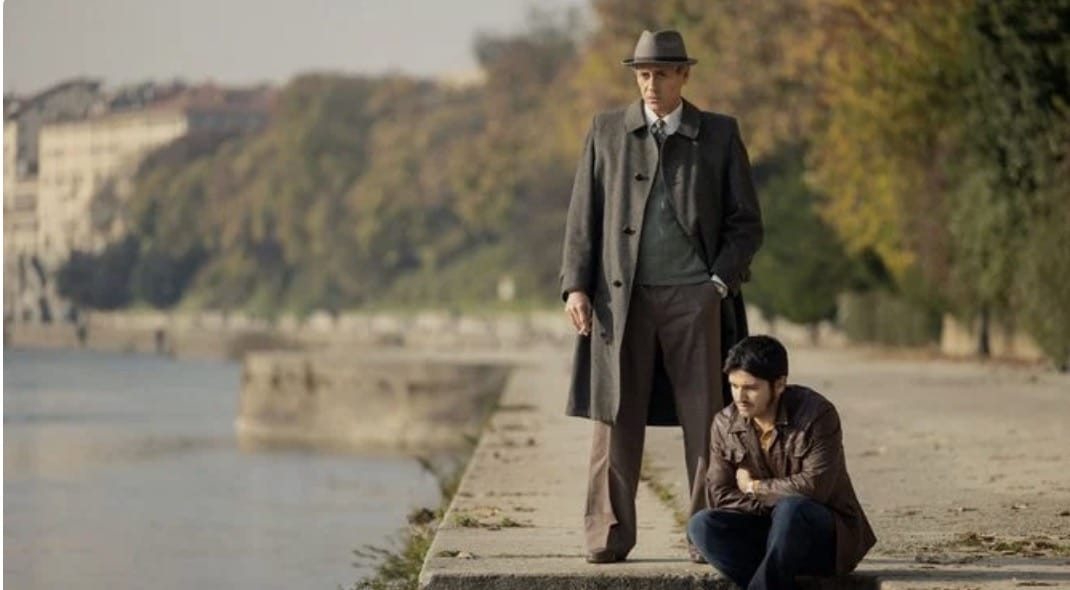

Dir: Sergio Castro-San Martin | Thriller 2026
The political thriller has enjoyed something of a renaissance in recent years, but Il Chileno distinguishes itself by refusing to trade in easy heroics. Instead, Sergio Castro-San Martín crafts a taut, morally murky drama where ideology, survival and betrayal become impossible to separate. Inspired by Juan Cristóbal Guarello’s Carne de cañón, the film transforms a little-known chapter of Chilean exile into an engrossing human story that resonates far beyond its historical setting with its alluring visual appeal.
Set in 1976 against the turbulent aftermath of Chile’s military dictatorship, the film follows Aldo Marín, a political exile navigating an unfamiliar Italy while wrestling with the ghosts of the country he left behind. What begins as a portrait of displacement gradually evolves into a gripping social thriller, exposing the invisible networks of power, surveillance and political compromise that continue to shape lives long after revolutions have faded from the headlines.
Castro-San Martín evokes the late twentieth century with remarkable confidence. Sun-bleached Italian streets, smoky cafés, cramped apartments and industrial backdrops create a lived-in authenticity rather than nostalgic period dressing. The cinematography favours muted earth tones and textured natural light, giving the film a weathered, almost documentary realism that makes every encounter feel precariously believable. Even moments of stillness carry the suggestion that someone is watching.
Camilo Arancibia anchors the film with an understated, emotionally intelligent performance, capturing a man forced to conceal both fear and conviction. Sara Serraiocco brings warmth and ambiguity to a character whose loyalties remain intriguingly uncertain, while Andrew Bargsted, Gaetano Bruno and Lorenzo Richelmy enrich the ensemble with performances that never lapse into caricature. Every supporting role contributes to the film’s atmosphere of quiet suspicion.
Rather than relying on explosive action, the narrative builds tension through conversations, shifting allegiances and the psychological weight of exile. Castro-San Martín understands that the most frightening weapon is often uncertainty, allowing suspense to accumulate with patient precision before delivering moments of genuine emotional impact.
The score subtly reinforces the film’s unease, weaving restrained orchestral motifs with melancholic textures that echo both homesickness and paranoia. It never overwhelms the drama, instead becoming another layer of the film’s simmering emotional landscape.
Il Chileno succeeds because it is as interested in personal identity as political history. It asks what remains of a revolutionary once the slogans have disappeared, and whether exile offers freedom or merely another form of imprisonment. Intelligent, atmospheric and quietly gripping, this is a sophisticated social thriller that lingers long after the closing frame.
LOCARNO FILM FESTIVAL 2026