


Dir: Maxence Voiseux | Doc 2026
Premiering in the Directors’ Fortnight sidebar of the Cannes Film Festival 2026, and a decade in the making, Gabin is a modest yet confident documentary debut that stretches well beyond observational portraiture.
Directed by Maxence Voiseux, the film marks his first feature after a background in documentary training at the University of Paris VII, and that grounding is visible in both the film’s patience and its occasional over-reliance on familiar cinema vérité style.
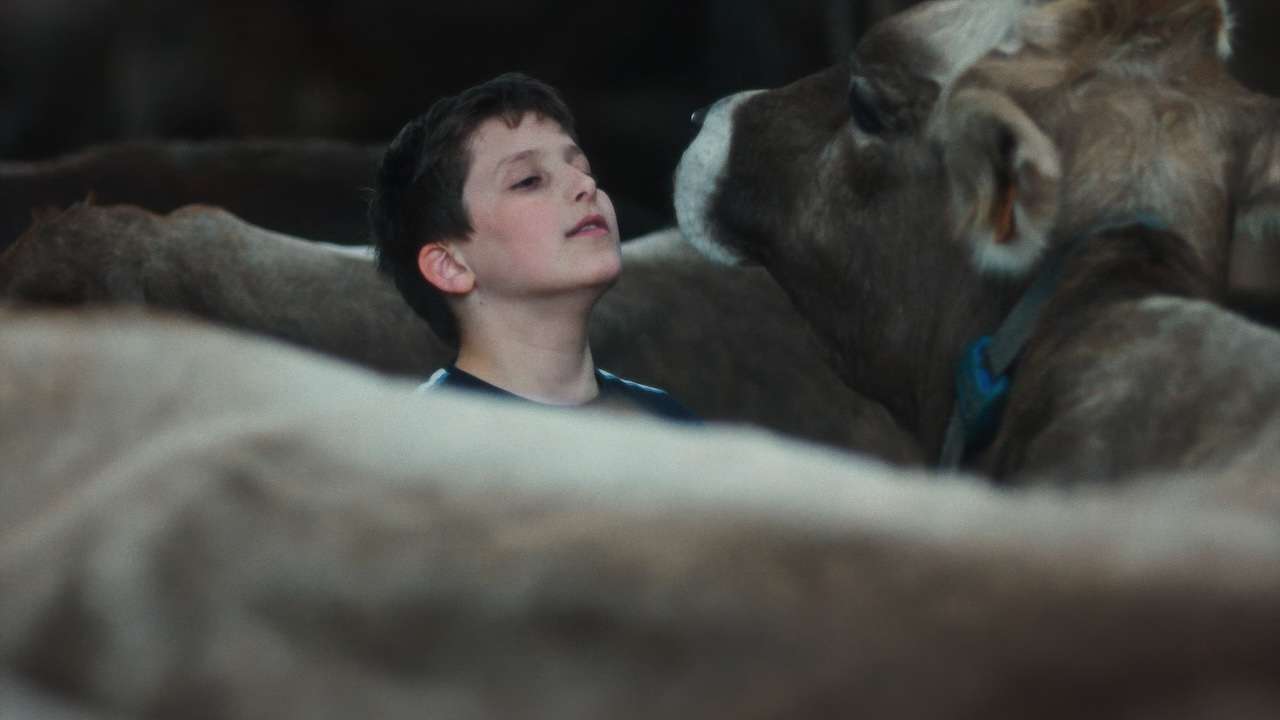
Gabin follows a boy in northern France—Gabin Jourdel—from the age of 8 to 18, caught between familial obligation (taking over his father’s butcher shop) and a diffuse but persistent longing for autonomy and the desire to distance himself from his working class roots. The narrative unfolds episodically, charting his dreams—raising animals, saving the family farm—against the slow grind of rural decline and familial expectation.
Visually, the film embraces a muted naturalism. The cinematography—by François Chambe and Martin Roux—captures overcast skies and earthy tones of the terroir, reinforcing the sense of a life bounded by geography and tradition. Yet this aesthetic, while coherent, rarely evolves alongside Gabin himself, missing an opportunity to mirror his internal changes more dynamically.
What Gabin does best is create a strong sense of closeness and realism. Voiseux avoids heavy narration, instead letting us experience the everyday flow of Gabin’s life for ourselves. This leads to deeply authentic moments: uncomfortable silences during family meals, the quiet pride of physical work, and the hesitant way teenagers express their hopes for the future. The camera often feels less like it is simply watching and more like it is part of the family’s changing relationships.
At the same time, this subtle approach can sometimes make the film feel slow or directionless. Its focus on realistic observation means that some scenes lack dramatic energy or clear purpose. Although the story spans ten years and suggests major change, the overall narrative feels loose and unfocused compared to more tightly structured documentaries. As a result, the film feels emotionally honest and genuine, but at times it also wanders.
Gabin is an imperfect but compelling debut. Its strength lies in its commitment and emotional authenticity; its greatest weakness is a reluctance to shape that material into a more decisive cinematic argument. Voiseux demonstrates a clear sensitivity to his subject and a respect for the lived experience of rural France, but the film stops short of transforming that sensitivity into a fully realised artistic statement. Still, as a first feature, it signals a filmmaker worth watching—one who understands the power of time, even if he has yet to fully master its cinematic articulation.
DIRECTORS’ FORTNIGHT | CANNES FILM FESTIVAL 2026