

Dir: Vincent Garenq | France docudrama 2026
Forsaken arrives at the Cannes Film Festival 2026 with a weight that few films carry: it dramatises the final days, in October 2020, of Samuel Paty, leading to his murder by a stranger, Abdoullakh Anzorov, an 18 year-old Islamist extremist. It’s a case that still reverberates across France and beyond. It’s a sobering reconstruction of societal failure, more concerned with accountability than catharsis.
Forsaken is a sombre story that shows how misinformation, fear, apathy and failure to react – ordinary social dynamics—can converge into something irreversible. It’s film built on inevitability and dread avoiding sensationalism.
Director Vincent Garenq structures Forsaken as a countdown: the last eleven days leading to Paty’s murder, adding tension and dread to an already tragic event. This approach gives the film a certain inevitability. Rather than asking what happened – he was beheaded in broad daylight minutes from the school gates where he taught – it asks how a chain of small failures can accumulate into catastrophe. The narrative is procedural in spirit, almost forensic, tracing how a false accusation snowballs into deadly consequences. The result is less a conventional biopic than a systems drama, where the “antagonist” is diffuse: fear, and collective inaction
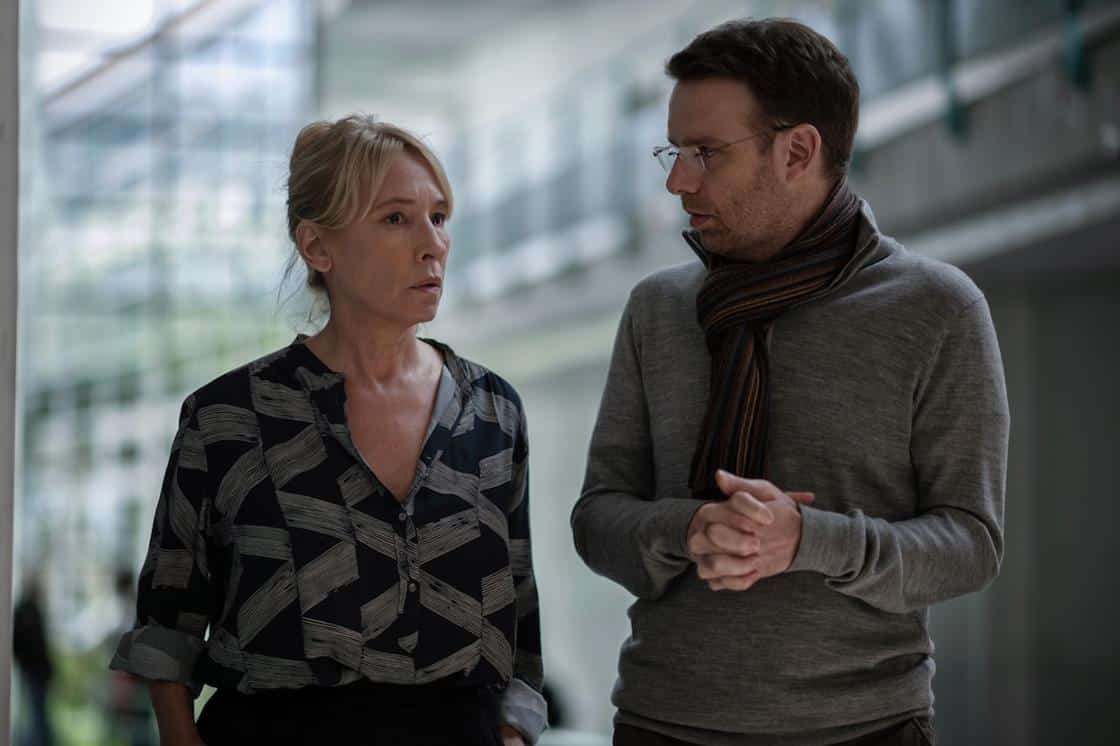
Antoine Reinartz plays Paty with deliberate understatement and restraint, a performance that avoids martyrdom clichés, instead presenting him as an ordinary teacher and father—calm, thoughtful, slightly overwhelmed. That choice aligns with the film’s thesis: this could happen to someone unremarkable, which is precisely why it’s terrifying.
Emmanuelle Bercot and the supporting cast appear to embody institutional roles (school leadership, parents, officials), reinforcing the sense of a social ecosystem rather than a hero-centred narrative.
The title Forsaken is not subtle—and that’s intentional. The film argues that Paty was progressively abandoned by segments of the community that amplified misinformation, by bureaucratic caution and slow responses and by a digital ecosystem that rewards outrage and hystrionics over truth.
The Cannes synopsis emphasises how “a rumour, a click, and collective inaction” can lead to irreversible tragedy. This framing also resonates strongly with broader debates about free speech, secularism, and the role of schools in modern France, without necessarily resolving them.
Garenq, known for fact-based dramas, adopts an almost documentary-like realism. Rather than artful aesthetics, he creates muted visual palette with a chronological structure. The danger with this approach is dryness—but here it serves the subject matter, avoiding sensationalism around a still-sensitive event, where the sensibilities of family and those affected are to be respected surrounding his death. The director is well aware of reopening wounds without offering new insight so this has slightly limited his freedom of expression
Forsaken is culturally and politically a significant film, even if not positioned as an awards contender, and as such the festival recognises its sensitivity and potential controversy. So it’s intended to spark conversation rather than compete aesthetically. Given the real-world trauma behind it, that positioning feels deliberate. Clear, focused narrative built on real investigative material with restrained performances due to the ethics. Sometimes drifting into didacticism yet naturally cautious, the film offers a critique of misinformation and institutional inertia with the usual hackneyed phrase “lessons will be learnt.” They clearly weren’t in this incident that follows on from Lee Rigby’s similar murder in England years earlier.
That all said, Forsaken is not easy viewing, nor is it meant to be. It’s a sobering reconstruction of a societal failure, more concerned with accountability than catharsis. If it succeeds, it won’t be because it tells you something new about Samuel Paty—but because it forces us to confront how ordinary dynamics—can converge into an unconscionable tragedy. Paty was clearly much loved and revered by his pupils – lessons always ended with ‘a joke to take home’. He hoped to be remembered but not like this.
CANNES FILM FESTIVAL | SPECIAL SCREENING