

Directors: Adam Nielsen, Eva Mulvad, Andreas Koefoed | Denmark | 95’
Few documentaries promise to get quite so uncomfortably under the skin as Father’s House, an audacious piece of hybrid filmmaking that turns the mechanics of religious manipulation into gripping, often deeply disturbing cinema. Revisiting the extraordinary story of Faderhuset, a Danish Christian-evangelical sect which evolved from a charismatic religious community into an intensely controlling organisation, the film examines how the promise of spiritual salvation and unconditional love can become instruments of psychological coercion.
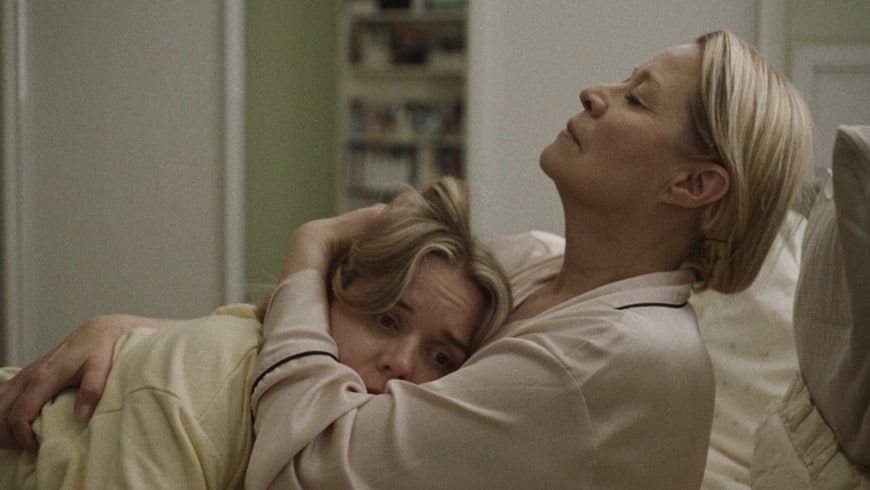
Rather than rely on conventional talking-head testimony, directors Adam Nielsen, Eva Mulvad and Andreas Koefoed employ an inspired dramatic device, enlisting acclaimed Danish actors Trine Dyrholm and David Dencik to reconstruct the experiences of former members, with the survivors themselves present to advise, correct and sometimes confront the performances.
The results are riveting. What begins in apparently ordinary domestic surroundings gradually descends into a nightmarish world of humiliation, intimidation, bizarre religious rituals and emotional abuse. Under the leadership of Ruth Evensen, unconditional love and unquestioning obedience became dangerously intertwined. Members were made to feel special, protected and accepted, only to find themselves increasingly isolated and subjected to the sect’s rigid rules. Particularly disturbing are the accounts of a young woman symbolically adopted by the leader and drawn into a ritual she experienced as profoundly violating, and of a disabled former member subjected to verbal abuse by fellow believers.
Dyrholm and Dencik bring formidable conviction to their roles, but the film’s most extraordinary performances may belong to the former members themselves, watching their traumatic histories being recreated before their eyes. Their interventions lend the reconstructions an unusual authenticity, while the tension between actor and participant creates a fascinating film-within-a-film dynamic. This is documentary filmmaking that refuses to keep its subjects safely at a distance.
The story has a particular resonance in Denmark, where Faderhuset became notorious not only for its increasingly authoritarian religious practices but also for its involvement in one of the country’s most divisive cultural confrontations. In 2001, the sect acquired Copenhagen’s legendary alternative youth centre, Ungdomshuset, on Jagtvej 69. When police evicted its young occupants in March 2007 and the building was subsequently demolished, the resulting unrest became a defining flashpoint in modern Danish political and cultural history. Although the congregation formally dissolved in 2013, allegations of spiritual abuse and the testimonies of former members have ensured that its legacy has not disappeared.
There is a wider Nordic significance here, too. In societies often regarded as among Europe’s most secular, liberal and socially progressive, the film challenges the comfortable assumption that religious extremism and coercive communities belong elsewhere. It exposes the vulnerability that can exist beneath the reassuring surface of a supposedly enlightened society, asking how otherwise intelligent people can surrender their autonomy in exchange for belonging, and how the language of faith, love and salvation can be weaponised.
There are echoes of The Act of Killing and Four Daughters in the filmmakers’ willingness to blur the boundaries between documentary testimony and dramatic recreation, but Father’s House establishes its own compelling territory. Its most unsettling moments are not necessarily the acts of cruelty themselves, but the survivors’ reactions as they watch their past being reconstructed, sometimes confronting memories that have remained deeply buried. There is something both cathartic and profoundly uncomfortable about witnessing people reclaim ownership of experiences over which they once had so little control.
At 95 minutes, this is a formally adventurous, psychologically astute and timely examination of faith turned into a mechanism of domination. Bringing a distinctly Danish story into an international conversation about power, vulnerability and the human need to belong, Father’s House is chilling without being exploitative, and a powerful reminder that the most effective forms of control rarely announce themselves as such.