

Dir/Wri: Pawel Pawlikowski | Cast: Sandra Huller, Hans Zischler, August Diehl, Dvid Striesow, Betty Knox, David Menkin | Poland, Germany DocuDrama 82′
Paweł Pawlikowski’s Fatherland, that won the Grand Prix (tied) at Cannes Film Festival 2026, unfolds less as a conventional historical drama more as an intimate yet far-reaching memoir—at once intensely interior and quietly expansive in its reckoning with memory, exile, and cultural inheritance.
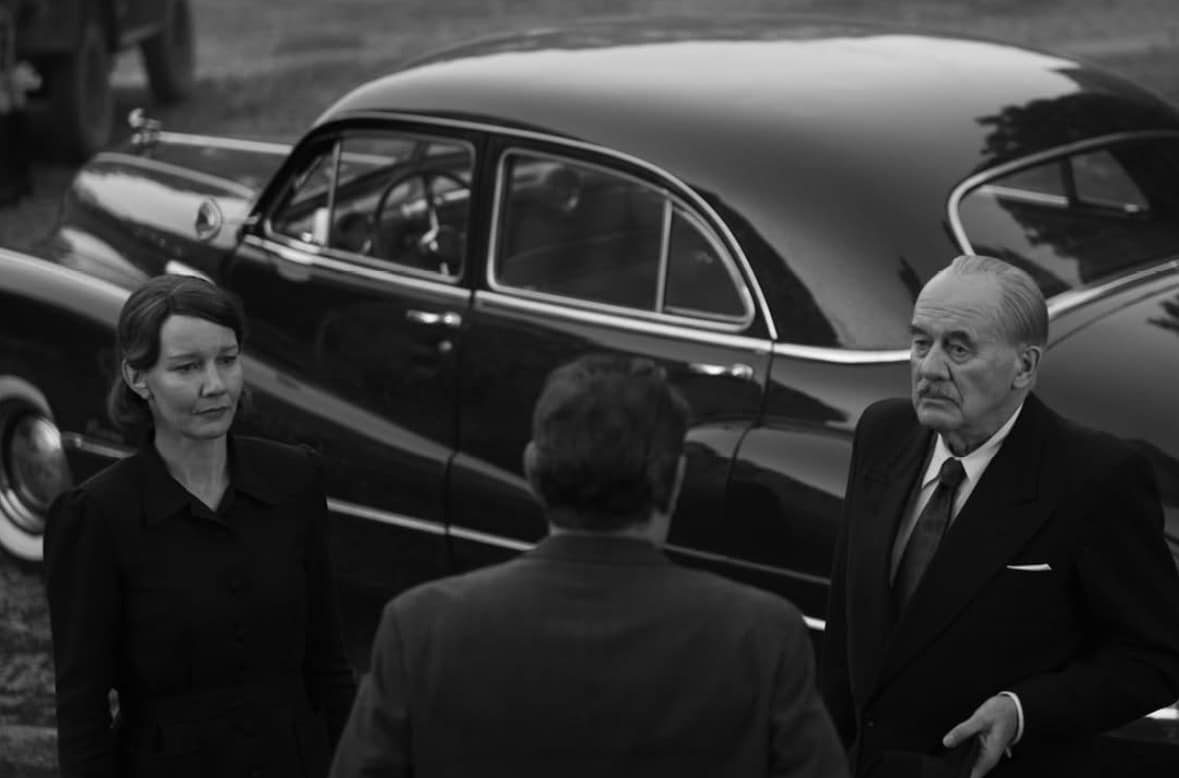
Fatherland takes place across post-war Germany of the late 1940s where it follows German author Thomas Mann and his daughter Eriks (Sandra Huller) on a road trip through a ruined divided country, their stand against Nazism, on their way to exile. Framed with the cool observational distance of a press conference and a series of speeches, their first port of call is the Monopol Hotel, Frankfurt—a space of transit, diplomacy, and quiet staging—where identity itself feels provisional. Here, Thomas Mann prepares to re-enter a Germany that is no longer his, Erika now has American citizenship, and acts as his chauffeuse, managing everything from his wardrobe to his translations. She is both caretaker and interlocutor, mediator between languages, histories, and egos.
It is Erika Mann who anchors the film: a steady, watchful presence navigating the shifting moral and political terrain, her role as daughter, mediator, and custodian of her father’s legacy giving the narrative its emotional and intellectual centre.
August Diehl appears only briefly, as her brother Klaus, in a tightly observed hotel-room encounter that nevertheless sharpens the film’s atmosphere of unease and transience. Where Pawlikowski’s earlier Cold War carried a sweeping, tragic romanticism, Fatherland adopts a more austere, contemplative tone—its melancholy refined into something cooler and more self-interrogating. Shot in luminous black and white, the film’s sombre visual language reinforces a sense of inevitability, as though its characters are moving through both history and their own recollections with equal, inescapable weight..
Their journey to Weimar to meet Soviet General Tulpanov takes place like a procession through ideological theatre. They are received as cultural royalty, feted among officials and artists in lavish dinners punctuated by choral performances from Messien to Mozart —music deployed not simply as ornament but as soft power. Pawlikowski understands ceremony as a kind of choreography, and here it becomes clear that Mann himself is both guest and instrument. Erika, sharply attuned to the shifting political terrain, accuses her father of shaping his speeches for posterity, for legacy, even as the present is carved up by American and Soviet authority.
Erika has spoken at length to her brother Klaus, in the film’s opening scene, he seemed depressed but his suicide, by sleeping pills, comes as a shock to the entire family, and this will cast a blanket of gloom over the remainder of the journey. The funeral, set in a rainy Cannes make this an especially solemn occasion, and takes place in complete silence in one of the film’s most moving sequences.
The film’s most unsettling undercurrent emerges in its treatment of historical space. Buchenwald—invoked with chilling restraint—is no longer solely a site of memory but repurposed as a Soviet political prison. Pawlikowski stages the family funeral in near-total silence, a sequence that resists spectacle and instead insists on absence: of sound, of resolution, of moral clarity. It is one of the film’s starkest gestures, where history collapses into uneasy continuity.
Music recurs as both balm and indictment. Each of Mann’s speaking engagements is accompanied by organ compositions that swell with ecclesiastical gravity, imbuing his words with a near-sacral authority. Yet Pawlikowski subtly undercuts this elevation. The speeches—delivered with measured solemnity—begin to feel performative, suspended between genuine reckoning and rhetorical self-preservation. Culture, in Fatherland, is never neutral; it is always entangled with power.
Visually, the film is exquisite. Shot in luminous black and white, each frame gleams with a pristine, almost sculptural elegance—like a monochrome jewel box. The meticulous compositions and camerawork by the director’s regular DoP Lukasz Zal showcase statuary, architecture, and interior spaces dense with artistic heritage. Germany is rendered as a museum of itself, its cultural legacy intact yet haunted, its beauty inseparable from its complicity.
The personal fractures at the film’s core deepen with the off-screen presence of Klaus Mann. His suicide reverberates through the narrative, culminating in the suggestion that his funeral will take place in Cannes—a gesture that folds personal tragedy into the broader spectacle of cultural memory and recognition. Erika’s relationship with her father grows more strained, her scepticism cutting through his gravitas, exposing the fragile boundary between moral authority and self-mythologising.
In one of the film’s final images, father and daughter pass a derelict church. Inside, an organ remains miraculously intact. The moment lingers—unresolved, almost suspended—as if Pawlikowski is asking whether culture can survive its own ruin, and if so, in what form.
Fatherland offers no easy answers. Instead, it composes a meditation on exile, authorship, and the uneasy persistence of art in a fractured world—where every note, every word, carries the weight of history.
CANNES FILM FESTIVAL | MAIN COMPETITION 2026