

Dir: Grant Gee | UK/Ireland 2026
Reviewed by Ian Long
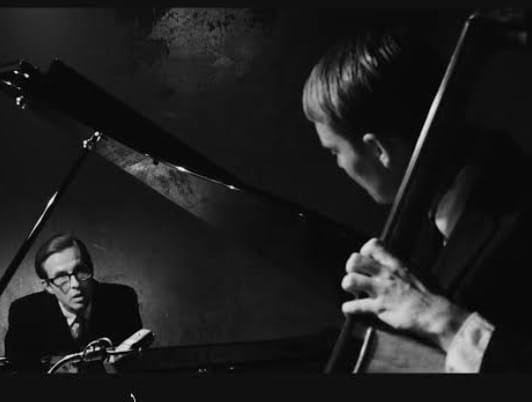
“Sometimes the intermission is part of the music,” jazz pianist Bill Evans’ mother tells him in the course of this powerful biographical drama, whose narrative spans a catastrophic‘intermission’ in Evans’ own troubled life. His brilliant trio, featuring drummer Paul Motian and bassist Scott LaFaro, had reached a musical peak in June 1961 with their residency at New York’s Village Vanguard club. But eleven days after the last concert in their run, LaFaro died in a car crash – an event which shattered Evans.
Unable to face the idea of playing music – almost, it seems, of existing at all – Evans retreats to the apartment of his elder brother Harry Jr. (Barry Ward), who, along his wife Pat (Katie McGrath) and young daughter Debbie, evidently thinks the world of him. But things are severely compromised by Bill’s all-consuming heroin addiction. Repeated nocturnal excursions to score and strained moments when he nods out in front of Debbie lead a reluctant Harry Jr. to ask Bill to leave.
He takes refuge at the Florida home of the Evans brothers’retired parents, Harry Sr. (played with roguish charm by Bill Pullman) and Mary (Laurie Metcalf). When Harry Sr. takes Bill out to the local bar, the father’s boozing is prodigious. It could be mistaken for nothing more than an off-the-leash spree with the prodigal son, but Harry Sr. was actually a problem drinker whose alcoholism seriously disrupted the family, possibly contributing to his children’s severe psychological problems.
Mary is a different proposition. A piano teacher, she fostered a love of music in her boys, who both played the instrument. She tells Bill how the true scale of his gift was revealed when he broke his wrist in childhood. For months, he could do no more than watch Harry Jr. practice. But when he began to play again, his skill dwarfed that of his brother. More proof of an intermission’s benefits.
Like Evans’ music this is a chamber piece, made with intense artistry. Although director Grant Gee shot it entirely in Ireland, he convincingly conjures up early 60s New York,mostly via interiors and close-ups whose tone, composition and monochrome palette aptly evoke the era. Some archive footage of Manhattan by documentarist D. A. Pennebaker was apparently also used, but in such a seamless way that I wasn’t aware of any transition.
Anders Danielsen Lie plays Evans as a gaunt night creature, a man living in something of a cloud. When people try to remind him of events they’ve shared, he often can’t remember them. He deflects questions, speaks vaguely, and accepts setbacks fatalistically. When someone asks what Miles Davis is like, his response is simply “he’s a great musician” – even though some of Davis’s dealings with him were borderline abusive.
Although the film focuses mainly on the hiatus caused by the tragedy, brief flash-forwards to later events all involve self-inflicted fatalities – including that of Evans himself. Despite his great talent, he is already on a steep downward spiral when we meet him which would persist through his final twenty years, and would likely have played out in similar fashioneven without LaFaro’s death.
The title (a Miles Davis quote, also the name of Evans’ best-known album) is ironic. Bill does indeed seem surrounded by positive emotions. Far from resenting his kid brother’s achievements, Harry Jr. is touchingly enthusiastic about them– particularly the new album, a live recording from the Vanguard shows. His mother nurses him through the agonies of withdrawal. But none of it stops Bill from reverting straight back to heroin when his junkie girlfriend Elaine asks, “you wanna cook up?”
The film doesn’t pose the question directly, but it’s worth speculating: is there any connection between outstandingmusical talent and intense self-destructiveness? Many great musicians, like Sonny Rollins, Elliott Carter and Andrés Segovia, have led long, fulfilled lives. The celebrated alto saxophonist Marshall Allen still tours at the age of 102 – and he was born five years before Evans.
Did Evans somehow need the torment to generate the sublime work? Or was music just one more palliative for an emotionalpain that couldn’t finally be tamed? The film’s only passage of real joy comes at the very beginning, with his trio united in profound colloquy. Even if the grace, peace or bliss that Evans found in music was only fleeting, at least it was real. @Ian Long
IN UK CINEMAS FROM 11 September
BEST DIRECTOR BERLINALE 2026