

Dir: Alex Cox. 2026 . 88′ | USA
Reviewed by Peter Herbert
Nikolai Gogol’s ‘Dead Souls’ has been described as “an epic poem of hallucinatory reality pushed into the surreal “. Admired and influential in literary circles, the writing has been filmed as Russian film and tv versions. Alex Cox is the first western filmmaker to adapt the 1842 poem and for this reason is more than welcome as Dead Souls also finds the British director delivering one of his most accomplished films.
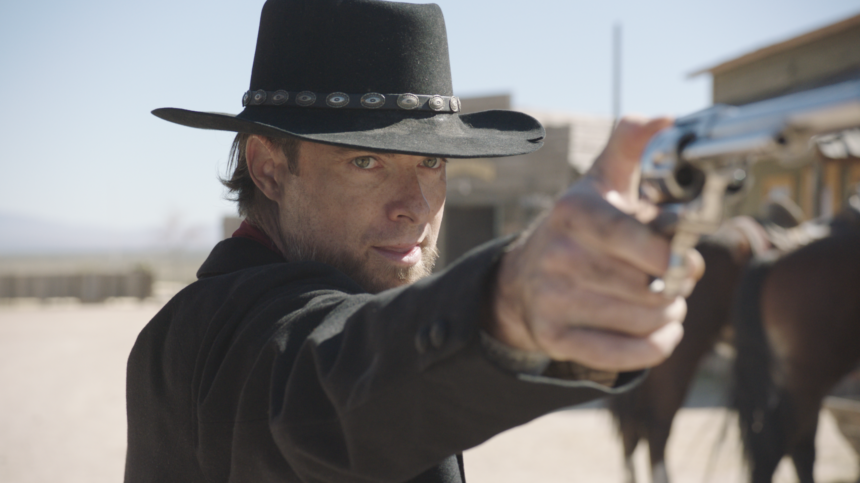
The opening credit titles reference Luis Bunuel’s The Exterminating Angel as a mysterious stranger walks out of a barren western landscape into a small frontier town. He is Strindler, a government inspector tasked with offering prominent townsfolk an unusual and somewhat macabre proposition. Arranging to buy rights to dead Mexicans registered as burials for possible lucrative reasons, his strange behaviour arouses suspicion as he ingratiates himself into the community.
The narrative simplicity of the first half builds around Cox’s central performance as Strindler who shuffles encounters with others as if playing a pack of cards. The performance is not unlike the way Ed Harris’s firebrand revolutionary holds together Walker for Cox in his 1987 film.
The charisma of Cox with his striking visual persona is balanced by a mix of finely played characters. Actors Merritt Crocker, Shayn Herndon, Eric Schumacher and Ed Tudor Pole also display extravagantly moustached facial hair while Karen E Wright, Maria Robles and Amariah Dionne provide striking female cameos. The widow is hauntingly played by British singer songwriter actress Sarah Vista who is a smouldering vision of the devil as a woman negotiating with Strindler behind her veil.
The film also contains the widow in a musical dream version of The Streets of Laredo that includes a deeply moving male voice acting as a form of surreal chorus for the song’s traditional lament of death. The sequence precipitates the second act where the tone of the film splinters further as snuff smelling Strindler descends into tragicomic absurdity while he pays the price for gambling with Gods of death.
Cox handles shifts of tone in the second half with his familiar puckish punk sensibilities. These include how he mounts a horse or suffers the vile effects of drinking from a 17-year-old bottle of liquid. There is reference to the philosophical quote a man who fears death is not alive and hallucinatory animation reveals how he was abandoned by his father who raised him to trust money more than friendship.
The beautiful camerawork of Ignacio Aguilar and Chance Faulkner is reminiscent of great traditions of westerns made in Arizona and the Spanish region of Almeria. The soundtrack reflects Cox’s love of music and is a curated collection of spoken word, including a wild rendition of Mussorgsky’s Night on Bare Mountain and traditional early western ballads. The script contains themes involving immigration and displacement allowing Dead Souls to offer moral and allegorical comments on the current state of world and American politics.
It is possible to speculate on one of the film’s literary quotes. This is a reference to Herman Melville’s novel The Whale aka Moby Dick which was made into a film by John Huston. It is not inconceivable to imagine that Huston, as with Cox in a dual acting/filmmaking role, is another rogue filmmaker who could bring to life the quixotic antihero at the centre of Gogol’s poem. Dead Souls concludes on a vivid closeup of its creator and is rumoured to be Alex Cox’s last movie. If this is the case, Dead Souls offers the perfect sound associated with a swan song and stands high amongst the best finales of any filmmaker’s career.
https://www.peterherbert.online
https://theartsproject1.wixsite.com/theartsproject