
Picasso and Bacon: The Tormented Human Figure
Pablo Picasso and Francis Bacon never became artistic partners, nor did they share the same vision of the world. Yet their relationship, explored in the Albertina’s compelling exhibition Picasso – Bacon: What It Feels Like to Be Human, is one of the most revealing encounters in modern art. Bringing together their work, the exhibition traces a remarkable artistic inheritance: how Picasso’s revolutionary reimagining of the human figure helped open the way for Bacon’s far darker investigation of the human condition.
Picasso was the dominant artistic force of the first half of the twentieth century, a restless innovator whose Cubism shattered conventional perspective and whose successive reinventions challenged the very definition of representation. Bacon, working in the aftermath of the Second World War, emerged into a world haunted by mass destruction, existential anxiety and the collapse of traditional certainties. Having encountered Picasso’s work in Paris in 1927, Bacon recognised that painting could be liberated from the obligation to reproduce appearances. He wanted to achieve for his own generation what Picasso had achieved for his: to make the human figure express the deepest contradictions of existence.
The Albertina Museum’s juxtaposition of Picasso’s Bathers with a Ball (1928) and Figure on the Seashore (1929) with Bacon’s contorted figures reveals both the connection and the divergence. Picasso’s bodies become strange, monumental constructions, their limbs and proportions distorted almost beyond recognition. Yet his formal experimentation retains an element of play, sensuality and Mediterranean vitality. Bacon takes distortion somewhere more disturbing. His figures seem trapped within their own flesh, their faces collapsing under psychological pressure, as though the body were an unreliable prison rather than a vehicle for beauty.
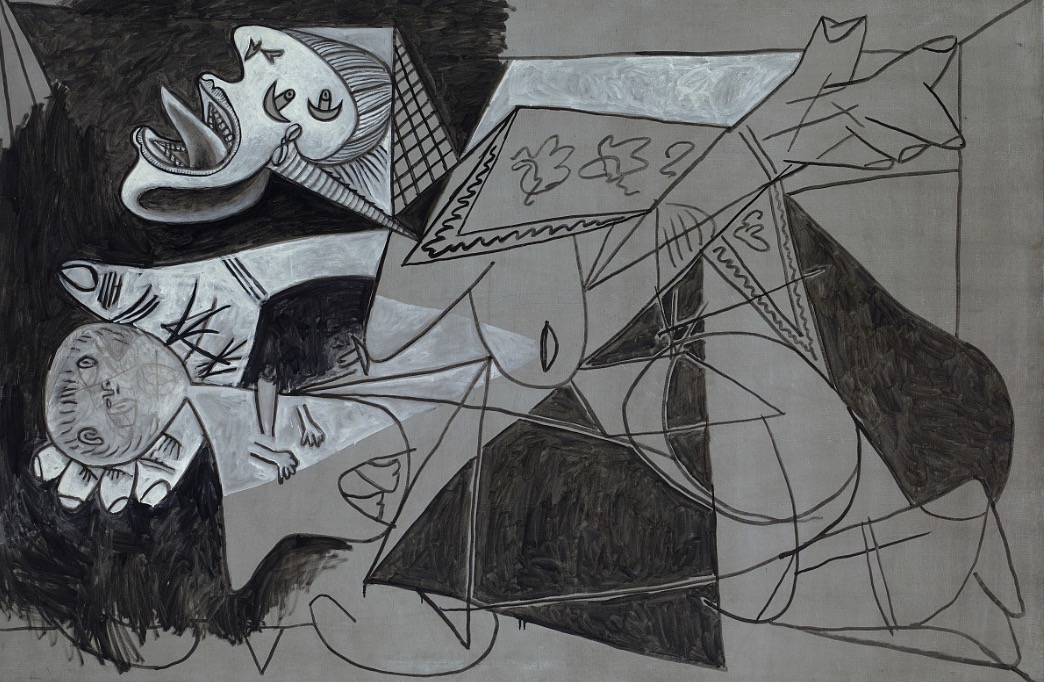
Both artists drew deeply on the cultural inheritance of European art. Picasso wrestled with the classical nude, Spanish bullfighting and the Old Masters, while his response to the Spanish Civil War culminated in Guernica (1937), an anguished indictment of violence. Bacon, meanwhile, returned obsessively to the Crucifixion, a subject through which religious iconography became a vehicle for modern anguish rather than spiritual consolation. In both cases, inherited imagery is dismantled and reconstructed to express a world in which familiar certainties have broken down.
The two artists also shared an interest in the relationship between desire and vulnerability. Picasso’s portraits of Dora Maar, including the exhibition’s Dora Maar (1940), transform the face into a field of conflicting emotions. Bacon’s Three Studies of Isabel Rawsthorne (1967) similarly refuses the comfort of a stable likeness, turning portraiture into an exploration of identity under pressure. His Self-Portrait (1972) is less a record of appearance than an unsettling encounter with mortality.
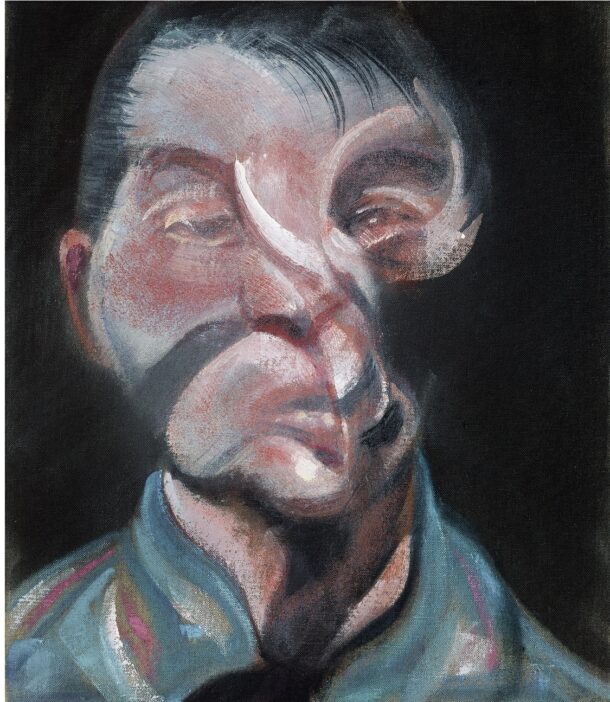
Francis Bacon | Self-Portrait, 1972 | Private Collection © The Estate of Francis Bacon / All rights reserved / Bildrecht, Vienna and DACS, London 2026
There is an intriguing cinematic counterpart to this fascination with distorted identity and the grotesque in Vienna’s film culture. Ulrike Ottinger’s Die Blutgräfin (The Blood Countess), starring Isabelle Huppert, draws on the legend of Elisabeth Báthory to create a macabre, extravagantly theatrical world of vampirism and aristocratic excess. Its grotesque imagery and fascination with the monstrous body offer a suggestive parallel with Bacon’s unsettling figures, while its deliberate rejection of naturalism recalls Picasso’s refusal to accept conventional representation. The connection is not one of direct influence, but of a shared willingness to use distortion, theatricality and the uncanny to expose what lies beneath the surface of respectable appearances. Painting and cinema become complementary ways of making the familiar strange.
Ultimately, the relationship between Picasso and Bacon is not simply one of influence, but of transformation. Picasso shattered the body’s outward form; Bacon intensified its inward torment. Seen alongside contemporary cinema’s fascination with the grotesque, their work reminds us that modern art is at its most powerful when it abandons comfortable likeness in favour of a more troubling truth about what it feels like to be human.
CURRENTLY AT THE ALBERTINA MUSEUM, Vienna Austria | The Blood Countess can be seen at VIENNALE FILM FESTIVAL 2026
Pablo Picasso: Mother and Child (Study for Guernica), 1937 (main image)