

Dir: Yael Melamede | US Doc 75′
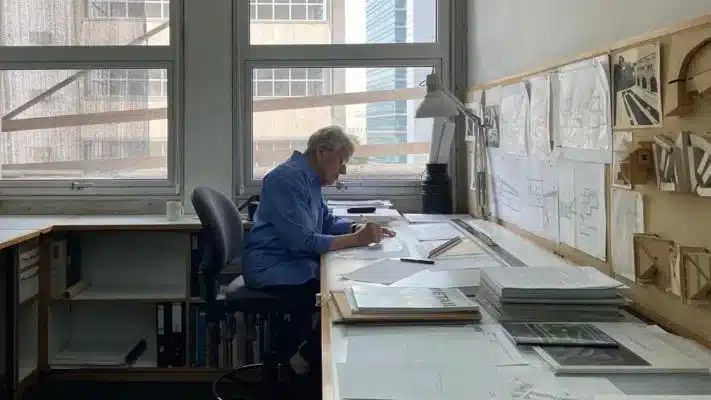
Ada – My Mother the Architect is more than a biographical portrait—it’s a meditation on how architecture shapes not only skylines, but also the social and environmental fabric of our lives. Directed by Yael Melamede, the film explores the life and work of Ada Karmi-Melamede, one of Israel’s most accomplished architects, through the intimate lens of her daughter.
The documentary argues—sometimes subtly, sometimes explicitly—that architecture is never neutral. Buildings influence how people interact, how communities form, and how individuals experience space. Ada’s projects, particularly civic institutions like courthouses, are presented as embodiments of democratic values. Light, proportion, and material are not just aesthetic choices; they become ethical ones. The film makes a compelling case that thoughtful design can elevate public life, creating environments that foster dignity, transparency, and human connection. It also touches on Israel’s development as a state that has gradually transformed since it’s foundation in the mid 20th Century, and describes how Ada’s entire family were very much there with their flare and professional expertise to shape the environment from 1946 onwards but her own talents were often overlooked in this very male-dominated profession.
However, the documentary is less direct when it comes to environmental sustainability in the modern sense. While it celebrates sensitivity to place—Ada’s attentiveness to landscape, climate, and cultural context—it stops short of deeply interrogating architecture’s ecological footprint. In an era defined by climate issues, this would have added further depth. The film points at environmental harmony through discussions of natural light and spatial flow, but it rarely confronts the harder questions: resource consumption, urban sprawl, or the role of architects in combating environmental degradation.
That said, the film tackles the humanistic framing of architecture. By focusing on Ada’s philosophy, it opines that environmentally responsible design begins with respect—for people, for context, and implicitly, for the planet. Her work resists spectacle in favour of restraint, which can be read as a quiet form of sustainability. In this sense, the documentary broadens the definition of environmental architecture beyond technology and into values.
Critically, the personal dimension both enriches and limits the documentary due to Yael’s personal connection. The mother-daughter relationship adds emotional depth, but it sometimes feels over-sentimental. The director’s adoring stance of her mother Ada’s legacy is treated with deserved reverence, but this often limits dissenting perspectives on her work or on architecture’s broader complicity in environmental challenges. A more critical lens might have strengthened the film’s engagement with the pressing realities of today’s built environment.
Packed with plentiful images of Ada’s contribution to Israel’s built environment Ada – My Mother the Architect succeeds in reminding viewers that architecture has a powerful impact on the environment it aims to serve, often known as ‘psycho-geography’. It shapes not just where we live, but how we live—and, by extension, how sustainably we inhabit the world. While it may not fully grapple with contemporary ecological debates, it lays an important philosophical foundation: that good architecture begins with awareness, responsibility, and care for the spaces we create and the world they occupy.
IN UK CINEMAS RELEASE ON 1 MAY 2026