

Dir/Wri: Charlene Bourgeois-Tacquet | France, Drama 98′
French writer/director, Charlene Bourgeois-Tacquet, arrives in the main competition at Cannes this year with an intimate character-driven drama, an accomplished follow-up to Anais in Love.
La Vie d’une Femme has the quiet confidence of its main character Gabrielle, a 55 year old surgeon in a Paris hospital. She’s a commanding woman at the top of her game and Léa Drucker plays her with a certain smug, self-assurance. It’s a film that is easy to admire, easy to watch… but just a little too easy to decode.
Gabrielle is entirely consumed by work, responsibility, and the slow erosion of anything resembling a personal life. She juggles a loving but marginalised husband (Charles Berling), an ailing mother suffering from Alzheimer’s (Marie Christine Barrault), and the mounting pressures of a collapsing public French hospital system.
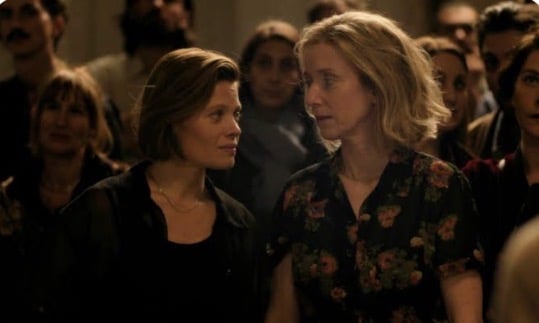
Her carefully controlled existence begins to shift when Mélanie Thierry’s Frida enters her life. A novelist, she embeds herself in Gabrielle’s ward to research a book. What begins as observation turns into something more, destabilising Gabrielle’s sense of identity, desire, and the life she has constructed.
Bourgeois-Tacquet directs in a naturalistic mode that feels almost disarmingly fluid. The camera lingers, conversations overlap, emotions surface indirectly. It’s the kind of “effortless” realism that plays extremely well on the Croisette—and likely beyond. There’s a clear commercial instinct here too: this is arthouse cinema that will appeal to the mainstream alike.
And at its centre, Drucker is superb. She gives Gabrielle a density that the script sometimes lacks—fatigue, desire, irritation, resilience all flicker across her face with minimal fuss. Thierry, meanwhile, brings a looser, energy that offsets the film’s otherwise controlled tone. Together, they anchor the film with performances that feel lived-in rather than performed.
But then there’s the structure. Why the need for chapters inter-titled in pink? The film is repeatedly segmented, as if anxious that we might miss the passage of time or thematic progression. Instead of enhancing the narrative, this underlines it—insistently, and feels gimmicky and out of place. This is not a teenage romcom. Yet you feel the hand of the filmmaker organising, categorising, shaping. It’s totally odds with the supposed naturalism.
More frustratingly, the film begins to feel like it’s assembling a portfolio of “timely” themes: Alzheimer’s? Tick. Late-in-life queer awakening? Check. Feminist self-realisation within institutional constraints? Absolutely. The crumbling healthcare system? Of course. Each element is handled with care, even sensitivity—but together they accumulate into something that feels less like ‘life observed’ and more like ‘life curated’ – why, to win a festival prize?.
Not that these threads don’t belong; it’s that the film seems determined to include all of them. The result is a kind of thematic saturation, where nothing is quite allowed to breathe deeply enough. You start to sense the film ticking boxes rather than discovering truths.
And yet—despite this—it somehow works. Or at least, it works enough. The performances carry it, the tone is inviting, and the emotional beats land even when you can see them coming.
La Vie d’une Femme is a polished, natural, and undeniably engaging film, elevated by excellent performances—particularly from Léa Drucker. But beneath its fluid surface lies a more calculated construction, one that divides, labels, and ultimately over-explains itself. So an imposing film that wants to say everything about a woman’s life today. The irony is that in trying to include it all, it risks saying less than it might have.
CANNES FILM FESTIVAL 2026 | IN COMPETITION